
Astragalus vs Ginseng: Which Traditional Chinese Herb Is Right For You?
If you ask ten people to name a Chinese herb, chances are one of the first names you'll hear is Ginseng.
Its reputation is legendary.
It's one of the most recognized herbs in the world.
But here's something that surprises many people.
Among herbalists, another root appears just as often in traditional formulas, herbal teas, soups, and wellness preparations.
That herb is Astragalus Root (Huang Qi).
Both herbs have been used for centuries.
Both have long histories in traditional Chinese herbalism.
Both are commonly associated with vitality and wellness traditions.
And both continue to attract attention from herbal enthusiasts and researchers alike.
Yet despite their similarities, Astragalus and Ginseng are very different herbs.
They taste different.
They are prepared differently.
They are traditionally used in different ways.
And often, the herb that is right for one person is not necessarily the herb another person enjoys most.
So which herb should you choose?
Astragalus vs Ginseng At A Glance
| Feature | Astragalus (Huang Qi) | Ginseng (Ren Shen) |
|---|---|---|
| Botanical Name | Astragalus membranaceus | Panax ginseng |
| Plant Part Used | Root | Root |
| Traditional Flavor | Sweet | Slightly Bitter & Sweet |
| Tea Flavor | Mild & Pleasant | Earthy & Distinctive |
| Beginner Friendly | ★★★★★ | ★★★★☆ |
| Most Common Preparation | Soups, Broths, Teas | Teas, Decoctions, Extracts |
| Traditional Reputation | Daily Wellness Root | Premier Tonic Herb |
| Can They Be Used Together? | Yes | Yes |
Let's Make This Easy
If you're looking for the shortest answer possible, here it is:
Astragalus is often easier for beginners.
Ginseng is often the more famous herb.
Now let's look at why.
The Biggest Difference Between Astragalus And Ginseng
The easiest way to understand these herbs is to imagine two people.
Astragalus is the dependable friend who quietly shows up every day.
Ginseng is the celebrity everyone has heard about.
Astragalus rarely receives the same attention as Ginseng, yet it appears in countless traditional formulas and is one of the most commonly used roots in Chinese herbalism.
Its flavor is mild.
Its preparation is straightforward.
And many people find it easy to incorporate into daily routines.
Ginseng, meanwhile, has achieved legendary status.
For centuries, it has been one of the most prized roots in traditional herbal systems.
Its history, rarity, and reputation have helped make it one of the most famous herbs on earth.
Neither herb is better.
They simply offer different experiences.
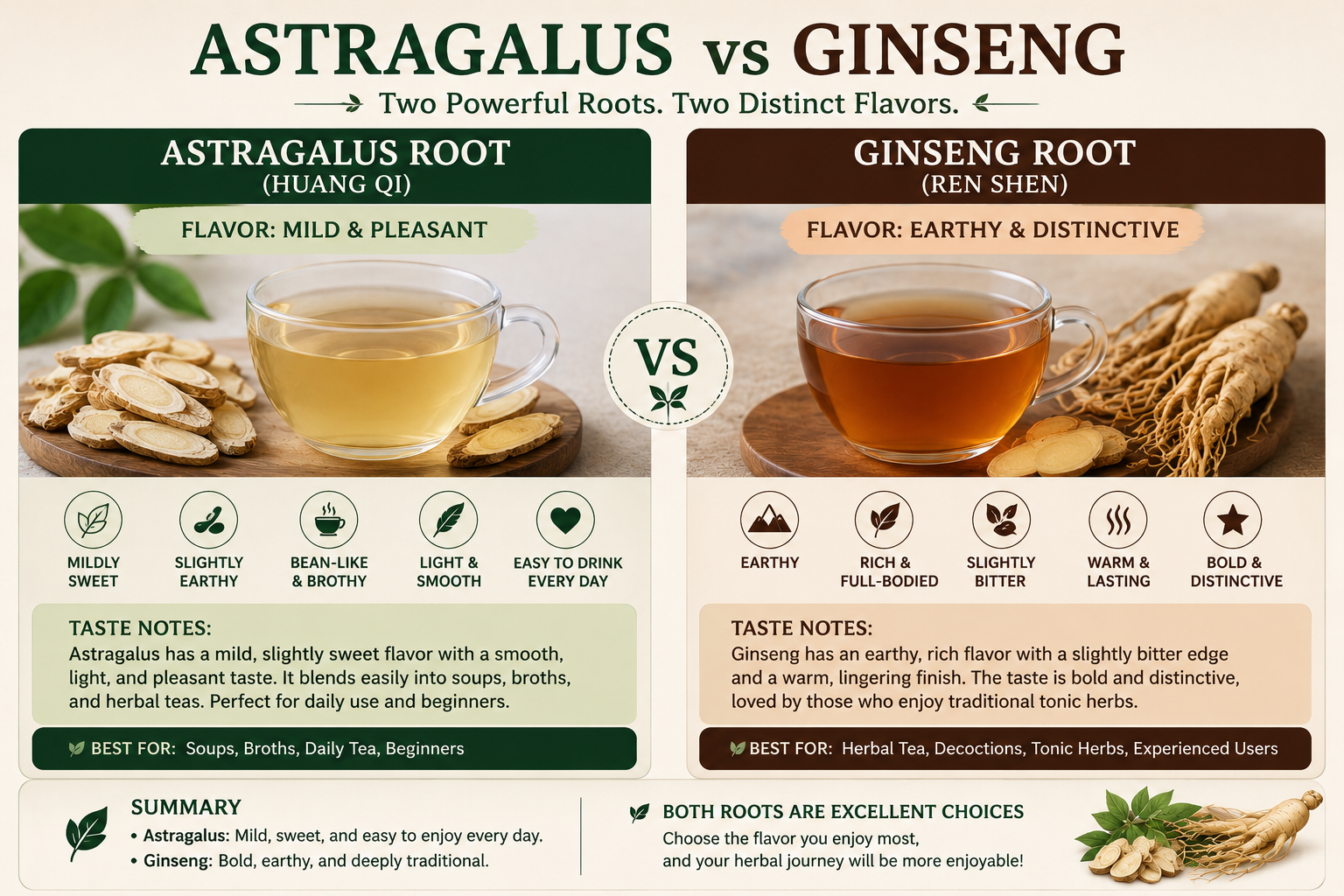
Which herb tastes better, Astragalus or Ginseng?
This is often the question that determines whether someone keeps using an herb.
Because let's be honest.
The best herb in the world won't help if you hate drinking it.
Astragalus Flavor
Astragalus has a mild, slightly sweet flavor.
Many people describe it as:
- Mildly earthy
- Slightly sweet
- Bean-like
- Brothy
- Easy to drink
Its gentle flavor is one reason Astragalus frequently appears in soups and broths.
Ginseng Flavor
Ginseng is more assertive.
Many people describe it as:
- Earthy
- Rich
- Slightly bitter
- Distinctive
- Long-lasting
Some people love Ginseng immediately.
Others need a few cups before they appreciate its unique character.
If you enjoy milder teas, Astragalus usually wins.
If you enjoy stronger herbal flavors, Ginseng often becomes the favorite.
Why Do Herbalists Use Astragalus?
Astragalus has been used for centuries in traditional Chinese herbalism and remains one of the most frequently used roots in herbal wellness preparations.
Many herbalists appreciate how easily it blends into everyday life.
Astragalus is commonly added to:
- Soups
- Broths
- Herbal teas
- Decoctions
- Traditional formulas
Its approachable flavor and versatility have helped make it one of the most popular herbs among beginners.
Why Do Herbalists Use Ginseng?
Ginseng's reputation extends far beyond traditional Chinese herbalism.
It has become one of the most recognized herbs in the world.
Throughout history, Ginseng has been treasured as one of the premier tonic herbs and continues to attract interest from researchers, herbalists, and tea drinkers alike.
For many people, simply owning Ginseng feels like owning a piece of herbal history.
Can Astragalus And Ginseng Be Used Together?
Yes.
In fact, many traditional formulas combine Astragalus and Ginseng.
They are not competitors.
They are teammates.
This is one reason many experienced herbal enthusiasts keep both in their herbal pantry.
Which Herb Should Beginners Start With?
If someone walked into our store and said:
"I've never used Chinese herbs before. Which one should I buy first?"
We would usually suggest Astragalus.
Not because it is better.
Because it is easier.
The flavor is gentler.
The preparation is simpler.
And it fits naturally into soups, teas, and broths.
Ginseng is still an excellent choice.
It simply has a stronger personality.
What Herbs Are Commonly Paired With Them?
Looking at herb pairings often helps explain how herbalists view a particular herb.
Astragalus Is Commonly Paired With:
- Goji Berry
- Red Dates (Da Zao)
- Licorice Root
- Reishi Mushroom
- Codonopsis (Dang Shen)
Ginseng Is Commonly Paired With:
- Astragalus Root
- Wu Wei Zi
- Goji Berry
- Reishi Mushroom
- American Ginseng
Choose Astragalus If...
- You are new to Chinese herbs.
- You prefer mild flavors.
- You enjoy soups and broths.
- You want a versatile daily-use herb.
- You like gentle herbal teas.
Choose Ginseng If...
- You want to experience one of the world's most famous herbs.
- You enjoy stronger flavors.
- You appreciate traditional tonic herbs.
- You are interested in herbal history.
- You don't mind spending a little more.
What Does Modern Research Say?
Both Astragalus and Ginseng have attracted significant scientific interest.
Researchers continue studying their phytochemicals, traditional uses, and biological activity.
Today they remain among the most researched herbs in traditional herbal medicine.
Research & References
- Auyeung KK, Han QB, Ko JK. Astragalus membranaceus: A Review of Its Protection Against Inflammation and Gastrointestinal Cancers.
https://pubmed.ncbi.nlm.nih.gov/25491516/ - Li M, Qu YZ, Zhao ZW, et al. Astragaloside IV Protects Against Oxidative Stress.
https://pubmed.ncbi.nlm.nih.gov/22326276/ - Panossian A, Wikman G. Effects of Adaptogens on the Central Nervous System and the Molecular Mechanisms Associated with Their Stress-Protective Activity.
https://pmc.ncbi.nlm.nih.gov/articles/PMC3991026/ - Lee NH, Son CG. Systematic Review of Randomized Controlled Trials Evaluating Ginseng.
https://pubmed.ncbi.nlm.nih.gov/23930003/ - Kim JH. Cardiovascular Diseases and Panax Ginseng: A Review on Molecular Mechanisms and Medical Applications.
https://pubmed.ncbi.nlm.nih.gov/24716142/ - Christensen LP. Ginsenosides: Chemistry, Biosynthesis, Analysis and Potential Health Effects.
https://pubmed.ncbi.nlm.nih.gov/18472280/
Final Verdict
If you want a gentle, versatile herb that fits easily into daily life, Astragalus is often the better starting point.
If you want to explore one of the most famous herbs in the world and enjoy stronger herbal flavors, Ginseng is difficult to ignore.
The truth is that many herbal enthusiasts eventually stop choosing between them.
They simply keep both on hand.
One offers familiarity and everyday versatility.
The other offers prestige, history, and one of the most recognizable names in herbalism.
Together they represent two of the most important roots in traditional Chinese herbal traditions.
About The Author
Author: Sarah Johnson, Certified Herbalist
Last Updated: June 9, 2026
Sarah Johnson has worked with traditional Chinese herbs, medicinal mushrooms, roots, berries, flowers, and botanical products for decades. Through 1st Chinese Herbs, she has helped thousands of customers better understand herbal traditions, tea preparation, herb selection, and botanical wellness practices.
Trusted Since 1994
Get Real Herbs. Feel The Difference.