
Build Your Own Chinese Herbal Tea
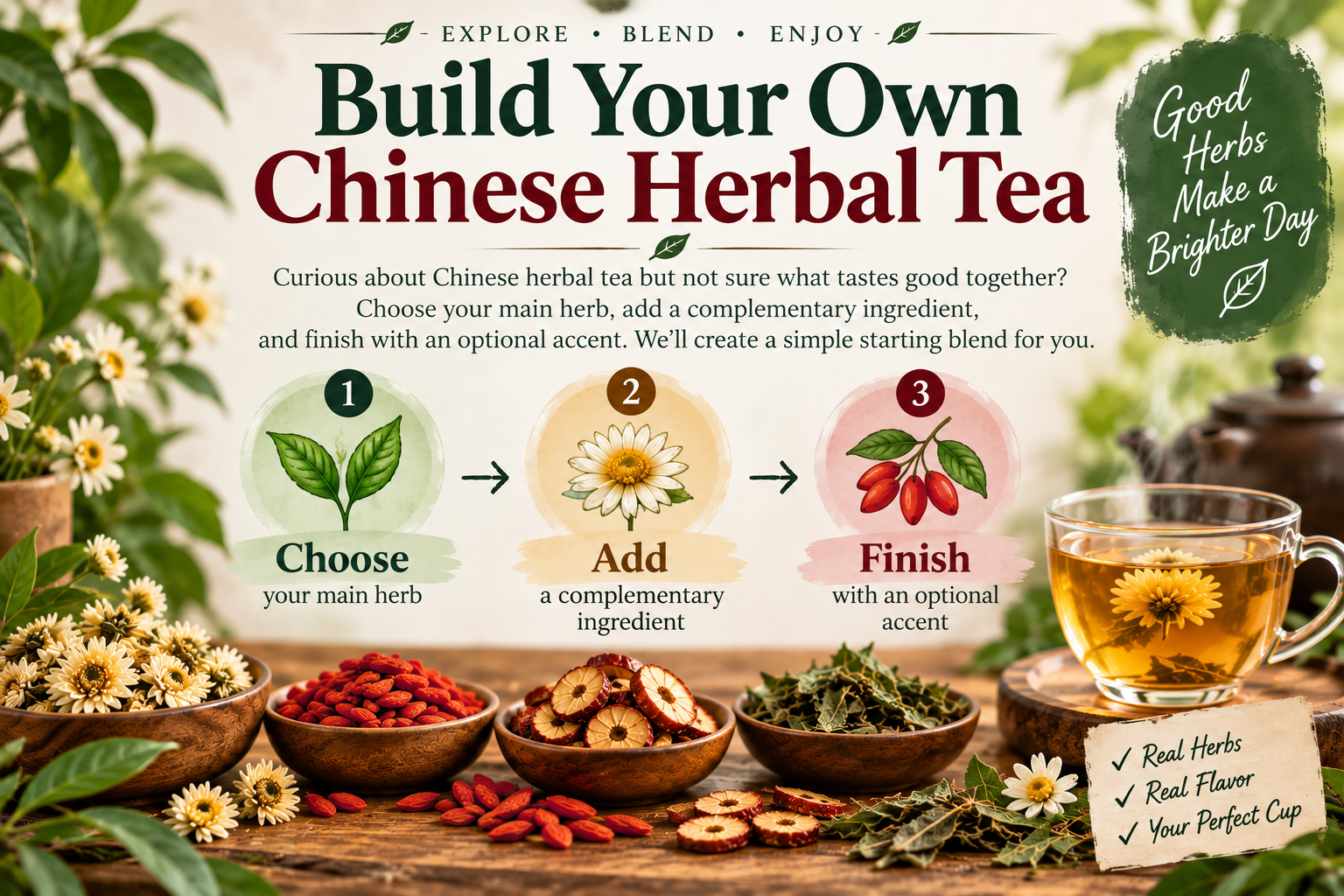
Curious about Chinese herbal tea but not sure what tastes good together? Choose your main herb, add a complementary ingredient, and finish with an optional accent. We'll create a simple starting blend for you.
Walk into a collection of Chinese herbs for the first time and the possibilities can feel overwhelming. Should you combine goji berries with chrysanthemum? What goes well with Chinese red dates? How much of each herb should you use? And should everything be steeped like ordinary tea?
This guide makes the process easier. Instead of beginning with complicated formulas, we're starting with something much simpler: flavor.
Use the builder below to experiment with two- and three-ingredient combinations. Then continue down the page for a flavor guide, starter blends, proportions, and preparation tips.
Choose Your Main Herb
This ingredient provides most of the flavor and character.
Add a Complementary Herb
Add sweetness, tartness, citrus, floral character, freshness, or an earthy note.
Finish Your Blend
Add a smaller accent ingredient or keep your blend simple with just two herbs.
Your Chinese Herbal Tea Blend
Your Starting Blend
What does "part" mean? A part is a proportion, not a fixed measurement. If you decide that 1 part equals 1 teaspoon, 2 parts would equal 2 teaspoons.
What Will It Taste Like?
How Should I Prepare It?
Want to Make This Blend?
Shop the ingredients you selected at 1st Chinese Herbs.
What Is Chinese Herbal Tea?
The phrase Chinese herbal tea can describe drinks prepared from flowers, leaves, fruits, peels, roots, seeds, bark, fungi, and other botanical ingredients used in Chinese herbal traditions.
Despite the word "tea," many of these drinks do not contain tea leaves from Camellia sinensis, the plant used to make green, black, white, and oolong tea. They are more accurately herbal infusions or decoctions.
Some Chinese herbal preparations are complex traditional formulas. This page is different. The blends here are intentionally simple and organized primarily around flavor and preparation for people learning about individual herbs.
Which Chinese Herbs Taste Good in Tea?
You do not have to memorize dozens of herbs before making a simple cup. Start by deciding what kind of flavor sounds appealing.
| If You Like... | Herbs to Explore | General Flavor |
|---|---|---|
| Floral | Chrysanthemum, Honeysuckle | Light and aromatic |
| Sweet & Fruity | Red Date, Longan, Goji | Mellow and naturally sweet |
| Tart | Hawthorn, Schisandra | Bright and tangy |
| Citrusy | Tangerine Peel | Aromatic with gentle bitterness |
| Fresh | Mint | Cooling in flavor and refreshing |
| Warm & Spicy | Ginger, Cinnamon Bark | Warm, fragrant and spicy |
| Mild & Earthy | Lily Bulb, Poria, Lotus Leaf | Subtle, green or earthy |
| Very Sweet | Monk Fruit, Licorice Root | Strong natural sweetness |
A Simple Way to Blend Chinese Herbal Tea
One reason tea blending becomes confusing is that beginners often try to use too many ingredients at once. You can learn much more about flavor by beginning with just two or three.
2 Parts — Main Herb
This is the dominant flavor in your blend.
1 Part — Complementary Herb
This adds contrast, sweetness, fruitiness, floral character, citrus, or another layer of flavor.
½ Part — Optional Accent
This adds a finishing note without becoming the main flavor.
For example, you might begin with 2 parts chrysanthemum + 1 part goji berry + ½ part tangerine peel.
The ratio is only a starting framework. Ingredients vary tremendously in strength. If your accent is monk fruit, licorice root, cinnamon, or another particularly strong ingredient, you may want considerably less than ½ part.
10 Easy Chinese Herbal Tea Combinations to Try
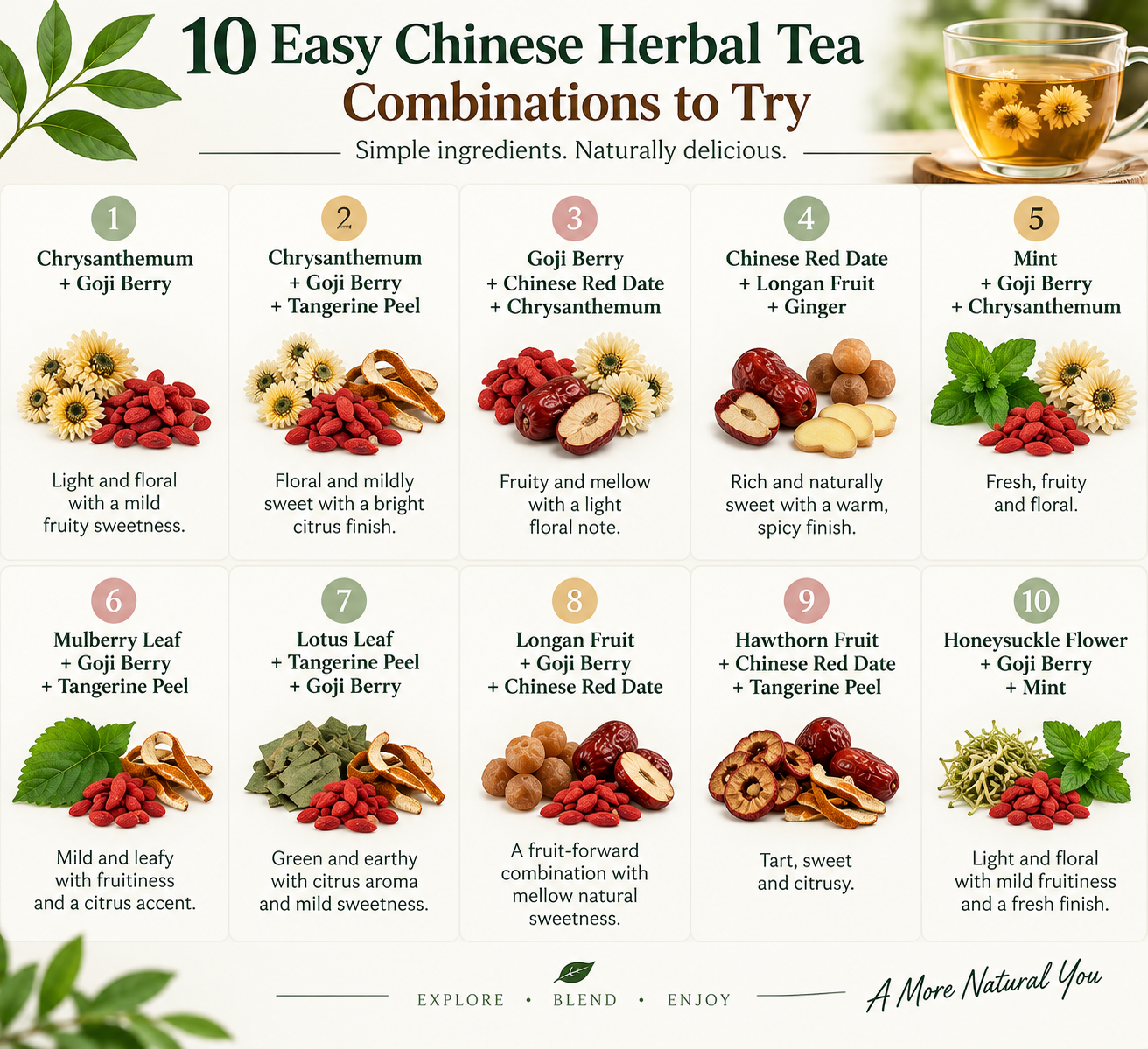
Don't feel like creating a combination from scratch? These simple pairings and three-herb blends provide approachable places to begin exploring flavor.
1. Chrysanthemum + Goji Berry
Light and floral with a mild fruity sweetness. A very approachable two-ingredient combination.
2. Chrysanthemum + Goji Berry + Tangerine Peel
Floral and mildly sweet with a bright citrus finish. Use the tangerine peel as the smaller accent.
3. Goji Berry + Chinese Red Date + Chrysanthemum
Fruity and mellow with a lighter floral note.
4. Chinese Red Date + Longan Fruit + Ginger
Rich and naturally sweet with a warm, spicy finish.
5. Mint + Goji Berry + Chrysanthemum
Fresh, fruity and floral. Keep the mint lighter if you don't want it to dominate the cup.
6. Mulberry Leaf + Goji Berry + Tangerine Peel
Mild and leafy with fruitiness and a citrus accent.
7. Lotus Leaf + Tangerine Peel + Goji Berry
Green and earthy with citrus aroma and mild sweetness.
8. Longan Fruit + Goji Berry + Chinese Red Date
A fruit-forward combination with mellow natural sweetness.
9. Hawthorn Fruit + Chinese Red Date + Tangerine Peel
Tart, sweet and citrusy—a good choice for someone who prefers a brighter-tasting cup.
10. Honeysuckle Flower + Goji Berry + Mint
Light and floral with mild fruitiness and a fresh finish.
Should I Steep or Simmer Chinese Herbs?
This is one of the most important differences between making ordinary tea and preparing many Chinese herbs. Not every herb should automatically be prepared the same way.
| Herb Type | Common Starting Method | Why? |
|---|---|---|
| Flowers | Steep | Usually delicate and quick to infuse |
| Leaves | Steep | Generally release flavor relatively easily |
| Peels | Longer steep or gentle simmer | More substantial than delicate leaves |
| Dried Fruits | Longer steep or simmer | Dense pieces may take longer to soften and infuse |
| Roots & Rhizomes | Often simmered | Dense plant material generally needs more extraction time |
| Bark | Often simmered | Hard, dense botanical material |
If you combine a sturdy root, fruit, or bark with delicate flowers or leaves, you don't necessarily have to cook everything for the same amount of time. The sturdy ingredients can often be prepared first, with delicate ingredients added later.
Always check the preparation directions for the specific herb you purchased. Cut size, processing, plant part, and the type of preparation can affect brewing time.
How Much Herbal Tea Should I Use?
For a simple beverage-style herbal infusion, a practical starting point is often around 1–2 teaspoons of the finished loose blend per 8 ounces of water, but this is not a universal rule.
A teaspoon of fluffy chrysanthemum flowers weighs much less than a teaspoon of dense sliced fruit or root. That is one reason traditional herbal preparations are often measured by weight rather than by volume.
When you're experimenting primarily with flavor, begin conservatively. You can make the next cup stronger, sweeter, more floral, or more tart after you know how the first version tastes.
Don't Try to Make the Perfect Blend on Your First Cup
Tea blending is partly experimentation. Write down what you used before you drink it. If you love the cup, you'll know how to make it again. If you don't, change only one thing the next time.
Too weak? Use a little more herb or steep longer.
Too strong? Reduce the dominant ingredient.
Too bitter? Reduce bitter or strongly aromatic ingredients.
Too sweet? Reduce monk fruit, licorice, red date, or other sweet ingredients.
Needs more brightness? Experiment with a small amount of tangerine peel, mint, tart fruit, or a floral ingredient.
Too complicated? Go back to two herbs. Simple is perfectly fine.
Chinese Herbal Tea Questions
Can I mix Chinese herbs together for tea?
Many herbs are traditionally combined, but compatibility, preparation, and safety depend on the individual herbs. For casual flavor exploration, beginning with simple two-ingredient combinations makes it easier to understand what each ingredient contributes.
What are some easy Chinese herbs for tea beginners?
Chrysanthemum, goji berry, Chinese red date, mint, longan fruit, mulberry leaf, and tangerine peel are examples with recognizable flavor characteristics. Preparation requirements still vary by ingredient.
How many herbs should I put in a tea blend?
You do not need a long ingredient list. Two or three herbs are enough for learning how flavors interact. More ingredients do not automatically make a better tea.
What is the difference between an infusion and a decoction?
An infusion generally involves steeping botanical ingredients in hot water. A decoction typically involves gently simmering sturdier plant materials in water for a longer period.
Can I steep Chinese herbs instead of boiling them?
It depends on the herb. Many delicate leaves and flowers work well as infusions, while dense roots, bark, fruits, or seeds may require longer preparation. Follow the directions appropriate for the individual ingredient.
Do Chinese herbal teas contain caffeine?
Many individual Chinese herbs do not naturally contain caffeine, but that does not mean every herbal tea blend is caffeine-free. Check all ingredients, especially if the blend also contains green, black, white, oolong, pu-erh, or another true tea.
Can I make Chinese herbal tea without understanding TCM?
You can learn about individual herbs as botanical ingredients and explore their flavors without attempting to create a traditional Chinese medicine formula. Traditional TCM formulas are a different subject and are based on traditional formulation principles rather than flavor alone.
How should I store loose Chinese herbs?
Keep dried herbs well sealed and protected from excess moisture, heat, and direct sunlight. Follow any product-specific storage instructions on the package.
This tea builder is intended to help visitors explore flavors and learn about simple herbal tea preparation. It does not create individualized traditional Chinese medicine formulas.
Herbs may interact with medications and may not be appropriate during pregnancy, nursing, or for people with certain medical conditions. Individual herbs also have their own cautions, contraindications, serving considerations, and preparation requirements.
Review the information for each herb you plan to use and consult a qualified healthcare professional when appropriate.
This information is provided for educational purposes only and is not intended to diagnose, treat, cure, or prevent any disease.