
Gan Cao vs. Zhi Gan Cao: What's the Difference Between These Two Forms of Licorice Root?
Quick Answer:
Gan Cao and Zhi Gan Cao both come from licorice root, but they are not exactly
the same herbal preparation. Gan Cao generally refers to dried, unprepared licorice root,
while Zhi Gan Cao refers to licorice root that has been traditionally processed,
commonly with honey. In Chinese herbalism, that processing matters.
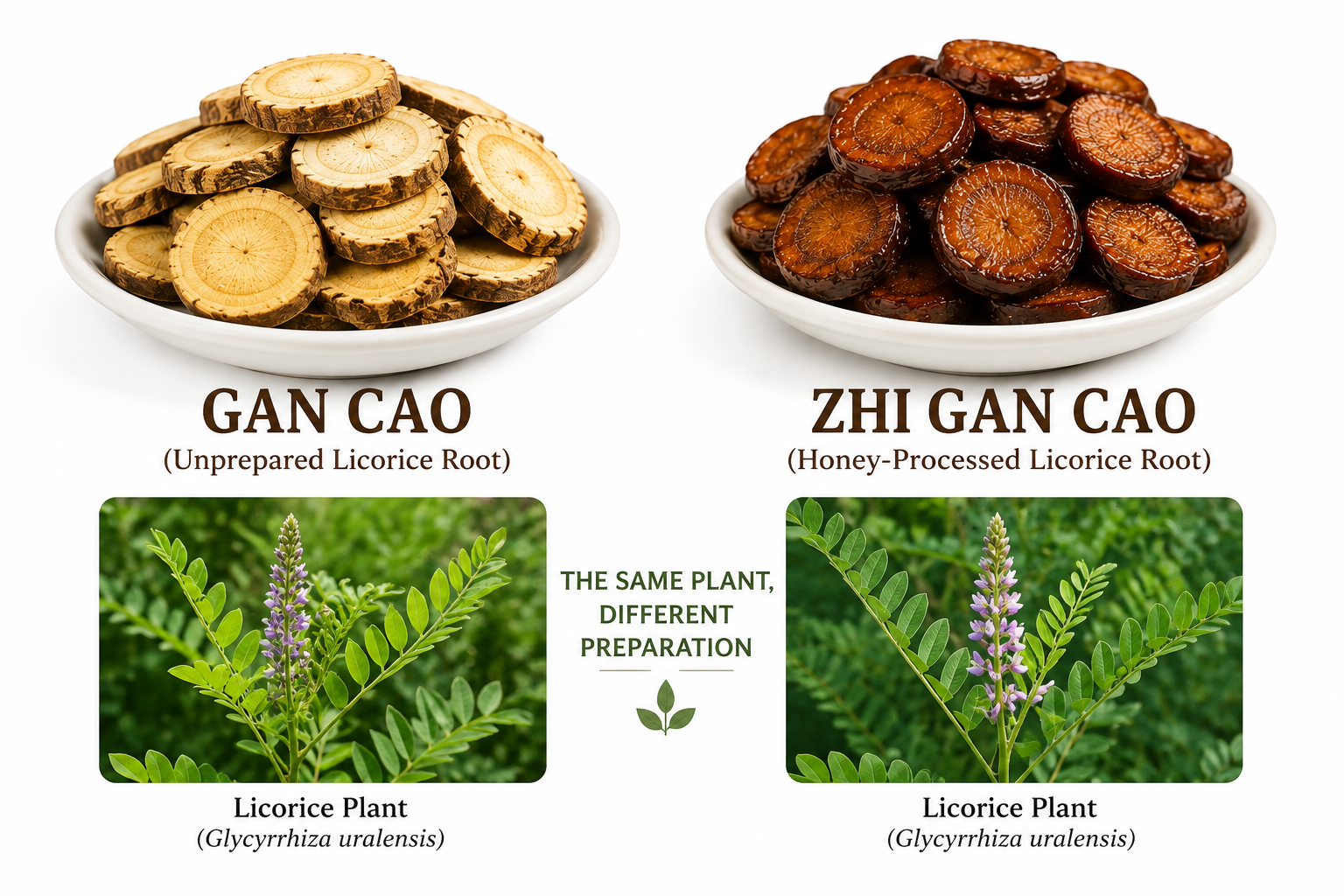
Imagine you're reading a traditional Chinese herbal formula.
You see Gan Cao on one ingredient list.
Then another formula calls for Zhi Gan Cao.
Both translate back to licorice root.
So naturally you wonder:
"Aren't these the same herb?"
Almost. The "ZHI" before "Gan Cao" is there for a specific reason.
And that's what makes this comparison so interesting.
Gan Cao and Zhi Gan Cao begin with the same basic botanical ingredient: licorice root.
But traditional Chinese herbalism doesn't look only at which plant is being used.
It can also distinguish how an herb has been prepared.
That's the key to understanding Gan Cao vs. Zhi Gan Cao.

Let's Make This Easy
If you're looking for the simplest explanation:
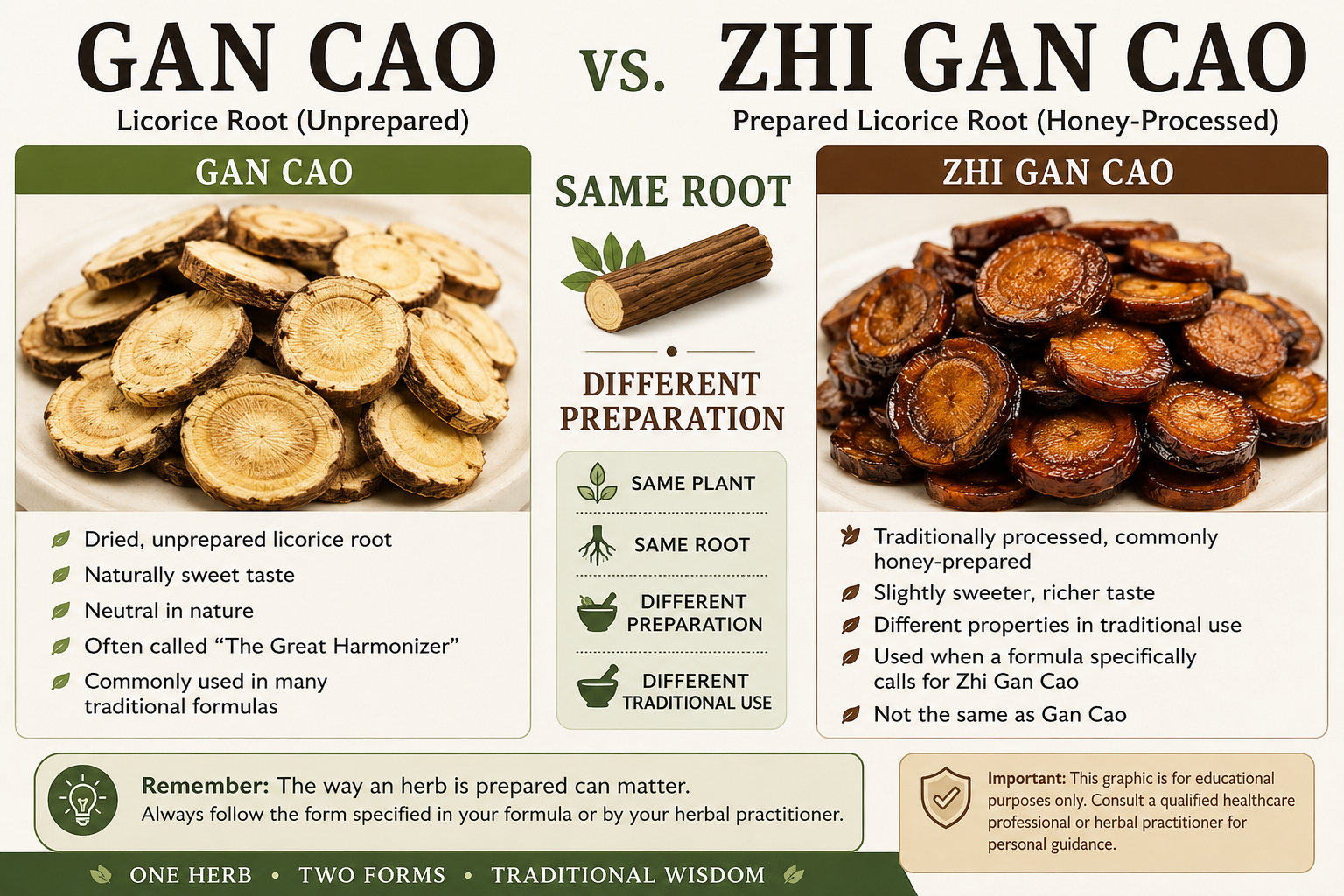
Gan Cao = dried licorice root.
Zhi Gan Cao = traditionally prepared licorice root, commonly processed with honey.
Same basic herb.
Different preparation.
Different traditional emphasis.
And they should not automatically be treated as interchangeable when you're following a specific traditional formula or practitioner's directions.
One Root → Two Traditional Preparations
Here's the easiest way to remember the difference:
Licorice Root
↓
Dried / Unprepared → Gan Cao
Traditionally Processed → Zhi Gan Cao
Unlike Da Qing Ye and Ban Lan Gen—where the difference is leaf versus root—the Gan Cao/Zhi Gan Cao distinction teaches another important lesson about Chinese herbalism:
Processing matters.
Traditional Chinese herbalism includes numerous preparation methods intended to change how an herb is traditionally characterized or used.
So when you see two different names for what appears to be the same plant, don't assume someone made a mistake.
The preparation may be the reason.
Gan Cao vs. Zhi Gan Cao Comparison Chart
| Feature | Gan Cao | Zhi Gan Cao |
|---|---|---|
| Common English Name | Licorice Root | Prepared Licorice Root |
| Chinese Name | 甘草 | 炙甘草 |
| Plant Part | Root | Root |
| Botanical Source | Licorice species used in Chinese herbalism | Licorice species used in Chinese herbalism |
| Preparation | Dried / unprepared | Traditionally processed |
| Common Processing | None beyond normal drying/preparation | Commonly honey-prepared |
| Traditional Flavor | Sweet | Sweet |
| Traditional Nature | Generally described as neutral | Often described somewhat differently depending on materia medica |
| Same Basic Herb? | Yes | Yes |
| Exactly The Same Product? | No | No |
| Automatically Interchangeable? | No | No |
| Most Important Difference | Unprepared licorice root | Processed licorice root |
What Is Gan Cao?
Gan Cao (甘草) is the Pin Yin name commonly used for licorice root in Chinese herbalism.
Depending upon the product and materia medica source, licorice used as Gan Cao may come from recognized Glycyrrhiza species.
When a product is specifically labeled Glycyrrhiza uralensis, it is commonly known as Chinese Licorice.
Gan Cao is naturally distinctive because licorice root contains compounds responsible for its remarkably sweet character, particularly glycyrrhizin.
In Traditional Chinese Herbalism, Gan Cao is famously associated with its role as a harmonizing herb and appears in a remarkable number of traditional formulas.
That is why you may sometimes hear Gan Cao called:
"The Great Harmonizer."
What Is Zhi Gan Cao?
Here's where things get interesting.
Zhi Gan Cao (炙甘草) isn't simply another Chinese name printed on the same bag of licorice root.
The word Zhi tells you something has happened to the herb.
Zhi Gan Cao refers to prepared licorice root, traditionally processed rather than simply used in its unprepared dried form.
It is commonly associated with honey processing.
This means the difference between Gan Cao and Zhi Gan Cao isn't:
Root vs. leaf.
It isn't:
Chinese licorice vs. candy licorice.
And it isn't:
Licorice vs. another plant.
It is fundamentally:
Unprepared vs. traditionally prepared licorice root.
That's the distinction to remember.
Why Would Anyone Process Licorice Root?
This question gets to the heart of traditional Chinese herb preparation.
Chinese herbalism has a long history of processing herbs in different ways before they are used.
An herb might traditionally be:
-
Dry-fried
-
Stir-fried
-
Steamed
-
Cooked
-
Wine-processed
-
Vinegar-processed
-
Salt-processed
-
Honey-prepared
These aren't simply culinary techniques.
Within traditional herbal theory, processing may be used to alter how an herb is characterized, emphasize particular traditional properties, moderate others, or make the prepared herb more appropriate for a particular traditional application.
Zhi Gan Cao is a perfect example of why the preparation written in a formula matters.
What You Need To Know
Did I Buy the Wrong Licorice Root?
Not necessarily.
If your formula calls for Gan Cao and you purchased dried Gan Cao, you purchased the form indicated by that name.
If your formula specifically calls for Zhi Gan Cao, however, don't automatically assume ordinary Gan Cao is identical.
Check the product label, formula instructions, or ask your qualified herbal practitioner.
Can I Substitute Gan Cao for Zhi Gan Cao?
Don't automatically substitute one for the other.
They originate from the same basic herb, but traditional Chinese herbalism distinguishes between the unprepared and processed forms.
If you're following a specific traditional formula, use the form the formula specifies unless your qualified practitioner advises otherwise.
Is Zhi Gan Cao a Different Species of Licorice?
Not simply because it says Zhi Gan Cao.
The major distinction represented by Zhi Gan Cao is the traditional processing of the licorice root.
Always check the botanical name on the individual product when species identification matters.
Is Zhi Gan Cao the Same as DGL?
No.
This is an important distinction.
DGL means deglycyrrhizinated licorice. It is a specially manufactured licorice preparation from which most of the naturally occurring glycyrrhizin has been removed.
Zhi Gan Cao is a traditional Chinese herbal preparation of licorice root.
These terms describe very different things.
Zhi Gan Cao ≠ DGL.
Is Gan Cao the Same as Black Licorice Candy?
Definitely not.
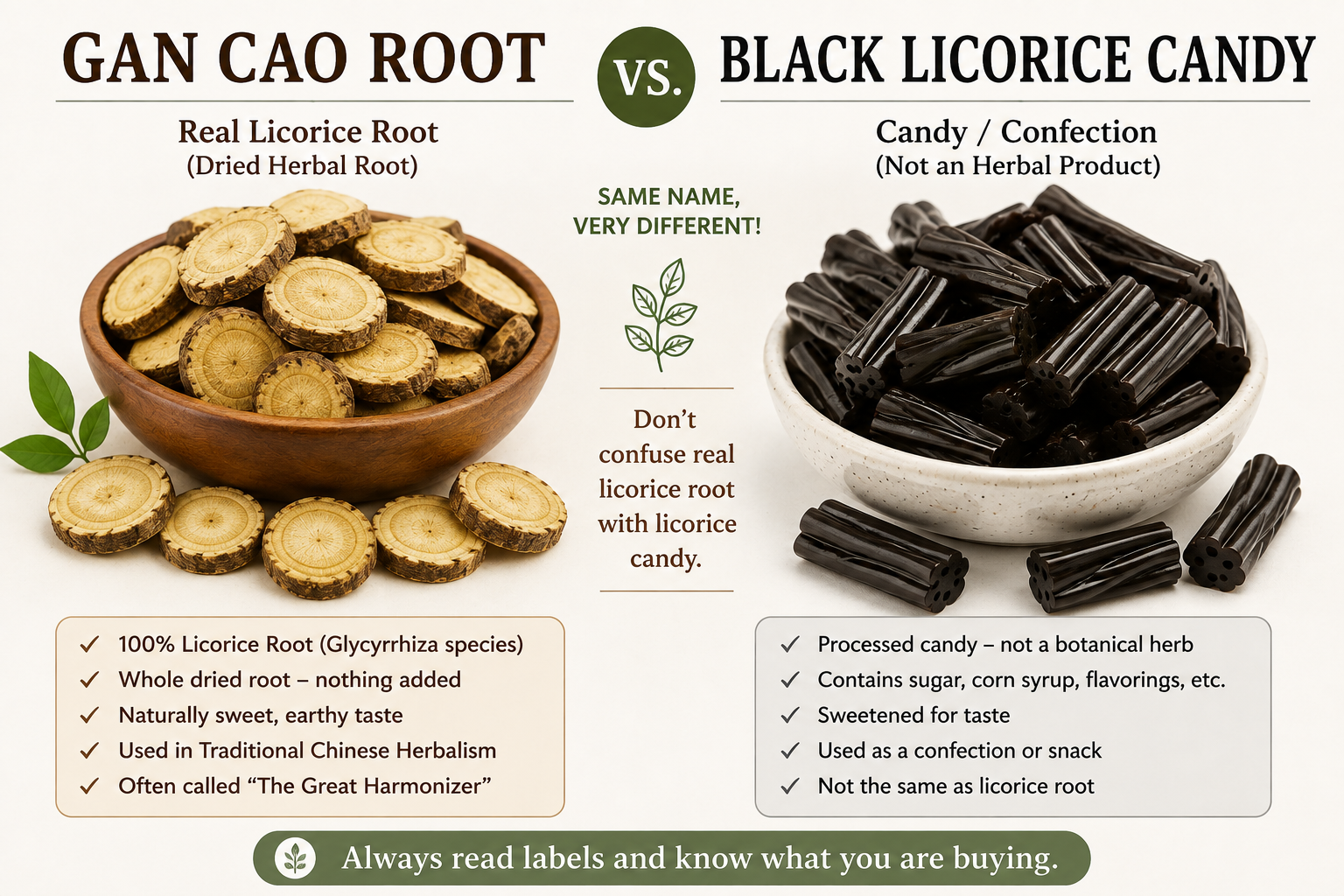
Gan Cao is botanical licorice root.
Black licorice candy is a manufactured food that can contain sugar, starches, flavorings and other ingredients. Some products associated with a "licorice" flavor may also obtain that characteristic flavor from ingredients such as anise.
Don't use candy as your reference point for what genuine Gan Cao should look or taste like.
What Do Gan Cao and Zhi Gan Cao Look Like?
Gan Cao is commonly sold as dried root pieces or slices.
Depending on the cut, you may see:
-
Tan to golden-brown exterior
-
Lighter yellow-tan interior
-
Visible natural root structure
-
Irregularly sized pieces
-
Round or oval disc-cut slices
Natural botanical variation is normal.
Zhi Gan Cao can look different because the root has undergone additional processing. Appearance can vary depending upon the processing method and supplier.
That's another reason the package name matters more than simply deciding that two bags "look like licorice."
What Does Gan Cao Taste Like?
Here's something beginners often don't expect:
Real licorice root is remarkably sweet.
That sweetness isn't necessarily from added sugar.
Licorice naturally contains glycyrrhizin, a compound associated with its characteristic intense sweetness.
Gan Cao also has an earthy, woody root character underneath that sweetness.
Zhi Gan Cao may have sensory differences associated with its processing, particularly when honey preparation is involved.
Neither should be confused with the flavor profile of commercial licorice candy.
The Bigger Lesson: Chinese Herb Processing Matters
Gan Cao vs. Zhi Gan Cao teaches something much larger than the difference between two bags of licorice.
When beginners start learning Chinese herbs, they naturally focus on:
What plant is this?
Later they discover that herbal identification can involve much more:
Which species?
Which plant part?
How was it cut?
Was it processed?
How was it processed?
Which form does the traditional formula specify?
This is one reason botanical names, Pin Yin names and preparation descriptions are so valuable when purchasing Chinese herbs.
Two products can originate from the same plant and still not be considered identical preparations.
Gan Cao vs. Zhi Gan Cao: Which One Should I Buy?
The answer is actually simple.
Choose Gan Cao when:
Your recipe, materia medica reference, or qualified practitioner specifically calls for Gan Cao or unprepared licorice root.
Choose Zhi Gan Cao when:
Your formula or practitioner specifically calls for Zhi Gan Cao or traditionally prepared licorice root.
If you're unsure:
Don't choose based solely on which one is cheaper, sweeter, or easier to find.
Follow the exact form specified by your formula or practitioner.
That eliminates most of the confusion.
The Most Common Gan Cao Buying Mistakes
Mistake #1: Assuming all licorice products are identical
Whole licorice root, Gan Cao, Zhi Gan Cao, DGL, powders and concentrated extracts are not automatically interchangeable.
Mistake #2: Ignoring the botanical name
"Licorice" can refer broadly to plants within the Glycyrrhiza genus. Check the botanical identity of the actual product you're purchasing.
Mistake #3: Ignoring processing
If a traditional formula specifically says Zhi Gan Cao, the preparation designation is there for a reason.
Mistake #4: Assuming Zhi Gan Cao means DGL
It doesn't.
Traditional processing and modern deglycyrrhizination are completely different concepts.
Mistake #5: Buying by appearance alone
Two licorice products may look similar while representing different preparations.
Read the label.
7 Interesting Facts About Gan Cao
-
Gan Cao is one of the most recognizable herbs in traditional Chinese herbal formulas.
-
Its naturally intense sweetness is associated in part with glycyrrhizin.
-
Gan Cao is frequently referred to as "The Great Harmonizer" because of its traditional role within formulas.
-
Gan Cao and Zhi Gan Cao can begin with the same basic licorice root but represent different preparations.
-
The word Zhi is an important clue that you're dealing with a prepared herb.
-
DGL and Zhi Gan Cao are not the same thing.
-
Understanding Gan Cao vs. Zhi Gan Cao teaches one of the most useful lessons for buying Chinese herbs: always check both botanical identity and preparation.
Gan Cao Frequently Asked Questions
What does Gan Cao mean?
Gan Cao is the Pin Yin name commonly used for licorice root in Chinese herbalism.
What does Zhi Gan Cao mean?
Zhi Gan Cao refers to traditionally prepared licorice root, commonly associated with honey processing.
Are Gan Cao and Zhi Gan Cao the same plant?
They can originate from the same licorice botanical source. The important distinction is that Zhi Gan Cao represents a processed preparation.
Is Gan Cao naturally sweet?
Yes. Licorice root contains naturally occurring compounds, particularly glycyrrhizin, associated with its characteristic sweetness.
Is sugar added to Gan Cao?
Plain Gan Cao should not be assumed to contain added sugar. Check the ingredient statement of the specific product you're purchasing.
Is Zhi Gan Cao sugar-free?
Don't assume that. Because traditional Zhi Gan Cao may involve honey processing, check the specific product's ingredients and preparation information if this matters to you.
Can Gan Cao and Zhi Gan Cao be used interchangeably?
They should not automatically be substituted for one another when a traditional formula specifies a particular preparation. Follow your practitioner's or formula's instructions.
Is Gan Cao the same as DGL?
No. DGL is deglycyrrhizinated licorice, a preparation from which most glycyrrhizin has been removed.
Important Licorice Root Safety Information
Whether you're researching Gan Cao or Zhi Gan Cao, licorice deserves an important safety discussion.
Whole licorice root naturally contains glycyrrhizin. Excessive or prolonged intake of glycyrrhizin-containing licorice can cause significant adverse effects in susceptible individuals.
Potential concerns can include:
-
Increased blood pressure
-
Decreased potassium
-
Fluid retention
-
Changes in heart rhythm
Consult an appropriate healthcare professional before using glycyrrhizin-containing licorice if you have high blood pressure, cardiovascular disease, kidney disease, low potassium or another electrolyte disorder; are pregnant or breastfeeding; or take prescription medications that may affect blood pressure, potassium, fluid balance, heart rhythm or corticosteroid activity.
More is not necessarily better.
Follow the amount, preparation and duration recommended by your qualified healthcare professional or trained herbal practitioner.
The Bottom Line
Here's the one thing I want you to remember from this comparison:
Gan Cao and Zhi Gan Cao aren't two completely different plants.
They demonstrate something much more interesting.
The way an herb is prepared can matter.
Gan Cao teaches us about the herb itself.
Zhi Gan Cao teaches us about Pao Zhi—the traditional processing of Chinese herbs.
And once you understand that distinction, a lot of Chinese herbal names that initially seem confusing begin to make sense.
So the next time you're reading a formula and see:
Gan Cao
or
Zhi Gan Cao
don't think:
"They're both licorice. What's the difference?"
Think:
"Which preparation does this formula actually call for?"
That's the question that matters.
Research & Traditional References
This comparison is based on traditional Chinese herbal materia medica and pharmacognosy concepts concerning Gan Cao, Zhi Gan Cao and the traditional processing of Chinese herbs.
Useful reference sources include:
-
Chinese Herbal Medicine: Materia Medica — Bensky et al.
-
Chinese Pharmacopoeia
-
Chinese Medical Herbology and Pharmacology — Chen & Chen
-
National Center for Complementary and Integrative Health (NCCIH) — Licorice Root
-
National Library of Medicine / PubMed — Research on Glycyrrhiza species, glycyrrhizin and licorice constituents
Modern research continues to investigate the chemical composition, processing and naturally occurring constituents of licorice species. Traditional uses described on this page refer to historical Chinese herbal practice and should not be interpreted as claims that these products diagnose, treat, cure or prevent disease.
Author: Sarah Johnson, Certified Herbalist
Last Updated: August 8, 2026
Trusted Since 1994
Helping customers understand Chinese herbs, traditional preparations, roots, leaves, flowers, berries, mushrooms and herbal ingredients.