

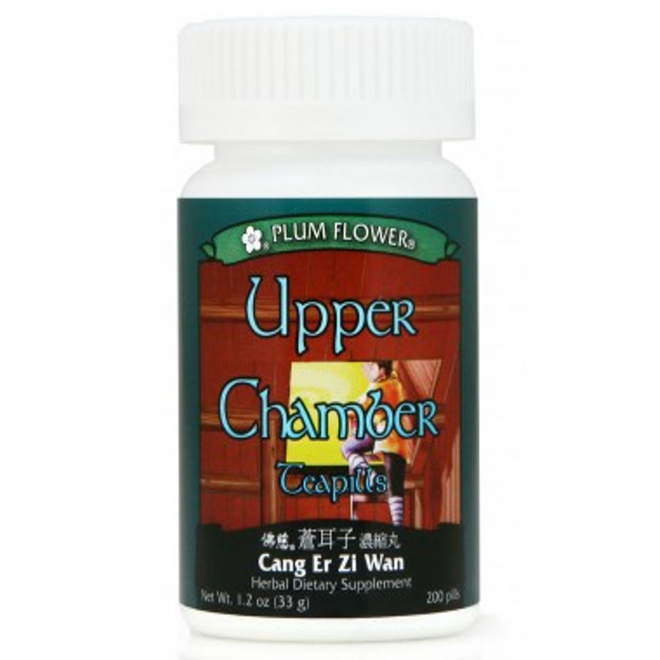
Upper Chamber Teapills – Cang Er Zi Wan
Traditional Chinese Herbal Formula | Plum Flower | 200 Teapills
Discover Upper Chamber Teapills, also known as Cang Er Zi Wan, a traditional Chinese herbal combination with a long history in Chinese herbal practice.
This four-herb formula features Cang Er Zi (Xanthium fruit), Bai Zhi (Angelica dahurica root), Xin Yi Hua (Magnolia flower), and Bo He (Mint).
In Traditional Chinese Medicine, the formula is historically associated with the concepts of Wind and the upper portion of the body. These terms belong to a traditional system of herbal classification and are not equivalent to modern medical diagnoses.
Conveniently prepared as small teapills, Upper Chamber requires no brewing, measuring, or straining.
What Is Upper Chamber – Cang Er Zi Wan?
Cang Er Zi Wan is a prepared version of the traditional Chinese herbal formula associated with Cang Er Zi San.
In Traditional Chinese Medicine, the formula is traditionally used to:
-
Dispel Wind
-
Open the nasal passages
-
Benefit the nose
-
Dispel turbidity
These are Traditional Chinese Medicine functions, not Western medical diagnoses or treatment claims.
What Does "Dispel Wind and Open the Nose" Mean?
Traditional Chinese Medicine uses terms such as Wind and turbidity to describe patterns rather than specific diseases.
In everyday language, someone researching Cang Er Zi Wan may be looking for a traditional formula when the nose feels stuffy, obstructed or difficult to clear.
That does not mean every case of nasal discomfort represents the same TCM pattern. Persistent, severe or unexplained symptoms should be appropriately evaluated.
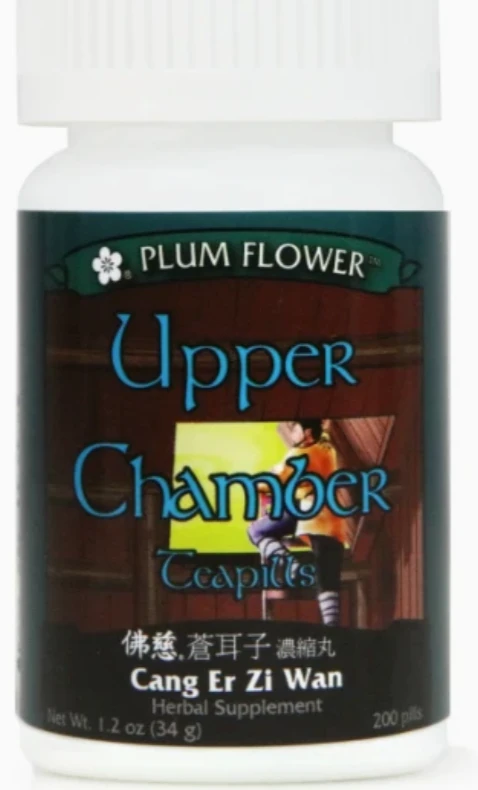 Upper Chamber Teapills (Cang Er Zi Wan) — Product Details at a Glance
Product Name: Upper Chamber Teapills
Pin Yin Name: Cang Er Zi Wan
Related Traditional Formula Name: Cang Er Zi San
Brand: Plum Flower
Form: Small round prepared teapills
Bottle Size: 200 teapills
Formula Size: 4 herbs
Traditional Focus: Nose and nasal passages
Label Directions: 8 teapills, 3 times daily
Approximate Supply: About 8 days when used at label directions
Preparation Required: None — swallow with water
Origin: China
What's in Upper Chamber Teapills?
Upper Chamber uses a focused combination of four traditional herbs associated with the nose and upper portion of the body.
| Pin Yin | Botanical Ingredient | Traditional Role |
|---|---|---|
| Cang Er Zi | Xanthium sibiricum fruit | Traditionally dispels Wind and benefits the nose |
| Bai Zhi | Angelica dahurica root | Traditionally dispels Wind and opens the nasal passages |
| Xin Yi Hua | Magnolia biondii flower | Traditionally opens the nasal passages and benefits the nose |
| Bo He | Mentha haplocalyx herb | Traditionally disperses Wind and clears the head |
Why Is Cang Er Zi the Featured Herb?
Cang Er Zi (Xanthium fruit) gives the traditional formula its name.
In Chinese herbalism, Cang Er Zi has a particularly strong traditional association with the nose and nasal passages.
It is combined with Bai Zhi and Xin Yi Hua, two additional herbs traditionally associated with the nose, while Bo He complements the formula through its traditional Wind-dispersing properties.
Is Upper Chamber the Right Traditional Formula for You?
Upper Chamber Teapills (Cang Er Zi Wan) is a traditional Chinese herbal formula with a long history of use in Chinese herbal practice.
You may be looking for this formula if:
-
You are searching for Cang Er Zi Wan or its traditional counterpart, Cang Er Zi San.
-
You want a formula containing Cang Er Zi (Xanthium fruit), Bai Zhi (Angelica dahurica), Xin Yi Hua (Magnolia flower), and Bo He (Mint).
-
You prefer the convenience of prepared teapills instead of measuring and brewing loose herbs.
-
You are exploring traditional Chinese herbal formulas associated with the concepts of Wind and the upper portion of the body.
What makes Upper Chamber different?
Unlike general-purpose herbal supplements, Upper Chamber is a specific four-herb formula rooted in Traditional Chinese Medicine. Its ingredients reflect traditional herbal formulation principles rather than a one-size-fits-all approach.
Important: Traditional Chinese Medicine terminology describes historical herbal practices and should not be interpreted as a medical diagnosis or a claim to treat disease. Consult a qualified healthcare professional to determine whether this formula is appropriate for your individual needs.
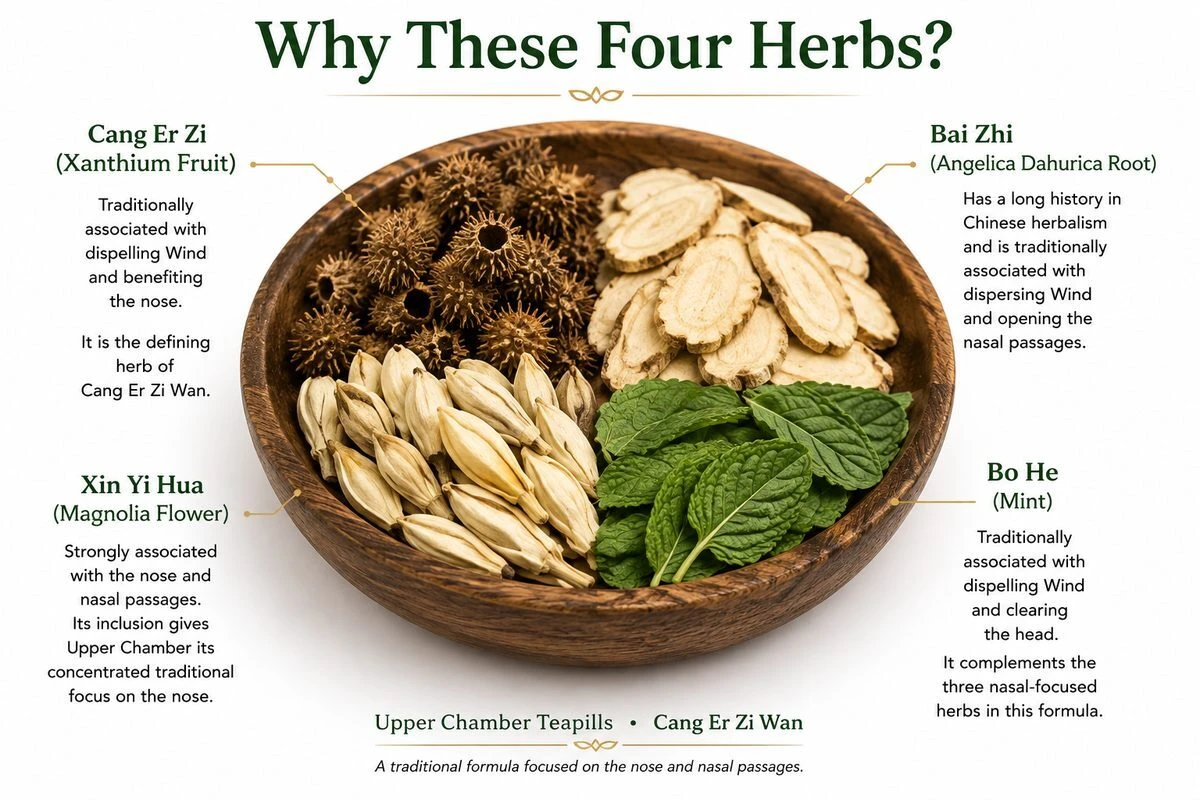
Why These Four Herbs?
Cang Er Zi — Xanthium Fruit
Cang Er Zi is traditionally associated with dispelling Wind and benefiting the nose. It is the defining herb of Cang Er Zi Wan.
Bai Zhi — Angelica Dahurica Root
Bai Zhi has a long history in Chinese herbalism and is traditionally associated with dispersing Wind and opening the nasal passages.
Xin Yi Hua — Magnolia Flower
Xin Yi Hua is another traditional Chinese herb strongly associated with the nose and nasal passages.
Its inclusion alongside Cang Er Zi and Bai Zhi gives Upper Chamber its concentrated traditional focus on the nose.
Bo He — Mint
Bo He is traditionally associated with dispersing Wind and clearing the head. It complements the three principal nasal-focused herbs in this prepared formula.
Why Teapills & How Do I Use Them?
Traditional Chinese herbal formulas can be prepared by measuring individual herbs and simmering them in water to make a decoction.
Upper Chamber Teapills provide the formula in a much more convenient prepared form.
There is no measuring, simmering or straining. Simply take the teapills with water according to the product directions.
Label Directions
Take 8 teapills, 3 times per day.
At the label directions of 24 teapills per day, one 200-count bottle provides approximately 8 days of use.
Follow the product label unless your qualified healthcare professional or Traditional Chinese Medicine practitioner has provided different instructions.
Cang Er Zi Wan vs. Cang Er Zi San — What's the Difference?
These names can be confusing when you're shopping for Chinese herbs.
Cang Er Zi San is the name commonly associated with the traditional herbal formula.
Cang Er Zi Wan refers to a prepared pill form associated with that traditional formula.
The word Wan generally indicates a pill, while San traditionally refers to a powder.
This Plum Flower product is sold as Upper Chamber Teapills – Cang Er Zi Wan and contains 200 prepared teapills.
Traditional Herbal Ingredients and Botanical Research
Upper Chamber contains four herbs with established histories of use in Traditional Chinese Medicine.
Cang Er Zi (Xanthium Fruit)
The defining ingredient of Cang Er Zi Wan, historically described in traditional Chinese herbal literature using concepts such as Wind and the nose.
Bai Zhi (Angelica Dahurica Root)
A traditional Chinese botanical included in numerous classical herbal combinations.
Xin Yi Hua (Magnolia Flower)
Magnolia flower buds have a long history in Chinese herbal practice and are traditionally associated with the upper portion of the body.
Bo He (Mint)
An aromatic herb traditionally included in Chinese herbal formulas and valued for its distinctive botanical characteristics.
Understanding the Research
Individual ingredients have been investigated in botanical and laboratory research. Findings about isolated ingredients do not establish the safety or effectiveness of the finished Upper Chamber Teapills formula for any medical condition.
For specific health concerns, consult a qualified healthcare professional.
Frequently Asked Questions
What are Upper Chamber Teapills?
Upper Chamber is the English product name for Cang Er Zi Wan, a traditional Chinese herbal formula with a particular traditional association with the nose and nasal passages.
What is Cang Er Zi Wan traditionally used for?
In Traditional Chinese Medicine, Cang Er Zi Wan is traditionally used to dispel Wind, benefit the nose and open the nasal passages.
These terms describe traditional TCM functions rather than Western medical diagnoses.
Is Cang Er Zi Wan the same as Cang Er Zi San?
They are closely related names. Cang Er Zi San refers to the traditional formula, while Cang Er Zi Wan indicates a prepared pill form associated with the formula.
What herbs are in Upper Chamber?
This product contains four herbs: Cang Er Zi (Xanthium fruit), Bai Zhi (Angelica dahurica root), Xin Yi Hua (Magnolia flower) and Bo He (Mint).
Does Upper Chamber contain Magnolia?
Yes. Xin Yi Hua (Magnolia biondii flower) is one of the four herbs in the formula and is traditionally associated with benefiting and opening the nose.
Does Upper Chamber contain Xanthium?
Yes. Cang Er Zi (Xanthium sibiricum fruit) is the defining herb in the formula.
Is Upper Chamber the same as Niu Huang Jie Du Pian?
No. Cang Er Zi Wan and Niu Huang Jie Du Pian are different traditional Chinese herbal formulas.
How many teapills are in the bottle?
Each bottle contains 200 teapills.
How do I take Upper Chamber Teapills?
The product label states 8 teapills, 3 times per day. Swallow them with water unless your qualified healthcare practitioner has provided different instructions.
How long does one bottle last?
At 8 teapills three times daily, 24 teapills are used per day. A 200-count bottle therefore provides approximately 8 days at the label directions.
Do I have to brew Upper Chamber as a tea?
No. Upper Chamber is already prepared as teapills, so there is no need to measure loose herbs, simmer a decoction or strain herbal tea.
Safety Information
Do not use during pregnancy or while nursing.
Consult an appropriate qualified healthcare professional before using herbal supplements if you take prescription medications, have a medical condition, are preparing for surgery or are unsure whether this traditional formula is appropriate for you.
Keep out of reach of children.
Do not exceed the product's labeled directions unless instructed by an appropriate healthcare professional.
Persistent, severe or worsening nasal symptoms should be medically evaluated rather than assumed to represent a Traditional Chinese Medicine pattern.
Upper Chamber Teapills – Traditional Nasal-Focused Herbal Formula
Upper Chamber is an especially straightforward traditional formula for shoppers specifically looking for Cang Er Zi Wan, Cang Er Zi San or a Chinese herbal formula traditionally associated with the nose and nasal passages.
It combines four recognizable traditional herbs — Cang Er Zi, Bai Zhi, Xin Yi Hua and Bo He — in a convenient prepared teapill.
No loose herbs to measure. No decoction to prepare. Just the traditional formula in an easy-to-use prepared form.
Research
-
Cang Er Zi (Xanthium Fruit): View botanical research on PubMed
-
Bai Zhi (Angelica Dahurica): Traditional Uses and Phytochemistry – PubMed
PubMed -
Xin Yi Hua (Magnolia Flower): Chemical Characterization of Magnolia biondii – PubMed
PubMed -
Bo He (Mint): Chemical Constituents of Mentha haplocalyx – PubMed
PubMed
Traditional Use & FDA Disclaimer
Information describing Chinese herbal functions and patterns is based on principles of Traditional Chinese Medicine and is provided for educational purposes.
These statements have not been evaluated by the Food and Drug Administration. This product is not intended to diagnose, treat, cure or prevent any disease.
Consult an appropriate qualified healthcare professional regarding medical conditions, medications, pregnancy, nursing or persistent symptoms.
These references are provided for educational purposes and discuss individual botanical ingredients. They do not establish that Upper Chamber Teapills diagnose, treat, cure, or prevent any disease.