
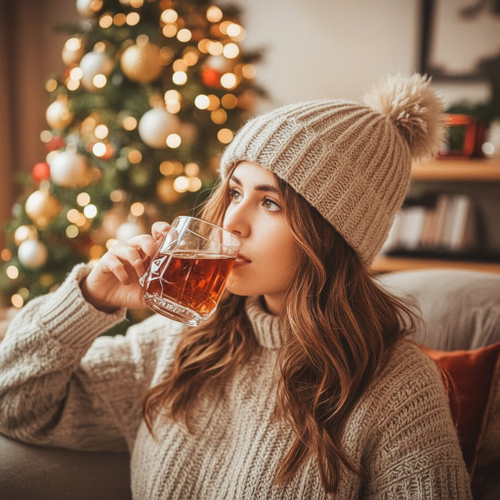
Holiday Stress Is Real. Let Tea Help You Feel Human Again.
Posted by Sarah Johnson, M.S. in Holistic Healing on Dec 18th 2025
Holiday Stress Is Real. Let Tea Help You Feel Human Again.
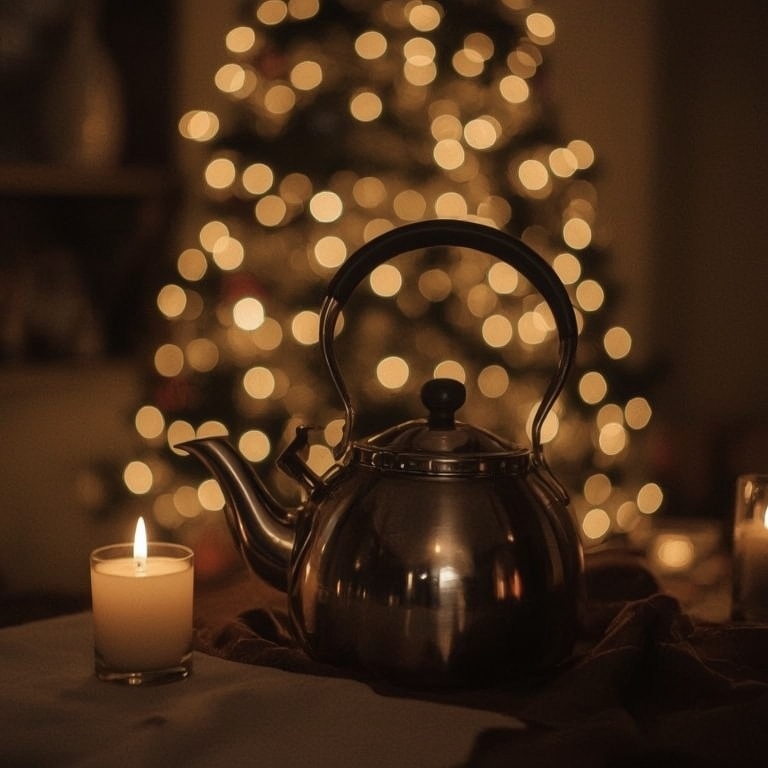 Picture this in your mind: the kettle hums, the lights are soft, and for the first time all day… your shoulders drop. No, the holidays haven’t suddenly become peaceful. But your body just got a message it understands: we can exhale now.
This guide shares Chinese herbal teas people love during the holidays—simple blends for calm, sleep, digestion, and “I’m fine” energy (you know the one). It’s warm, practical, and designed for real life: busy schedules, family chaos, travel, and late-night snack decisions.
Important note: This page is educational and not medical advice. Dietary supplements are not intended to diagnose, treat, cure, or prevent disease. If you are pregnant, breastfeeding, taking prescription medicines, or managing a medical condition, please check with a qualified clinician before using herbs.
Quick Answer: Best Chinese Herbal Teas for Holiday Stress
- For a racing mind at night: Fu Shen + Bai Zi Ren (gentle “calm cup” ritual)
- For heavy holiday meals: Chen Pi + Shan Zha (after-meal reset tea)
- For tired-but-tense days: Huang Qi + Da Zao (daytime resilience tea)
Best results tip: Pick one tea, drink it at the same time daily for 7 days, and track one outcome (sleep, digestion, or energy).
Prefer convenience? Choose teapills or extract powders instead of brewing.
Table of Contents
- Why holiday stress hits your body so hard
- Best tea for holiday stress (by how you feel)
- Calming tea before bed (sleep support routine)
- Tea for digestion after holiday meals
- 3 simple tea recipes (no herbal wizardry required)
- How to use bulk herbs vs powders vs teapills
- Safety + who should ask first
- Shop: build your holiday tea plan
- FAQs
- Why people trust 1st Chinese Herbs
- Related links
Why holiday stress hits your body so hard
Holiday stress isn’t just “mental.” It shows up everywhere: sleep gets lighter, digestion gets pickier, cravings get louder, and your nervous system runs like a browser with 47 tabs open—one of them playing music you can’t find.
Common holiday stress signs include:
- Racing thoughts at bedtime (or waking up at 2–4 a.m.)
- Bloating, heaviness, or “my stomach is mad” after rich meals
- Fatigue with tension (tired… but somehow still clenched)
- More caffeine, less patience, and a shorter fuse than usual
Tea is not a magic wand. But it is a daily ritual that nudges the body toward calmer rhythms—warmth, aroma, and a pause that tells your system: you’re allowed to slow down.
Chinese medicine’s simple view of holiday stress
In Traditional Chinese Medicine (TCM), stress is often described as causing “constraint” (things feel stuck), which can affect mood, sleep, digestion, and overall resilience. Translation: when life speeds up, your body may struggle to switch gears.
Chinese herbal teas are traditionally used to support the body’s ability to:
- Feel calmer and more grounded
- Support comfortable digestion and after-meal ease
- Promote a smoother wind-down at night
- Support “daily resilience” when your schedule is a bit too loud
Best tea for holiday stress (choose the one that matches your life)
Here’s the trick most people miss: the best tea is not the “strongest” tea. It’s the one you’ll actually drink consistently. Pick the description that sounds like you on a Tuesday in December.
“My mind won’t shut off” (tea for stress + sleep support)
Try: Fu Shen (Poria with root) + Bai Zi Ren (Biota seed)
Why people love it: It’s gentle, cozy, and fits a bedtime ritual without feeling like you’re taking “something intense.”
Shop calming tea ingredients →
“Stress hits my stomach” (tea for digestion after holiday meals)
Try: Chen Pi (aged tangerine peel) + Shan Zha (hawthorn berry)
Why people love it: It’s the “I enjoyed the meal but now I want to feel normal again” blend.
Shop digestion tea ingredients →
“I’m tired but tense” (tea for anxiety + daily steadiness)
Try: Huang Qi (astragalus slices) + Da Zao (red dates)
Why people love it: It feels like a warm, supportive habit—especially earlier in the day when you’re running on momentum and holiday obligations.
Calming tea before bed - Simple
If you want a calmer night, don’t start with perfection. Start with repeatable. Your nervous system learns through repetition.
The 10-Minute “Lights-Down” Tea Routine
- Dim lights (yes, even if the laundry is staring at you).
- Make one calming tea (same mug, same time).
- No screens while sipping—just music, a book, or quiet.
- Repeat nightly for 7 days.
Joy note: This is not about “fixing you.” It’s about giving your body a warm cue that it can soften.
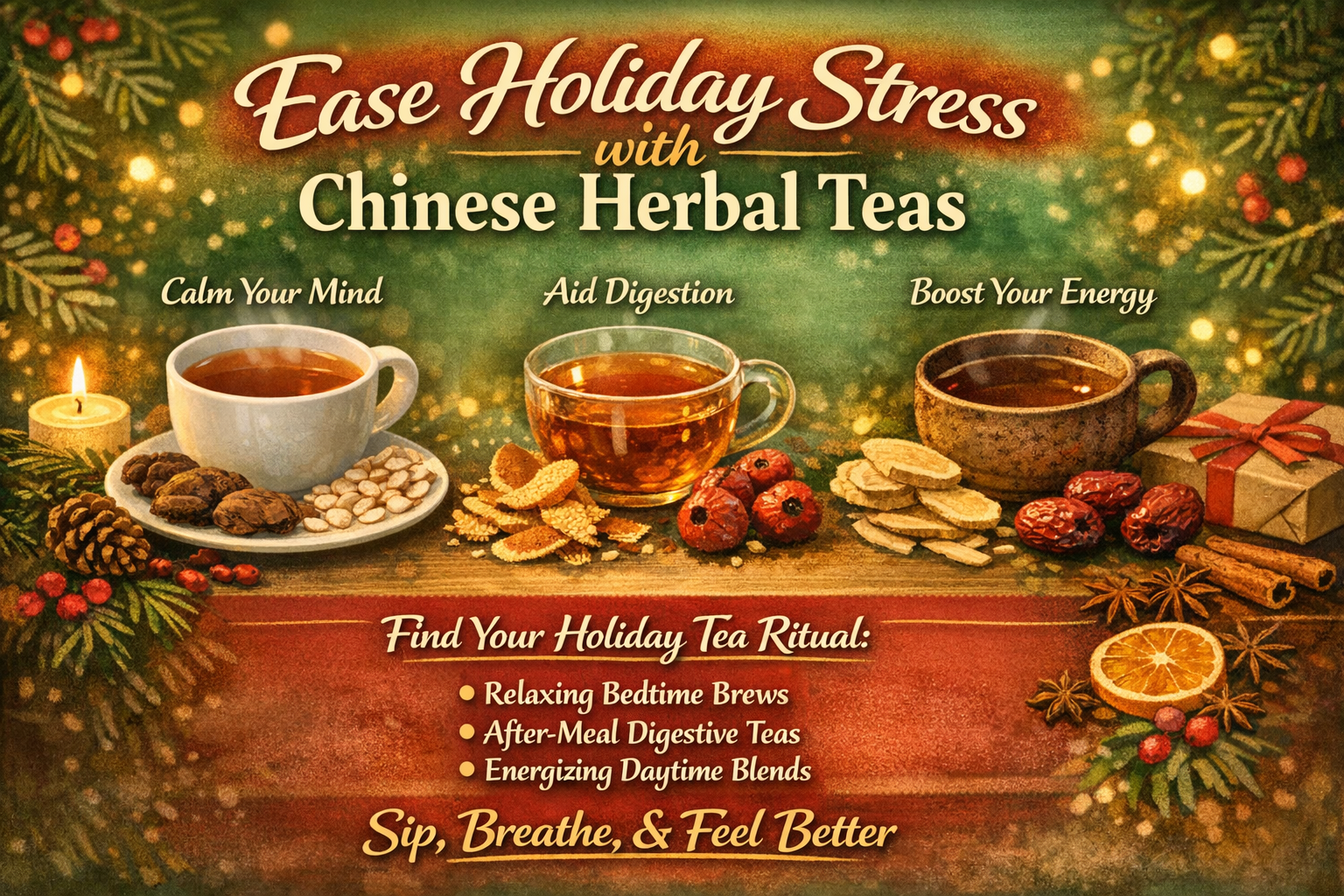
3 simple Chinese herbal tea recipes (you can actually do these)
Recipe 1: “Calm-Down Cup” (evening)
Best for: racing mind, tense evenings, winding down.
- Fu Shen: 6–10g
- Bai Zi Ren: 3–6g
- Optional: 1–2 red dates for flavor
Make it: Simmer gently 20–25 minutes. Sip warm 30–60 minutes before bed.
Recipe 2: “After-the-Meal Reset” (digestive comfort)
Best for: heavy meals, bloating, after-dinner heaviness.
- Chen Pi: 3–6g
- Shan Zha: 6–10g
- Optional: a thin slice of ginger
Make it: Steep 10–15 minutes (or lightly simmer 15 minutes). Drink warm after meals.
Recipe 3: “Resilience Tea” (daytime)
Best for: tired days, low resilience, “I have too much to do” energy.
- Huang Qi slices: 10–15g
- Da Zao (red dates): 2–4
- Optional: pinch of cinnamon
Make it: Simmer 25–40 minutes. Sip in the morning or early afternoon.
How to use bulk herbs vs extract powders vs teapills (choose your easiest option)
This is where most people get stuck. Here’s the simplest way to choose:
- Bulk herbs (tea/decoction): best if you enjoy brewing and want a traditional ritual.
- Extract powders: best if you want convenience and consistent daily use (mix into warm water or tea).
- Teapills: best for travel, busy schedules, or anyone who wants a “take-and-go” routine.
Mini How-To: Brewing Basics
Roots/barks: simmer 20–40 minutes (decoction).
Flowers/leaves: steep 10–15 minutes (infusion).
Start simple: one tea for 7 days beats six teas for two days.
Safety: who should ask first (and how to keep it simple)
- Pregnancy/breastfeeding: avoid self-prescribing; seek qualified guidance.
- Medications: check with a clinician if you use sedatives, antidepressants, blood thinners, immune medicines, or diabetes medicines.
- Sensitivity: start with one tea at a time for 7–10 days.
Warm reminder: Tea is meant to be supportive. If anything makes you feel “off,” pause and get guidance.
Shop: build your holiday tea plan (3 easy paths)
You don’t need a complicated cabinet. Choose the path that fits your life.
Path 1: Brew-at-Home Bulk Tea Kit
Best for: cozy ritual lovers.
- Fu Shen + Bai Zi Ren
- Chen Pi + Shan Zha
- Huang Qi + Da Zao
Path 2: Quick-Mix Extract Powders
Best for: busy schedules, consistent daily use.
Mix into warm water or tea—fast, simple, repeatable.
Path 3: Travel-Friendly Teapills
Best for: travel, workdays, “I’m not brewing anything.”
A consistent routine is often the biggest win.
Not sure what to choose?
Tell us your top 2 goals: sleep, digestion, daytime resilience, or calm. We’ll recommend a simple starting option.
FAQs: Holiday Stress + Chinese Herbal Tea
Do calming teas work like sleeping pills?
No. Calming teas don’t “knock you out.” They work best as gentle support alongside a routine (dim lights, no screens, consistent bedtime).
How fast will I feel something?
Some people feel a subtle shift quickly; many notice benefits gradually over 1–3 weeks of consistent use.
Can I drink these teas every day?
Many people do, but it depends on your medications and health conditions. Start simple and check with a qualified clinician if unsure.
What if stress shows up as both insomnia and digestion issues?
Pick the most disruptive symptom first for 7–10 days, then adjust. You can also use a digestion tea after meals and a calming tea in the evening—keeping each blend simple.
What’s the best tea for stress during the holidays?
The best tea is the one you’ll use consistently. Many people start with a calming evening tea (Fu Shen + Bai Zi Ren) and a simple digestion tea (Chen Pi + Shan Zha) after heavy meals.
Is tea safe with medications?
It depends. If you take sedatives, antidepressants, blood thinners, immune medicines, or diabetes medicines, check with a clinician first.
Why people trust 1st Chinese Herbs
Our Editorial Promise
- Experience: We’ve supplied bulk Chinese herbs and teapills for decades and learn from customer feedback about what’s practical.
- Expertise: We explain traditional use and preparation methods clearly, without overpromising.
- Authority: We aim to cite reputable sources when discussing general wellness topics, and we label claims responsibly.
- Trust: COAs may be available upon request, and quality and sourcing transparency matter.
A warm note from us
The holidays don’t have to be perfect to be meaningful. If you can create one small ritual—one cup of tea at the same time each day—you give your body a steady signal: we can soften. That’s not small. That’s how change starts.