

Zhi Shi – Immature Bitter Orange Fruit – Cut Form – ActiveHerb – 1 lb
Zhi Shi, also known as immature bitter orange fruit, is the dried young fruit of Citrus aurantium. It has a long history of use in traditional Chinese herbal practice and is commonly selected as an ingredient in professionally designed herbal formulas.
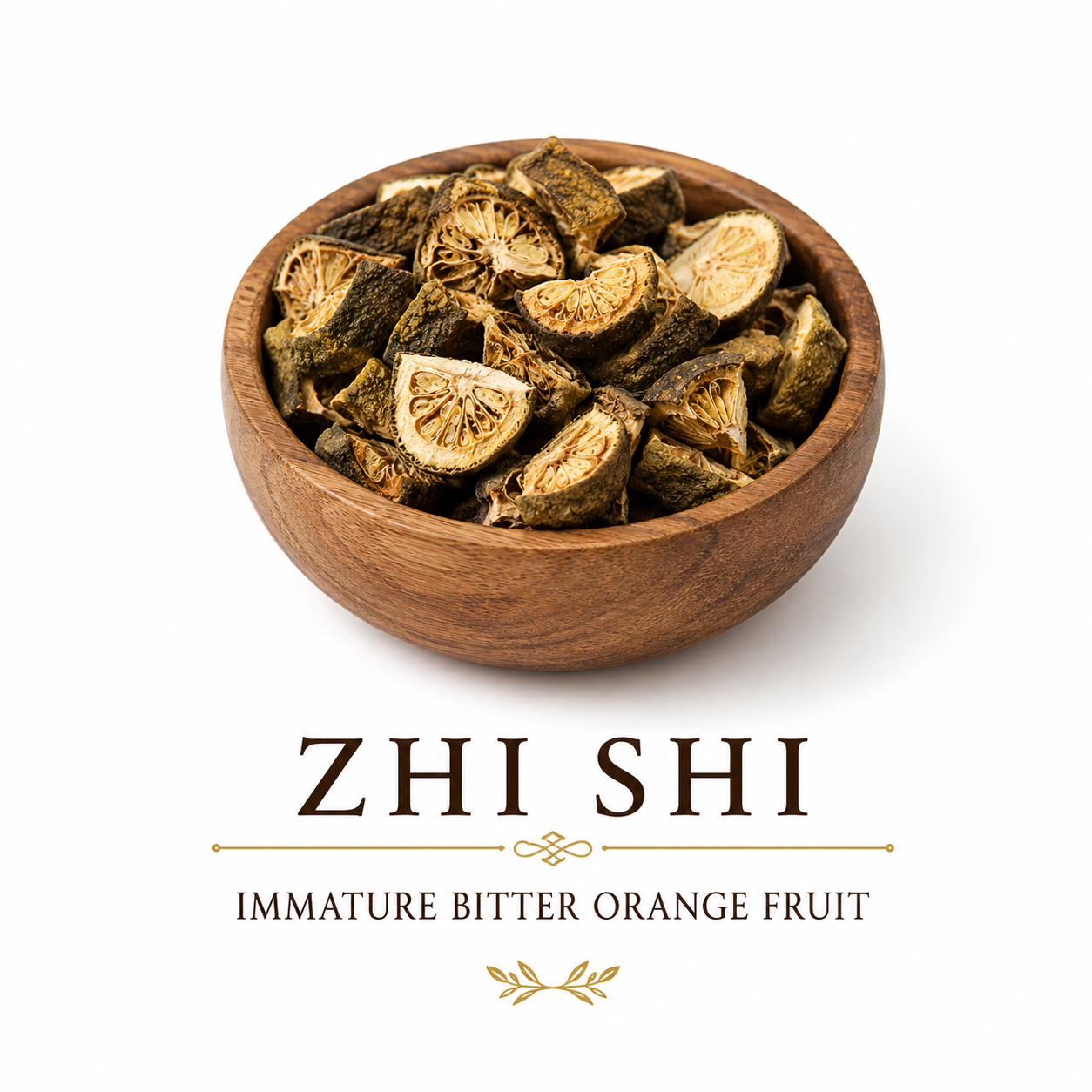
This one-pound package from ActiveHerb contains Zhi Shi in a convenient cut form. The smaller pieces are ready to measure and traditionally decoct, eliminating the need to cut or break apart hard whole fruits at home.
Customers choose Zhi Shi when they want a traditional bulk herb with clear botanical identification, carefully controlled processing and convenient preparation. Its distinct bitter citrus aroma and firm, dense pieces reflect the qualities expected from properly harvested immature fruit.
Product Highlights Of Zhi Shi
| Product name | Zhi Shi Cut |
|---|---|
| Common name | Immature Bitter Orange Fruit |
| Botanical name | Citrus aurantium |
| Traditional Latin name | Fructus Aurantii Immaturus |
| Pin Yin name | Zhi Shi |
| Plant family | Rutaceae |
| Plant part | Immature fruit |
| Form | Cut / sliced |
| Brand | ActiveHerb |
| Package size | 1 pound / 16 ounces |
| Origin | China |
What Is Zhi Shi?
Zhi Shi is the dried immature fruit of bitter orange. The fruits are collected while still young rather than being allowed to develop into fully mature oranges. After harvesting, they are cleaned, cut or sliced and carefully dried for storage and traditional herbal preparation.
The name Zhi Shi is commonly translated as “immature bitter orange” or “bitter orange young fruit.” Other names may include Fructus Aurantii Immaturus, Fructus Immaturus Citri Aurantii and immature fruit of bitter orange.
Zhi Shi should not be confused with sweet orange slices used as a food or beverage flavoring. It is a strong, distinctly bitter traditional herb that is generally prepared as part of a decoction or herbal formula rather than consumed as an ordinary fruit tea.
The Important Difference: Immature Versus Mature Fruit
One of the most useful things to understand about Zhi Shi is that its immature stage is intentional. Traditional herbalists do not simply select any bitter orange fruit. The fruit’s age, density, aroma and degree of maturity help determine its traditional identity and use.
Zhi Shi is harvested when the fruit is relatively small, firm and concentrated. A related herb called Zhi Ke is harvested at a later stage of development. Although both may come from bitter-orange plants, they are treated as distinct ingredients in traditional Chinese herbal practice.
This is why correct identification and harvesting at the appropriate stage matter. A mature citrus slice cannot automatically be substituted for properly prepared Zhi Shi.
Traditional Chinese Herbal Information
The following information describes the historical use of Zhi Shi within traditional Chinese herbal theory. These terms are part of a traditional system of classification and are not statements that the product diagnoses, treats, cures or prevents a disease.
| Traditional taste | Bitter, acrid and sour |
|---|---|
| Traditional temperature | Warm |
| Traditionally associated channels | Spleen and Stomach |
| Traditional category | Herbs traditionally used to address accumulation and constrained movement of Qi |
Why Traditional Herbalists Choose Zhi Shi
In traditional Chinese herbal literature, Zhi Shi is described as strongly moving and dispersing. It has traditionally been included in formulas intended to address patterns described as stagnant Qi, retained food, accumulation, focal fullness and phlegm-related obstruction.
Traditional descriptions may say that Zhi Shi:
- Breaks up stagnant Qi and disperses accumulation
- Supports the traditional movement and regulation of Qi
- Transforms phlegm and disperses focal fullness
- Supports normal elimination when used in an appropriate traditional formula
- Helps address traditional patterns associated with retained food
These descriptions reflect historical Chinese herbal terminology. Zhi Shi is often combined with other herbs rather than used by itself. The appropriate combination depends on the individual, the traditional pattern being addressed and the overall purpose of the formula.
Understanding Zhi Shi. Zhi Shi is not valued because it tastes like orange. It is valued because the fruit is harvested early, while it is still small, firm and intensely bitter. That intentional early harvest is what distinguishes it from ordinary dried citrus and from the later-harvested herb Zhi Ke.
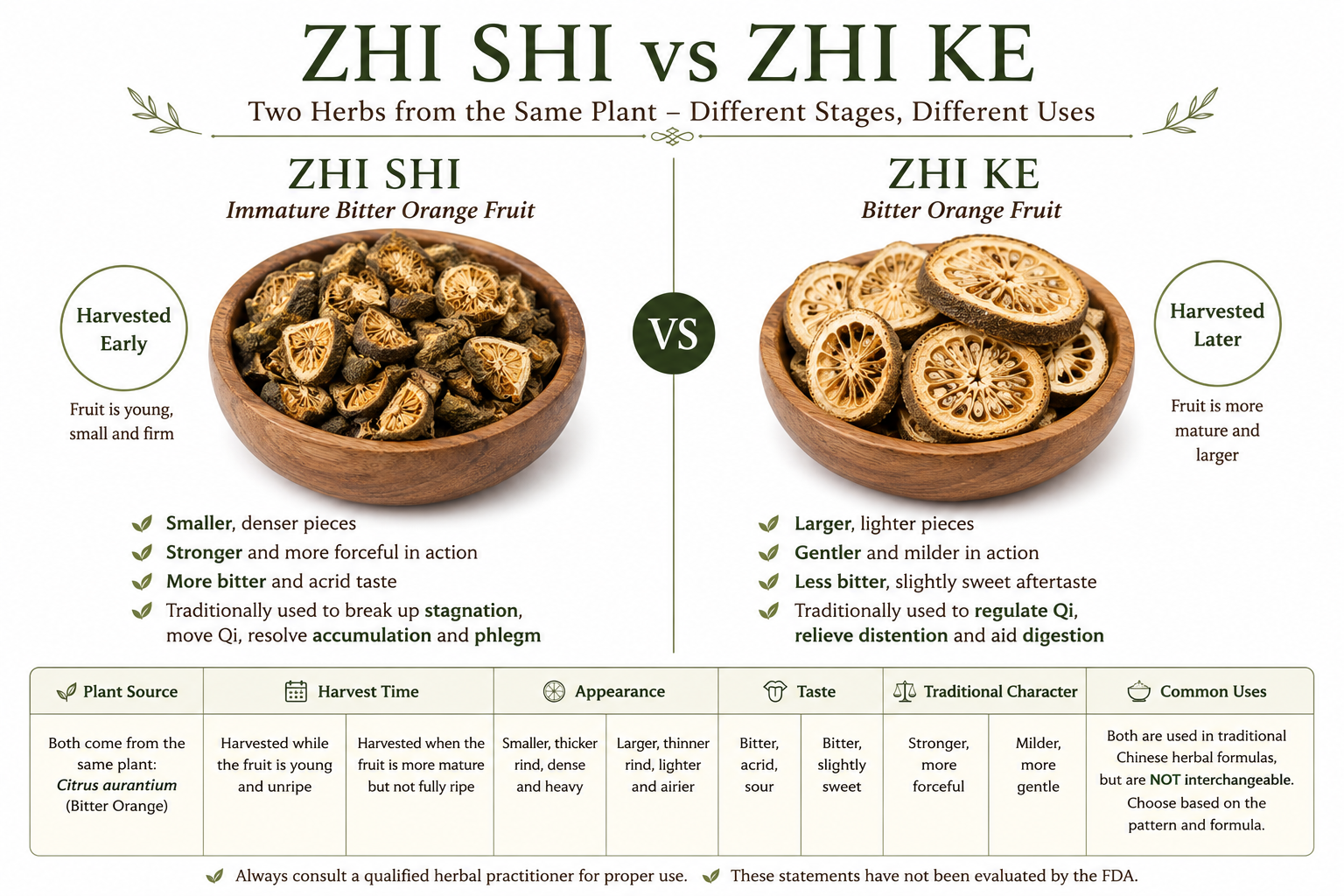
Zhi Shi Compared With Zhi Ke
Zhi Shi and Zhi Ke are sometimes confused because both are associated with bitter orange. They are not always interchangeable.
| Feature | Zhi Shi | Zhi Ke |
|---|---|---|
| Harvest stage | Collected while the fruit is younger and less developed | Collected at a later stage of maturity |
| Typical appearance | Smaller, denser pieces with a firm texture | Larger, more developed fruit pieces |
| Traditional character | Generally considered stronger and more forcefully moving | Generally regarded as gentler in traditional practice |
| Substitution | Do not substitute one for the other in a professional formula without consulting the practitioner who recommended it. | |
Why Choose Cut Zhi Shi?
Whole immature citrus fruits can be extremely hard and difficult to divide evenly. Cut Zhi Shi offers several practical advantages:
- It is easier to weigh accurately.
- The pieces can be added directly to a traditional decoction.
- More surface area is exposed to the simmering water.
- There is no need to cut hard dried fruit at home.
- The bulk format allows practitioners to combine it with other individual herbs.
Because natural herbs vary, the exact color, shape, thickness and size of the pieces may differ from one harvest to another. Natural variation does not automatically indicate a difference in quality.
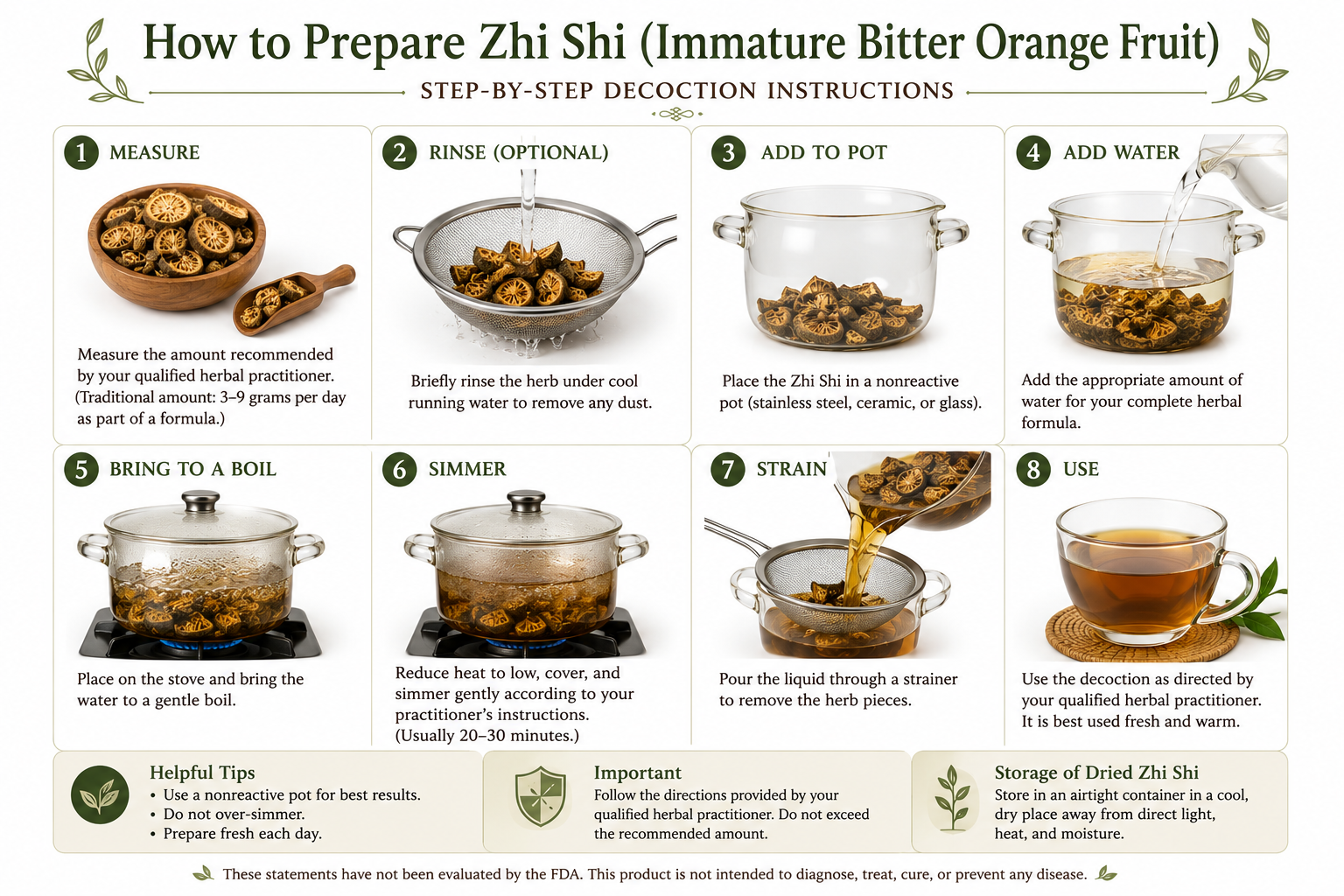
Learn the traditional step-by-step method for preparing Zhi Shi (Immature Bitter Orange Fruit) as a decoction.
How to Prepare Zhi Shi
Zhi Shi is most commonly prepared as a decoction. A decoction is made by gently simmering firmer plant materials in water to extract their water-soluble components.
Traditional Decoction Method
- Measure the amount recommended by your qualified herbal practitioner.
- Briefly rinse the cut herb under cool water if desired.
- Place it in a nonreactive stainless-steel, ceramic or glass pot.
- Add the amount of water required for your complete herbal formula.
- Bring the water to a gentle boil.
- Reduce the heat, cover and simmer according to your practitioner’s instructions.
- Strain the liquid before use.
ActiveHerb identifies a traditional bulk-herb amount of 3 to 9 grams per day. This is general historical information, not an individualized recommendation. Zhi Shi is a concentrated, strongly bitter herb and should preferably be used under the guidance of a qualified herbal professional.
Do not assume that more is better. Preparation time, amount and herbal combinations can change depending on the formula and the person using it.
Can Zhi Shi Be Used as an Everyday Tea?
Zhi Shi is not usually selected as a casual beverage tea. Its strong taste and traditional actions make it more appropriate for intentional herbal preparation. Customers seeking a pleasant citrus-flavored tea may prefer culinary orange peel rather than Zhi Shi.
How to Recognize Quality Zhi Shi
Quality begins with proper botanical identity, the correct plant part and harvesting at the appropriate stage of maturity. Appearance alone cannot verify every aspect of an herb, but good Zhi Shi commonly has several recognizable characteristics.
- Aroma: Noticeably bitter, citrus-like and aromatic rather than musty
- Texture: Firm and dry, without excessive dampness or softness
- Appearance: Dense immature fruit pieces with visible peel and interior structure
- Condition: Free from obvious mold, insects or unusual foreign material
- Taste: Intensely bitter, sour and somewhat acrid
Because this is a minimally processed agricultural product, differences in size, color and shape are normal. Proper identity testing and supplier quality controls are more meaningful than expecting every natural piece to look identical.
Why Choose ActiveHerb Zhi Shi?
ActiveHerb specializes in traditional Chinese herbal products and identifies this product by its Chinese name, common English name and botanical source. The herb is supplied in a sealed package to help protect it from moisture, air and outside contaminants during storage.
ActiveHerb states that its bulk herbs are selected with attention to the correct species, correct plant part and proper stage of maturity. The herbs are cleaned, cut or sliced and dried before packaging. Appropriate traditional processing may also be used when required for a particular herb.
Choosing a clearly identified professional herb brand is especially important for ingredients such as Zhi Shi, where the age and maturity of the fruit help distinguish it from related citrus materials.
Quality Features
- Botanical and Pin Yin identification
- Correct plant part and maturity
- Convenient cut or sliced form
- Sealed bulk packaging
- Produced under established quality-control procedures
- Certificate of Analysis may be available upon request
Storage Instructions
Keep Zhi Shi tightly sealed in its original package or transfer it to a clean, airtight container. Store it in a cool, dry location away from direct sunlight, steam, heat and strong odors.
Always use a clean, dry scoop. Moisture introduced into the bag may reduce shelf life and encourage deterioration. Do not store bulk herbs above a stove, beside a dishwasher, in a damp basement or in a bathroom.
Natural citrus aroma may gradually become less pronounced over time. For the best quality, follow the best-before information printed on the package.
Cautions and Important Safety Information
- Do not use during pregnancy or while breastfeeding unless specifically approved by a qualified healthcare professional.
- Consult a qualified practitioner before use if you have weak digestion, chronic digestive concerns or unexplained abdominal symptoms.
- Bitter orange naturally contains synephrine-related compounds that may affect heart rate or blood pressure in some people.
- Consult your physician before use if you have heart disease, high blood pressure, an abnormal heart rhythm, glaucoma, diabetes or another medical condition.
- Ask a pharmacist or physician about possible interactions if you take prescription medications, stimulants, decongestants, caffeine-containing supplements or weight-management products.
- Do not combine Zhi Shi with stimulant supplements unless your healthcare professional has approved the combination.
- Stop use and seek medical advice if you experience chest discomfort, a racing heartbeat, dizziness, severe headache or another unexpected reaction.
- Keep out of reach of children and pets.
California Proposition 65: California law requires warnings on certain products that may expose consumers to substances included on the state’s Proposition 65 list. Please review the Proposition 65 notice displayed on this product page or package.
Frequently Asked Questions
What does Zhi Shi taste like?
Zhi Shi has a strong bitter, sour and somewhat acrid citrus taste. It is considerably more intense than ordinary dried orange peel.
Is Zhi Shi the same as dried orange peel?
No. Zhi Shi is specifically prepared from immature bitter orange fruit. Ordinary culinary orange peel may come from mature sweet oranges and should not be considered an equivalent substitute.
Is Zhi Shi the same as Chen Pi?
No. Chen Pi is traditionally prepared from aged mature tangerine or mandarin peel. Zhi Shi consists of immature bitter-orange fruit and has a different traditional identity.
Is Zhi Shi the same as Zhi Ke?
They are related, but the fruits are harvested at different stages. Zhi Shi is collected younger and is traditionally considered more forcefully moving. Zhi Ke is harvested later and is generally regarded as gentler.
Does cut Zhi Shi need to be ground?
No. The cut pieces can normally be used directly in a decoction. Grinding is unnecessary unless a qualified practitioner has given specific preparation instructions.
Can I use Zhi Shi by itself?
Traditional Chinese herbalists commonly use Zhi Shi as one ingredient within a balanced formula. Professional guidance is recommended, particularly for people with medical conditions or those taking medications.
How much is in the package?
The package contains one pound, equivalent to 16 ounces, of cut or sliced Zhi Shi.
Why may the product look different from the photograph?
Zhi Shi is a natural agricultural product. Fruit size, color, thickness and cut may vary with the harvest. Product images are representative, but individual pieces will not be identical.
How long will one pound last?
That depends on the amount used in each formula and how frequently it is prepared. Follow the directions provided by your practitioner rather than estimating a serving based only on package size.
Is this a ready-to-drink tea?
No. This is a traditional bulk herb in cut form. It must be prepared before use and is not packaged in individual tea bags.
Why Buy Bulk Herbs From 1st Chinese Herbs?
Since 1994, 1st Chinese Herbs has helped customers, herbalists and practitioners find traditional Chinese and Western herbs with clear identification and dependable customer support.
- Serving herbal customers since 1994
- Ships from Washington State
- Carefully selected professional herb brands
- Botanical and Pin Yin names provided whenever available
- Friendly assistance before and after your purchase
- Certificates of Analysis available for qualifying products upon request
Questions before ordering? Our knowledgeable team is happy to help you choose the right product and answer any questions you may have.
The traditional information presented on this page is provided for historical and educational purposes only. It is not intended to replace advice from a physician, pharmacist or qualified herbal practitioner.
These statements have not been evaluated by the Food and Drug Administration. This product is not intended to diagnose, treat, cure or prevent any disease.