
Feeling Burned Out? How to Calm Your Nervous System Naturally (Reduce Stress & Cortisol)
Posted by 1st Chinese Herbs Research Team. on May 3rd 2026
Feeling Burned Out? How to Calm Your Nervous System Naturally (Reduce Stress & Cortisol)
Written by 1st Chinese Herbs Research Team • Last Updated: May 2026
Why You Still Feel Stressed
If you feel wired, tense, or unable to relax, your body is likely stuck in “on mode.” This is not a lack of solutions—it’s a nervous system that hasn’t reset. When stress builds up, your body stops switching off properly.
What’s Driving It
- Chronic stress or mental overload
- Poor or inconsistent sleep
- Too much stimulation (screens, caffeine)
- Irregular daily routines
- Energy spikes followed by crashes
- Poor Eating Habits
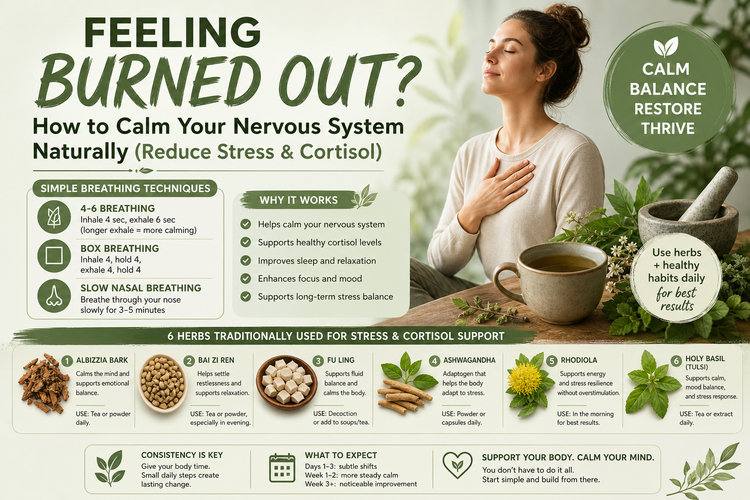
Simple Breathing Techniques That Actually Help
Breathing is one of the fastest ways to signal your body to relax.
- 4-6 Breathing: inhale 4 seconds, exhale 6 seconds (longer exhale = more calming)
- Box Breathing: inhale 4, hold 4, exhale 4, hold 4
- Slow Nasal Breathing: breathe through your nose slowly for 3–5 minutes
Do this once or twice daily. It sounds simple, but consistency matters.
6 Herbs Traditionally Used for Stress & Cortisol Support
1. Albizzia Bark (He Huan Pi)
Why it works: Traditionally used to support emotional balance and calm the mind.
How to use: Decoction (tea) daily or powdered form.
2. Bai Zi Ren (Biota Seed)
Why it works: Supports relaxation and helps settle restlessness.
How to use: Tea or powdered; often used in evening routines.
3. Fu Ling (Poria)
Why it works: Supports fluid balance and helps calm the body.
How to use: Decoction or added to soups and teas.
4. Ashwagandha
Why it works: Commonly used as an adaptogen to support stress response.
How to use: Powder or capsules, typically once or twice daily.
5. Rhodiola
Why it works: Supports energy and stress resilience without overstimulation.
How to use: Morning use preferred.
6. Holy Basil (Tulsi)
Why it works: Traditionally used to support calm and balance stress response.
How to use: Tea or extract, daily use.
Instead of guessing, many people begin with a simple combination that supports multiple aspects of stress at once.
Start with the Stress & Calm Herbal Kit
Why This Works Better
| Approach | Result |
|---|---|
| Random supplements | Inconsistent |
| Single herb | Limited |
| Simple herbal system | Balanced support |
What to Expect
- Days 1–3: subtle shifts
- Week 1–2: more steady calm
- Week 3+: noticeable improvement
This is not instant—but it builds.
If You’re Not Sure Where to Start
How to Use Bulk Herbs
Common Mistakes
Shop the Stress & Calm Bundle
References
Ashwagandha & cortisol:
https://pmc.ncbi.nlm.nih.gov/articles/PMC9737923/
Adaptogens & stress response:
https://pmc.ncbi.nlm.nih.gov/articles/PMC7756641/
Rhodiola & stress:
https://pmc.ncbi.nlm.nih.gov/articles/PMC11858268/
Holy basil (tulsi) overview:
https://www.va.gov/WHOLEHEALTHLIBRARY/tools/adaptogens.asp
Herbal support for anxiety:
https://pmc.ncbi.nlm.nih.gov/articles/PMC5938102/
This information is based on published research and traditional use. Always consult a qualified professional before making changes to your routine.
These statements have not been evaluated by the FDA. This content is for educational purposes only.