How To Spot False Herbal Claims
Posted by Sarah Johnson on Aug 1st 2026
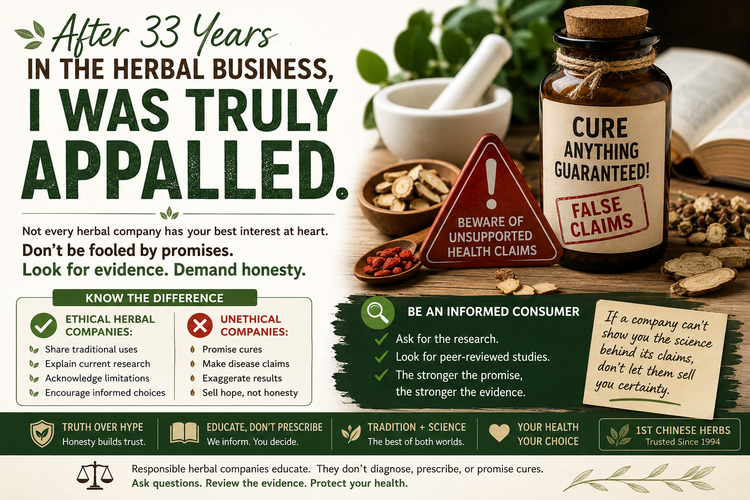
After 33 Years in the Herbal Business, I Was Honestly Appalled
In more than 33 years of helping people learn about herbs, I thought I had heard just about everything.
Apparently, I was wrong.
Recently, a customer called our office looking for information about a particular herb. As we talked, they kept comparing my answers to what another herbal company had told them.
Then they repeated something that literally stopped me in my tracks.
According to the customer, the other company had confidently stated that a single herb would cure their medical condition.
I couldn't believe what I was hearing.
Not because herbs don't have a long and fascinating history of traditional use—they absolutely do.
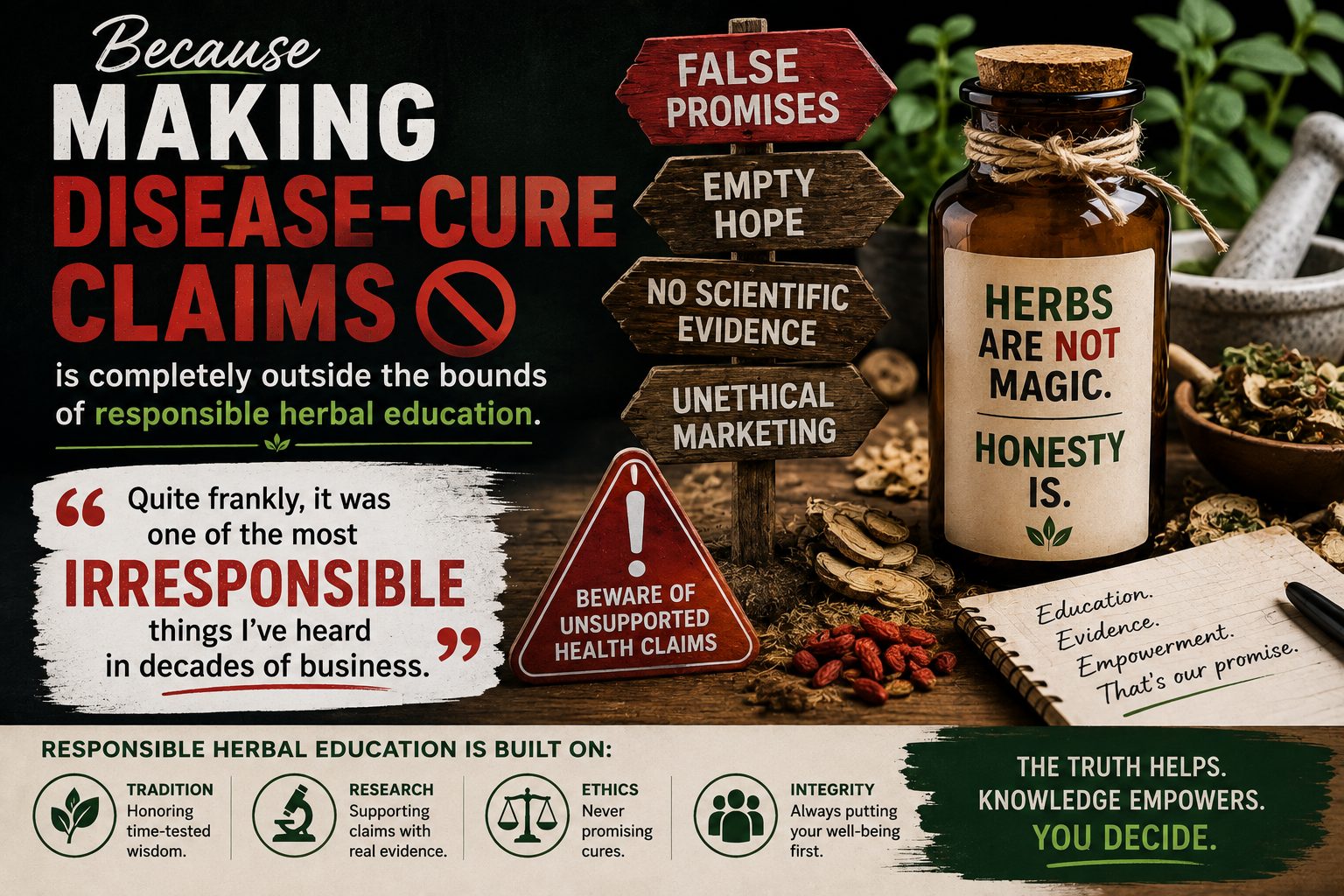
But because making disease-cure claims is completely outside the bounds of responsible herbal education.
Quite frankly, it was one of the most irresponsible things I've heard in decades of business.
This Is Where the Line Gets Crossed
There is a world of difference between educating someone about the traditional use of an herb and telling them that an herb will cure a disease.
One is education.
The other is making promises that no ethical herbal company should make.
When someone is frightened, in pain, or desperately searching for answers, it becomes very easy to believe anyone who sounds confident.
That's exactly why companies have a responsibility to choose their words carefully.
Customers deserve facts—not promises.
Herbs Are Not Prescriptions
One thing every consumer should remember is this:
An herbal company should not be acting as your physician.
If someone on the phone is telling you exactly what herb you need to treat or cure a disease, you should immediately become a more cautious consumer.
A reputable company can explain:
- How an herb has traditionally been used.
- What modern research has explored.
- How the herb is commonly prepared.
- Safety considerations.
But promising medical outcomes is an entirely different matter.
Don't Just Take Anyone's Word for It
This is the advice I gave that customer, and it's the advice I'd give anyone.
If a company makes a bold claim about an herb, ask them to show you the evidence.
Not testimonials.
Not marketing copy.
Not "We've seen it work."
Ask for published scientific research.
Ask for peer-reviewed studies.
Ask where the information came from.
A trustworthy company should welcome those questions.
In fact, they should be asking those questions themselves before making extraordinary claims.
Extraordinary Claims Require Extraordinary Evidence
The more dramatic the promise...
The stronger the evidence should be.
If someone tells you:
"This herb cures..."
or
"This will fix..."
or
"You don't need anything else..."
your next question should be:
"Can you show me the research that supports that claim?"
If they can't...
That should tell you everything you need to know.
Our Philosophy Has Never Changed
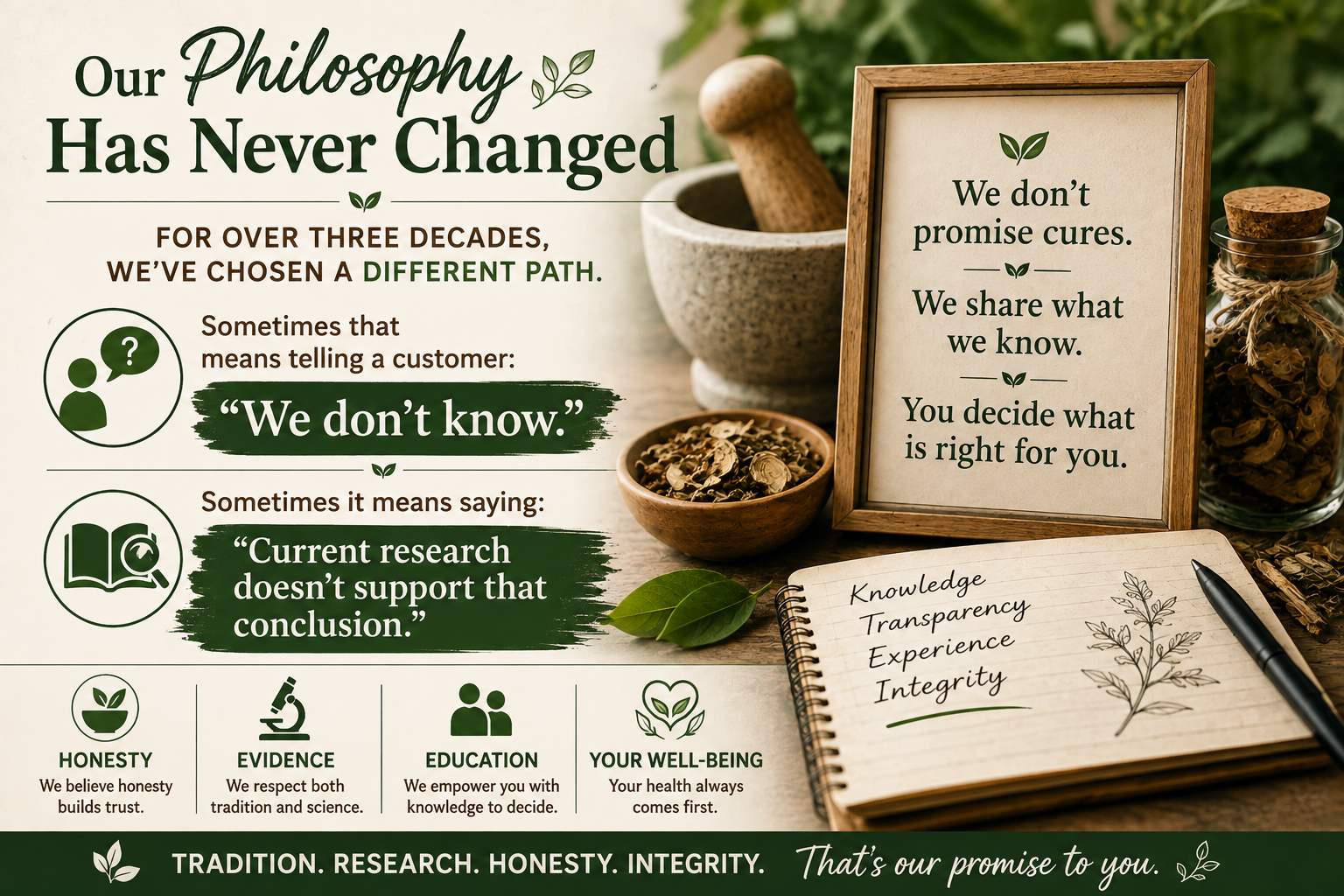
For over three decades, we've chosen a different path.
Sometimes that means telling a customer:
"We don't know."
Sometimes it means saying:
"Current research doesn't support that conclusion."
Sometimes it means explaining that an herb has a long history of traditional use, while also acknowledging that more high-quality research is needed.
Those aren't always the answers people hope to hear.
But they're honest.
And honesty builds trust.
The Bottom Line
Herbs deserve respect.
Customers deserve honesty.
And hope should never be sold through promises that can't be supported.
If you're researching herbs, don't settle for confident opinions alone.
Look for companies that educate instead of exaggerate.
Look for businesses willing to discuss both the strengths and the limitations of the available evidence.
Most importantly, don't be afraid to ask:
"Can you show me the research?"
After 33 years in this industry, I still believe that's one of the most important questions any customer can ask.
If it sounds too good to be true.... It probably isn't true.
References
Federal Trade Commission. Health Products Compliance Guidance
https://www.ftc.gov/business-guidance/resources/health-products-compliance-guidance
Federal Trade Commission. Health Claims (Truth in Advertising)
https://www.ftc.gov/business-guidance/advertising-marketing/health-claims
Ashar BH, Miller RG. Dietary Supplement Labeling and Advertising Claims. Medical Clinics of North America.
https://pubmed.ncbi.nlm.nih.gov/19998572/
Ellwood KC, Trumbo PR, Kavanaugh CJ. How the FDA Evaluates Scientific Evidence for Health Claims.
https://pubmed.ncbi.nlm.nih.gov/20137056/
Cohen PA. Too Little, Too Late: Ineffective Regulation of Dietary Supplements in the United States.
https://pubmed.ncbi.nlm.nih.gov/25602879/