
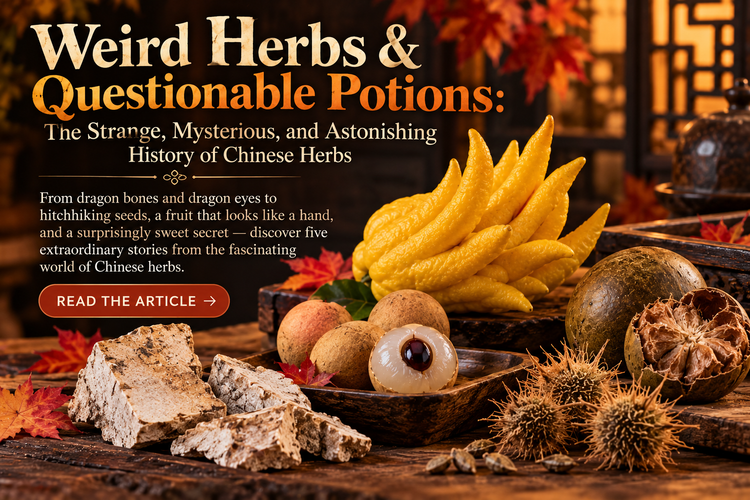
Weird Herbs & Questionable Potions: 5 Astonishing Secrets of Chinese Herbal History
Posted by 1st Chinese Herbs Research Team. on Oct 19th 2026
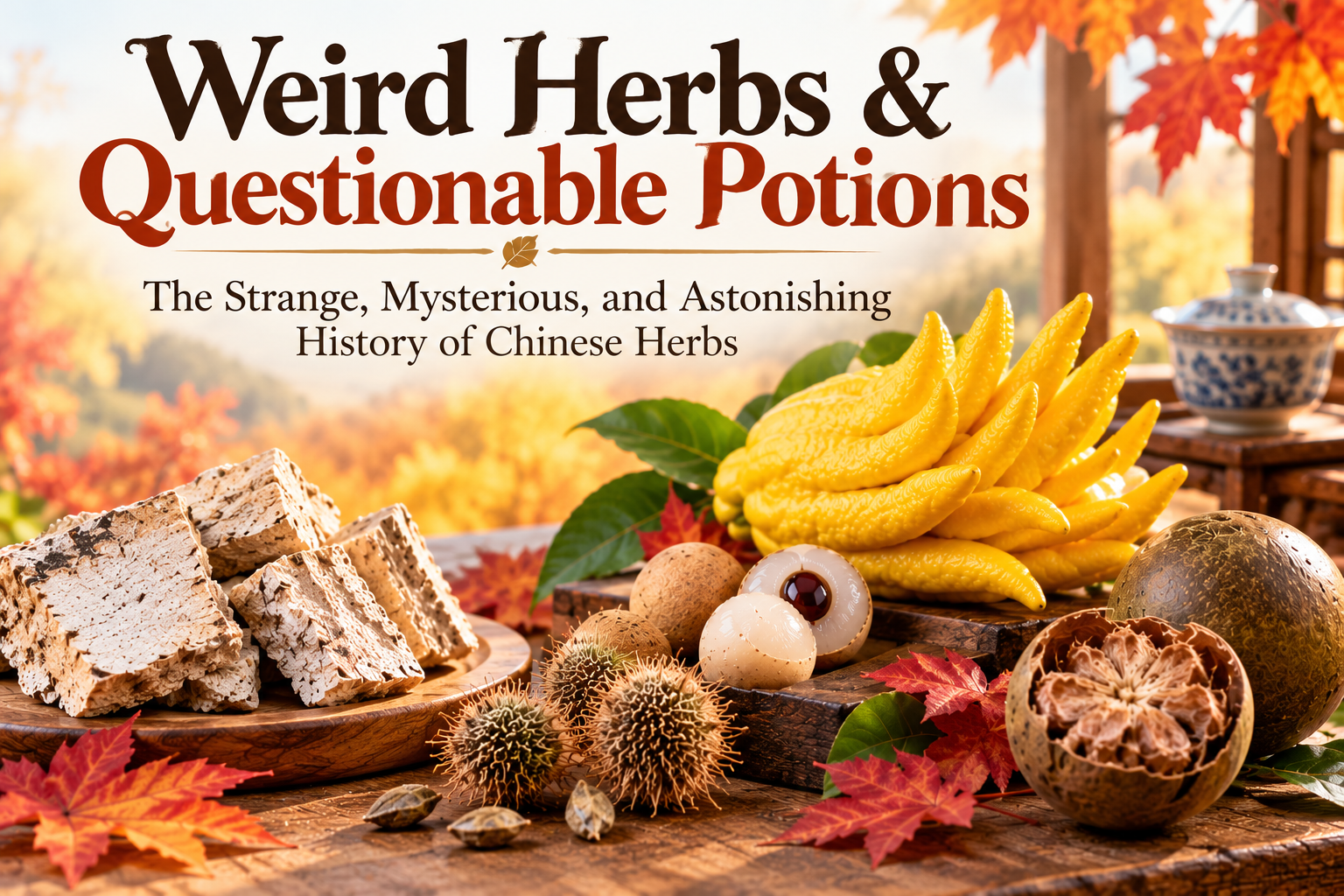
Weird Herbs & Questionable Potions: The Strange, Mysterious, and Astonishing History of Chinese Herbs
Dragon bones, mysterious fruits, botanical hitchhikers, and five extraordinary stories from the fascinating world of traditional Chinese herbs.
Long before Chinese herbs arrived in neatly labeled packages with botanical names, laboratory reports, and expiration dates, they had a rather mysterious reputation.
Some were believed to be treasures of the earth. Others appeared in ancient medical texts, imperial gardens, and legends passed down through generations.
And a few had names so unusual that you might wonder whether someone was preparing an herbal formula or inventing a story to frighten the neighbors.
As the fall season arrives, evenings grow cooler, leaves turn brilliant shades of gold and crimson, and there's something especially inviting about settling into a comfortable chair with a warm cup of tea and an extraordinary story.
It's the perfect time to open the creaky doors of an ancient Chinese apothecary.
Inside, we'll discover dragon bones that helped reveal ancient writing, a fruit that resembles a dragon's eye, seeds that hitchhike on unsuspecting travelers, a citrus fruit shaped like a hand, and a humble fruit with an astonishing secret.
Some stories are folklore. Others are documented history. And a few are remarkable examples of nature's ingenuity.
So pour yourself a warm cup of tea, settle into your favorite chair, and join us.
Just remember: Not everything in an ancient herbal cabinet belongs in your teacup.
1. Long Gu (Dragon Bone): The Ancient Fossils That Helped Reveal a Lost World
Imagine walking into an old Chinese herbal shop and asking for dragon bones.
The shopkeeper reaches into a wooden drawer and hands you pieces of pale, weathered material.
You examine them carefully.
No scales. No claws. No evidence of fire-breathing.
Just what appears to be very old bone.
And here's where the story becomes astonishing.
Long Gu (龙骨), meaning "Dragon Bone," is a traditional Chinese medicinal material consisting of fossilized animal bones and related fossil materials.
A Little History: How Did Dragon Bones Become Part of Chinese Medicine?
Long Gu has been described in traditional Chinese herbal literature for many centuries.
Ancient Chinese people encountered fossils long before modern paleontology existed. Without today's scientific understanding of prehistoric animals, unusual fossilized remains could inspire stories involving dragons and other extraordinary creatures.
In classical Chinese medicine, Long Gu was categorized among mineral-like substances traditionally associated with calming and settling functions within the historical medical system.
Those descriptions reflect traditional theory, not proof of modern clinical effects.
But Long Gu has another story—one that changed our understanding of Chinese civilization.
The Discovery That Changed History
In 1899, Chinese scholars began recognizing ancient inscriptions on bones and turtle shells that had circulated through medicinal-material markets.
The discovery is traditionally associated with the scholar Wang Yirong, although details of the famous account have been debated by historians.
The inscriptions became known as oracle bone script.
Many date to the Shang dynasty, more than 3,000 years ago.
These ancient writings recorded questions about matters such as harvests, weather, warfare, and royal affairs.
The discovery helped scholars better understand early Chinese writing and the history of the Shang royal court.
Not every medicinal dragon bone was an inscribed oracle bone, but the connection between medicinal-material markets and archaeological discovery is remarkable.
The astonishing truth: Materials once sold under the mysterious name "Dragon Bone" helped draw attention to some of the earliest surviving Chinese writing.
Imagine asking an herbal shopkeeper for dragon bones and accidentally uncovering a piece of ancient history.
That's considerably more exciting than finding an expired coupon in your kitchen drawer.
Historical note: Long Gu is included here for its cultural and archaeological importance, not as a recommendation for use.
2. Long Yan Rou (Dragon Eye Fruit): The Fruit With a Legendary Name
Imagine reaching into a basket of fruit and discovering something called a dragon's eye.
Would you eat it?
Would you wonder where the rest of the dragon went?
Would you ask whether the other eye was available?
Fortunately, Long Yan Rou (龙眼肉) is not a mythical creature's eyeball.
It is the dried flesh of the longan fruit, Dimocarpus longan.
And its name has a perfectly reasonable explanation.
Well, reasonable by the standards of people who enjoy naming fruit after dragons.
A Little History: Why Is Longan Called Dragon Eye?
Longan has been cultivated and enjoyed in southern China and other parts of Asia for many centuries.
Its Chinese name, Long Yan, translates to "Dragon Eye."
When a fresh longan is peeled, the translucent flesh surrounds a shiny, dark seed.
The appearance resembles an eyeball.
And somewhere in history, someone decided it looked like the eye of a dragon.
The name stayed.
Longan became valued as a food and appeared in traditional Chinese culinary preparations, including sweet soups and desserts.
Dried longan flesh also became a familiar ingredient in traditional Chinese herbal literature.
Why Is Long Yan Rou Important in Chinese Herbal Tradition?
Within classical Chinese medicine, Long Yan Rou is traditionally categorized as a sweet, warm substance associated with nourishing Blood and supporting the Heart and Spleen.
These are traditional classifications rather than established modern medical treatment claims.
Beyond herbal traditions, longan remains important as a culturally familiar fruit used in cooking and festive foods.
Scientists have also studied its natural plant compounds, including polysaccharides and phenolic constituents.
These studies explore its chemistry but do not establish that eating longan treats particular diseases.
The astonishing truth: A fruit that resembles an eyeball became both a traditional herbal ingredient and a beloved culinary food.
And unlike the dragon bones we just discussed, this dragon-themed ingredient is an actual fruit.
No dragons were harmed.
No mysterious creatures were disturbed.
Just a rather imaginative name.
Scientific reading: PubMed research on longan fruit, its chemistry, and traditional uses
3. Cang Er Zi (Cocklebur Fruit): The Little Hitchhiker With a Hidden Talent
Imagine taking a peaceful walk on a crisp fall afternoon.
The leaves are turning gold.
The air smells of autumn.
You're enjoying the scenery.
Then you get home and discover that half the countryside appears to have attached itself to your socks.
Congratulations.
You've probably met a plant that knows how to travel without walking.
Cang Er Zi (苍耳子) is the Chinese herbal name for cocklebur fruit, associated with Xanthium species, including Xanthium sibiricum in traditional Chinese materia medica.
The fruit develops a hard, prickly covering with hooked structures.
And those hooks have a very important job.
A Little History: Why Were These Strange Burs Noticed?
Cockleburs have been familiar plants across many regions for centuries.
Their unusual fruits are difficult to overlook, especially when they attach themselves to clothing or animal fur.
In Chinese herbal literature, Cang Er Zi became a recognized medicinal material with traditional classifications associated with wind-related patterns and the nasal passages.
Those historical categories are part of Chinese medical theory, not recommendations for self-treatment.
But the plant's most entertaining feature has nothing to do with traditional medicine.
It's the way the seeds travel.
Nature Invented a Transportation System
Cocklebur burs attach to passing animals, clothing, and other suitable surfaces.
As the animal or person moves, the fruit travels along.
Eventually, it falls off somewhere else, helping spread the plant's seeds.
No legs.
No wheels.
No postage required.
This type of seed dispersal is known as epizoochory, meaning dispersal by attachment to the outside of animals.
Hooked plant burs also helped inspire the development of hook-and-loop fastening technology, although the famous invention story specifically involves burdock rather than cocklebur.
The astonishing truth: Plants developed effective hitchhiking systems long before humans invented automobiles.
And some of those systems are still remarkably good at ruining a perfectly nice pair of socks.
An Important Safety Lesson
Cocklebur is a particularly good example of why unusual plants should never be assumed safe simply because they have a history in herbal medicine.
Certain cocklebur species and plant parts contain toxic compounds, including carboxyatractyloside. Poisoning can be severe.
Traditional Chinese herbal processing methods and professional identification are important historical topics, but they do not make casual home preparation safe.
This is a plant to admire for its unusual biology—not something to collect and brew yourself.
Scientific reading: PubMed research on Xanthium, cocklebur chemistry, and toxicity
4. Fo Shou (Buddha's Hand Citron): The Fruit That Looks Like It's Reaching for You
Imagine walking into your kitchen on a chilly fall morning.
There's a basket of fruit on the counter.
Apples.
Oranges.
Maybe a lemon.
And then you notice something that looks like a bright yellow hand reaching out of the basket.
Would you pick it up?
Or would you wait to see whether it moved?
Meet Fo Shou (佛手), commonly called Buddha's Hand Citron.
Its botanical identity is generally given as Citrus medica var. sarcodactylis.
Unlike an ordinary lemon, Buddha's Hand develops long, finger-like segments that can resemble an open or closed hand.
Some fruits have fingers that spread outward.
Others appear to be clasped together.
And almost all of them look as though nature was feeling particularly creative.
A Little History: Why Was It Called Buddha's Hand?
The name comes from the fruit's resemblance to a hand, often interpreted as a hand in a gesture associated with Buddhist imagery.
Buddha's Hand has a long history in Chinese culture.
It became associated with good fortune, happiness, and longevity, and has been displayed as a fragrant offering or decorative fruit.
Its distinctive appearance also made it a popular subject in Chinese art.
In some traditional settings, the fruit was appreciated for its fragrance as much as for its appearance.
Why Is Fo Shou Important?
Fo Shou appears in traditional Chinese herbal literature, where it is classified within the historical system of regulating Qi.
The aromatic rind contains naturally occurring volatile compounds responsible for its distinctive citrus fragrance.
Scientists have investigated the fruit's essential oils and other plant constituents.
In culinary settings, food-grade Buddha's Hand citron can also be used for its fragrant peel and zest.
Unlike many citrus fruits, it often contains very little juicy pulp.
The astonishing truth: A fruit shaped like a hand became an artistic symbol, a fragrant household treasure, a culinary ingredient, and a traditional Chinese herbal material.
Imagine placing one in an autumn fruit bowl.
Someone is bound to ask:
"Why is the lemon trying to grab me?"
Scientific reading: PubMed research on Buddha's Hand Citron
5. Luo Han Guo (Monk Fruit): The Wrinkled Little Fruit With a Sweet Secret
Now for our final mystery.
Imagine someone handing you a small, round, dried fruit.
It's brown.
It's wrinkled.
It looks a little like something forgotten in the back of a kitchen cupboard.
Then they tell you that this unusual fruit contains compounds with remarkable sweetness.
You might be forgiven for looking suspicious.
Meet Luo Han Guo (罗汉果), commonly known as Monk Fruit.
Its botanical name is Siraitia grosvenorii.
A Little History: Where Did Monk Fruit Get Its Name?
Monk Fruit has a long association with southern China, particularly the Guangxi region.
The name Luo Han Guo is often connected with the term luohan, used in Chinese Buddhist traditions for an arhat, a spiritually accomplished figure.
Stories linking the fruit with monks form part of its cultural history, although the precise origins of the name are not firmly established.
The fruit became familiar in regional food and beverage traditions.
Dried Monk Fruit has traditionally been used in beverages and culinary preparations.
But its most surprising characteristic lies in its chemistry.
Why Is Monk Fruit So Sweet?
Monk Fruit contains naturally occurring compounds called mogrosides.
Certain mogrosides have an intensely sweet taste.
Concentrated, purified Monk Fruit sweeteners can be substantially sweeter than ordinary table sugar, depending on the composition and concentration.
That doesn't mean every dried Monk Fruit has the same sweetness as a commercial extract.
Whole dried fruit and concentrated sweetener products are different preparations.
The fruit's unusual sweetness has attracted scientific and commercial interest, and Monk Fruit extracts are now used in various food products.
The astonishing truth: A small, wrinkled fruit contains naturally occurring compounds that can deliver remarkable sweetness.
It's a wonderful reminder that appearance can be deceiving.
A beautiful fruit might be ordinary.
A rather unattractive one might be hiding a remarkable chemical secret.
And that's a lesson worth remembering the next time you're sorting through the produce aisle.
Scientific reading: PubMed research on Monk Fruit and mogrosides
What Was Really Inside Those Ancient Chinese Herbal Cabinets?
Now imagine stepping into a Chinese herbal shop hundreds of years ago.
Wooden drawers line the walls.
Dried roots, fruits, and botanical materials are carefully arranged.
A traditional scale sits on the counter.
The air carries the earthy fragrance of dried plants.
Someone examines a curious-looking fruit.
Another person studies a fossil.
And somewhere, a merchant is probably explaining why something called Dragon Eye isn't nearly as alarming as it sounds.
There are no computers.
No online shopping carts.
No barcode scanners.
And certainly no next-day delivery.
But there is something extraordinary.
Generations of botanical observation, cultural tradition, written records, and remarkable stories.
Chinese materia medica developed over many centuries and included not only plants but also fungi, minerals, and historically some animal-derived materials.
Traditional practitioners developed elaborate systems of identification, processing, preparation, and classification.
Some historical observations eventually became subjects of modern scientific investigation.
Others reflected cultural beliefs or traditional medical theories.
And some were simply fascinating legends.
The stories are worth preserving.
So is the distinction between folklore, history, and modern scientific evidence.
Five Surprising Lessons From Chinese Herbal History
What did our unusual journey reveal?
Dragon Bone taught us that an old herbal cabinet could hold clues to ancient civilization.
Dragon Eye Fruit showed us how imagination and appearance can influence botanical names.
Cocklebur demonstrated that plants developed clever transportation systems long before humans did.
Buddha's Hand Citron reminded us that a fruit can become part of art, culture, fragrance, and food.
Monk Fruit revealed that remarkable chemistry can hide inside the most unassuming-looking fruit.
And perhaps the most important lesson is this:
Not every fascinating traditional herb needs to be famous for its supposed health benefits.
Sometimes its history, biology, cultural importance, or unusual appearance is interesting enough.
From Ancient Apothecaries to Modern Herbal Shopping
Fortunately, exploring Chinese herbs today doesn't require traveling through mountain passes, deciphering ancient manuscripts, or negotiating with a merchant over a mysterious-looking root.
At 1st Chinese Herbs, we've been helping customers explore traditional botanical products since 1994.
We believe the fascinating history of Chinese herbs deserves to be preserved alongside accurate botanical identification, clear product information, responsible sourcing, and appropriate safety guidance.
Whether you're interested in unusual fruits, traditional Chinese roots, fragrant botanical ingredients, or the remarkable stories behind them, there's always something new to discover.
And the best part?
You don't need an ancient scroll, a lantern, or a particularly fast horse to begin learning.
One Last Thought for This Fall Season
As the evenings grow cooler and autumn leaves gather outside, consider this:
Nature has always been an extraordinary storyteller.
A fossil becomes known as a dragon bone.
A fruit resembles a dragon's eye.
A prickly seed travels by hitchhiking.
A citrus fruit grows fingers.
And a wrinkled little fruit hides an astonishing sweetness.
Some stories are folklore.
Some are documented history.
And some are remarkable examples of the natural world.
The truth about Chinese herbs can be even more fascinating than the legends.
So this fall season, enjoy the colorful leaves, the crisp air, the mysterious stories, and perhaps a comforting cup of your favorite tea.
But leave the questionable potions to history.
Warm autumn wishes from 1st Chinese Herbs — Family-Owned Since 1994.
Educational and Safety Disclaimer
This article is provided for historical, botanical, cultural, and educational purposes. References to traditional Chinese medicine describe historical practices and traditional classification systems, not established medical treatments.
Some materials discussed may be toxic, unsuitable for consumption, or subject to special safety and sourcing considerations. In particular, cocklebur can be poisonous. Do not attempt to identify, harvest, prepare, or consume unfamiliar plants based on this article.
Consult a qualified healthcare professional before using herbal products, particularly if you have a medical condition or take medications.
FDA disclaimer: These statements have not been evaluated by the Food and Drug Administration. Products discussed are not intended to diagnose, treat, cure, or prevent any disease.