
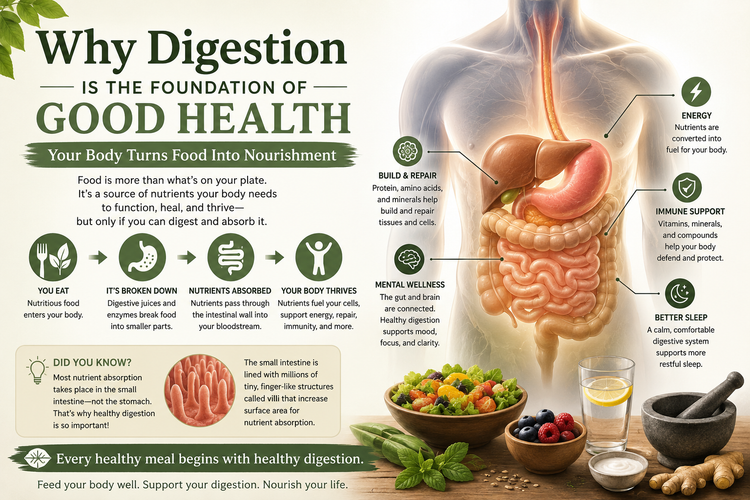
Why Digestion Is The Foundation Of Good Health
Posted by 1st Chinese Herbs Research Team. on Jul 29th 2026
Digestion: The Foundation of Health That Almost Everyone Overlooks
Imagine Building a House...
Imagine a truck arrives carrying the finest lumber, bricks, windows, roofing materials, plumbing supplies, and electrical wiring money can buy.
Everything needed to build a beautiful home is there.
Now imagine those materials never leave the truck.
The builders stand waiting.
The blueprints are perfect.
The materials are exceptional.
Yet the house is never built.
Not because the materials were poor.
But because they never reached the people who needed them.
Your body works in a remarkably similar way.
Every meal you eat contains proteins, healthy fats, carbohydrates, vitamins, minerals, and countless naturally occurring plant compounds. These nutrients have the potential to support your body's everyday functions.
But before your body can use any of them, one critical process must happen first.
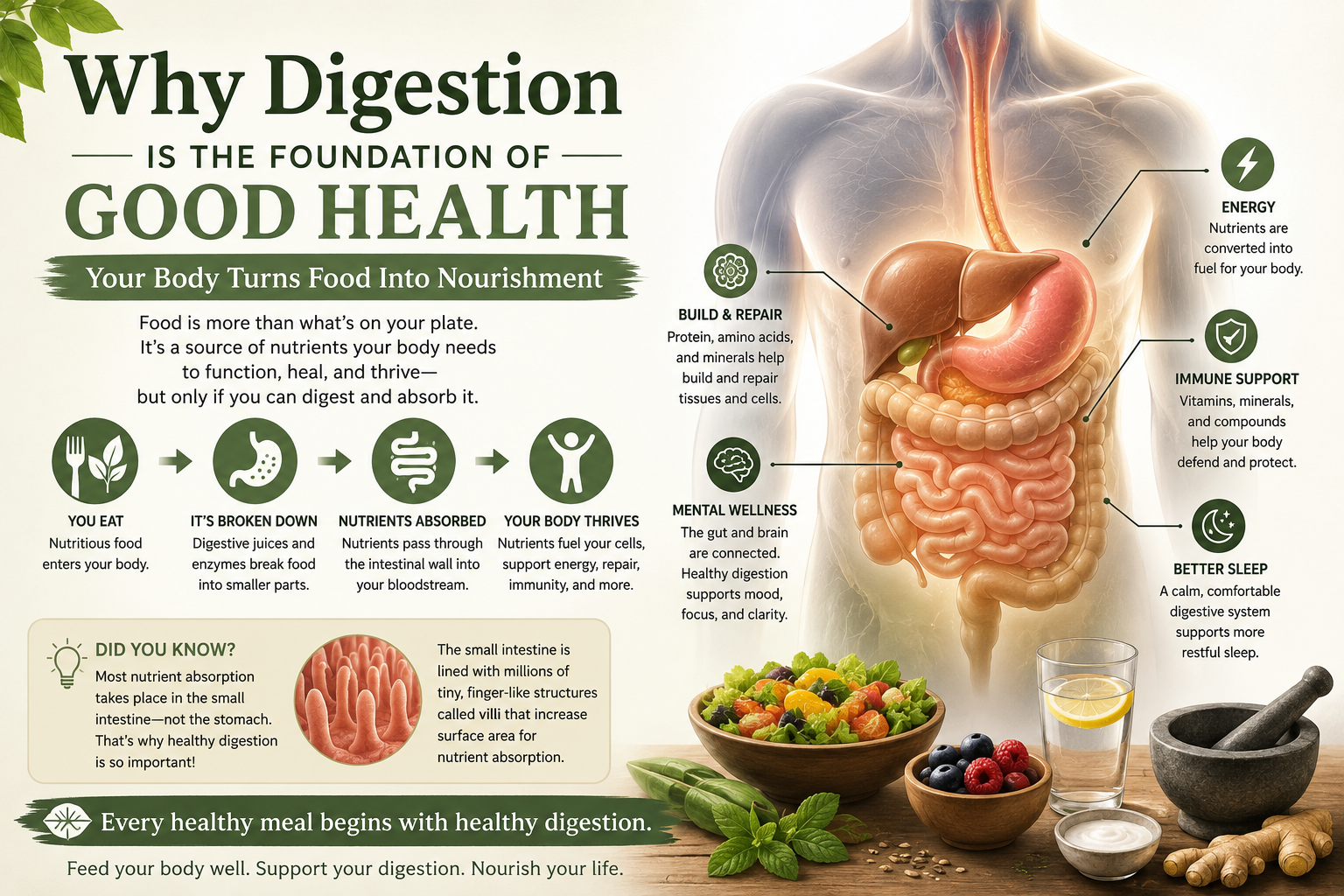
Your digestive system has to break food down, absorb the nutrients, and deliver them where they are needed.
Until that happens, even the healthiest meal remains little more than food sitting inside your digestive tract.
That is why digestion is not simply another body function.
It is the gateway through which nutrition becomes nourishment.
You Are Not Just What You Eat
You've probably heard the saying,
"You are what you eat."
There is truth in that statement.
But there is an even more accurate version.
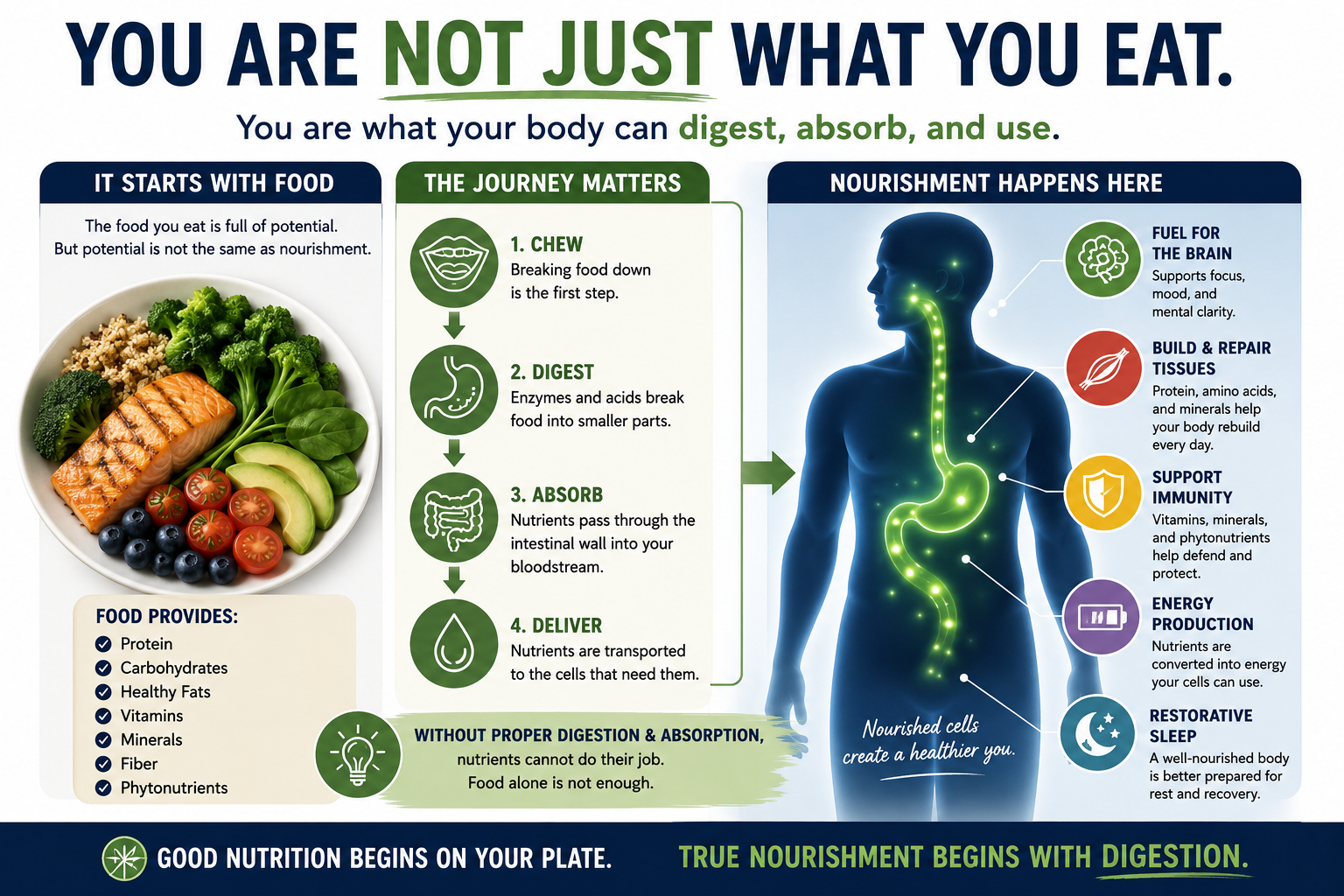
You are what your body can digest, absorb, and use.
This single idea changes how we think about nutrition.
Many people focus entirely on what they should eat.
They search for the healthiest vegetables.
The highest-quality protein.
The perfect vitamin.
The newest superfood.
The most powerful herbal supplement.
Those choices certainly matter.
However, food only provides the raw materials.
Your digestive system determines how effectively many of those materials become available for your body to use.
Without digestion, the nutrients in your food cannot perform the roles they were designed to perform.
Digestion Is Much More Than the Stomach
When people think about digestion, they often picture the stomach.
In reality, digestion involves nearly your entire digestive tract, along with several organs working together in remarkable coordination.
Digestion begins the moment you smell, see, or think about food.
Saliva begins preparing food inside the mouth.
Chewing breaks larger pieces into smaller ones.
The stomach mixes food with digestive juices.
The pancreas releases digestive enzymes.
The liver produces bile, which is stored in the gallbladder until needed to help digest fats.
Finally, much of the digestion and nutrient absorption takes place inside the small intestine.
Each step builds upon the previous one.
If one part of the process is interrupted, the efficiency of the entire system may be affected.
This is one reason digestive health deserves far more attention than it often receives.
Digestion and Absorption Are Not the Same Thing
Many people use the words digestion and absorption as though they mean the same thing.
They don't.
Understanding the difference helps explain why digestion is so important.
Digestion
Digestion is the process of breaking food into smaller components.
Proteins are broken into amino acids.
Carbohydrates become simple sugars.
Fats are broken into fatty acids and glycerol.
Only after food has been broken down can many nutrients move to the next stage.
Absorption
Absorption is the process of moving those nutrients through the lining of the small intestine and into the bloodstream or lymphatic system, where they can be transported throughout the body.
Think of digestion as unpacking thousands of small boxes.
Absorption is the delivery truck that carries those contents to every neighborhood in your body.
Both steps are essential.
One without the other is incomplete.
Why Digestion Is the Foundation of Nutrition
Every cell in your body depends on nutrients.
Your muscles require amino acids.
Your bones depend on minerals and protein.
Your nervous system needs a steady supply of nutrients to function normally.
Your body constantly replaces worn-out cells and manufactures enzymes, hormones, and countless other molecules necessary for everyday life.
But before any of that can happen, nutrients must first become available.
That's the job of digestion.
This doesn't mean every health problem begins in the digestive system.
Nor does it mean improving digestion will cure disease.
Those claims would be inaccurate.
It does mean that digestion is one of the body's most fundamental processes because it allows food to become usable nourishment.
Without digestion, even the healthiest diet cannot reach its full potential.
A Healthy Diet Is Only the Beginning
People often spend hours researching the healthiest foods.
Organic vegetables.
Whole grains.
Lean proteins.
Healthy fats.
Medicinal mushrooms.
Traditional herbs.
High-quality supplements.
Those are worthwhile choices.
But nutrition doesn't end when food reaches your plate.
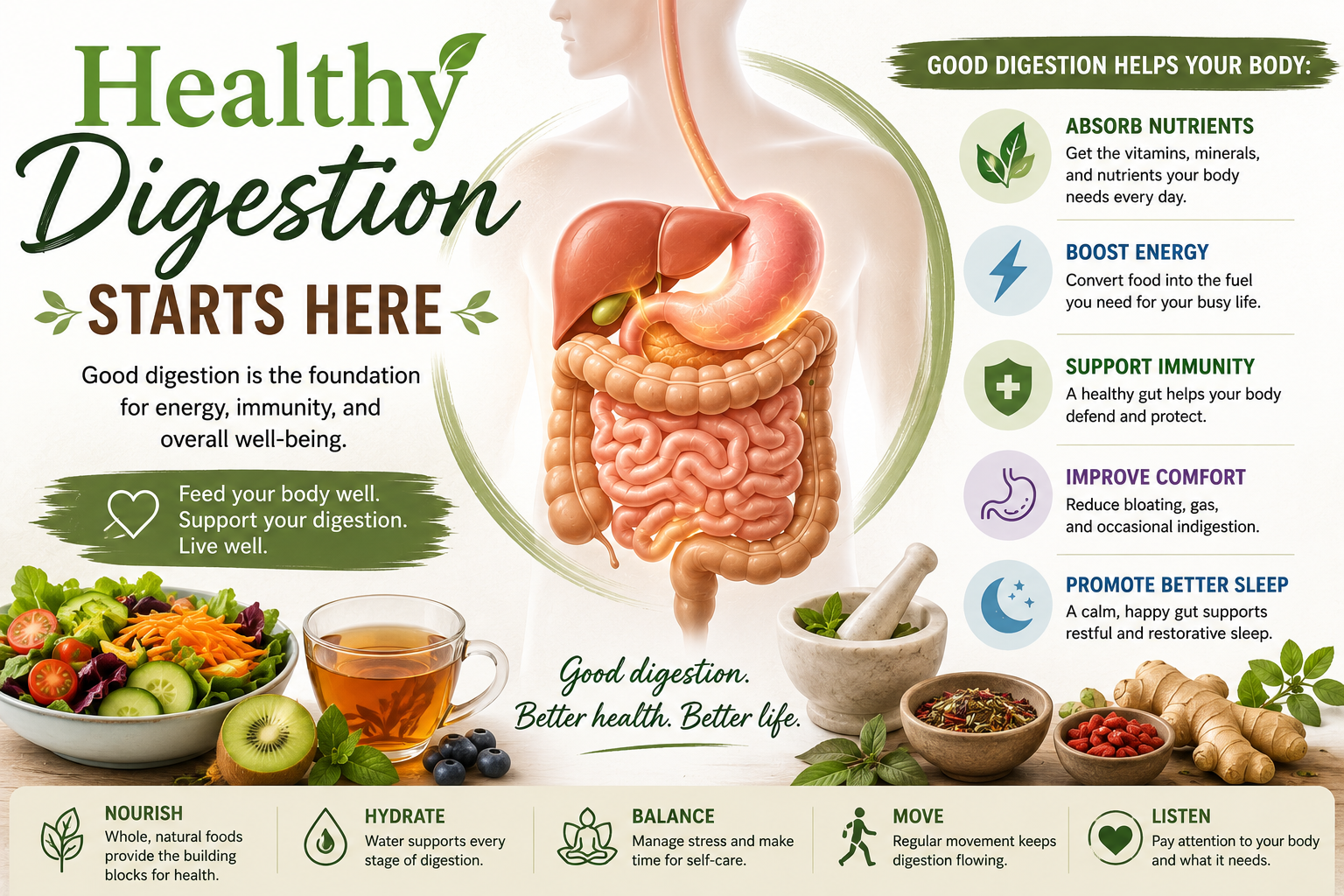
It continues through every stage of digestion and absorption.
The real question isn't only:
"What am I eating?"
It is also:
"How well is my body using what I eat?"
That shift in thinking is one of the most important lessons anyone interested in health can learn.
Did You Know?
Most nutrient absorption takes place in the small intestine—not the stomach.
The stomach's primary job is to mechanically and chemically break food into smaller particles. Once that work is underway, the small intestine becomes the body's main center for absorbing vitamins, minerals, proteins, fats, carbohydrates, and many other nutrients.
Coming Up Next...
Now that we've explored why digestion is the foundation of nutrition, the next question naturally follows:
What actually happens when your digestive system isn't working as efficiently as it should—and why can that affect your energy, comfort, sleep, and overall well-being?
What Happens When Your Digestive System Isn't Working at Its Best?
Imagine filling your car with premium fuel, only to discover that the fuel line is partially blocked.
The gasoline is there.
The engine is well built.
But the fuel cannot reach the places it needs to go.
Your digestive system works in much the same way.
Food contains the nutrients your body depends on every day. However, if those nutrients are not properly broken down and absorbed, your body may not have access to them as efficiently as intended.
This doesn't mean every digestive complaint leads to nutrient deficiencies, nor does it mean every health problem begins in the digestive tract.
It does mean digestion is one of the body's most important first steps.
Without it, nutrition cannot fully do its job.
From Your Plate to Every Cell
After nutrients are absorbed through the wall of the small intestine, they begin an incredible journey.
They travel through your bloodstream or lymphatic system to tissues throughout the body.
Different nutrients perform different jobs.
- Protein supplies amino acids used to build and repair tissues.
- Healthy fats help build cell membranes and support the absorption of fat-soluble vitamins.
- Carbohydrates provide glucose, one of the body's primary energy sources.
- Vitamins and minerals participate in hundreds of normal biochemical processes throughout the body.
- Water supports circulation, temperature regulation, and countless other everyday functions.
Every second of every day, your body is repairing, replacing, producing, transporting, protecting, and adapting.
It relies on a steady supply of nutrients to keep those normal processes moving.
That journey begins with digestion.
Why Digestion Matters for Energy
Have you ever eaten a nutritious meal yet still felt tired?
Fatigue has many possible causes, including poor sleep, stress, medications, chronic illness, anemia, thyroid disorders, depression, and many other medical conditions.
Digestive health is only one piece of that much larger picture.
However, digestion is directly involved in converting food into nutrients that can be used to produce energy.
If your body cannot efficiently break down and absorb nutrients over time, it may become more difficult to obtain everything needed for normal metabolic processes.
This is one reason healthcare professionals sometimes investigate digestive disorders when nutrient deficiencies are suspected.
Digestion and the Body's Normal Repair Processes
Your body never truly stops working.
While you read this article, millions of cells are reaching the end of their life cycle and being replaced.
Proteins are being built.
Enzymes are being produced.
Hormones are being released.
Immune cells are constantly monitoring for potential threats.
Bone tissue is continuously being remodeled.
Even your digestive tract renews much of its lining on a regular basis.
All of these normal processes require nutrients.
Without access to amino acids, essential fats, vitamins, minerals, and other nutrients, your body has fewer raw materials available for its everyday maintenance.
This doesn't mean improving digestion alone will restore health.
Rather, digestion provides the foundation upon which normal nutrition depends.
Can Digestion Affect Sleep?
People are often surprised to learn that digestion and sleep influence one another.
This does not mean digestive problems are the cause of every sleepless night.
Insomnia has many possible causes, including stress, anxiety, chronic pain, medications, breathing disorders, blood sugar fluctuations, and numerous medical conditions.
However, digestive discomfort can certainly interfere with restful sleep.
Anyone who has experienced acid reflux, heartburn, abdominal pain, nausea, bloating, or indigestion after a large evening meal understands how difficult it can be to fall asleep comfortably.
Researchers are also studying the complex communication network known as the gut-brain axis, which describes the ongoing interaction between the digestive system, nervous system, and brain.
Scientists continue to explore how digestive health, intestinal microorganisms, and sleep may influence one another.
Although much remains to be learned, one thing is already clear:
A comfortable digestive system is far more likely to support restful sleep than one that is under constant distress.
When More Supplements May Not Be the Best Answer
One of the most common mistakes people make is assuming that if they don't feel well, they simply need another supplement.
One vitamin becomes three.
Three become eight.
Soon the kitchen cabinet is filled with bottles.
Yet many people rarely stop to ask a different question.
Is my digestive system able to make good use of everything I'm already taking?
Supplements can play an important role for some individuals when recommended by a qualified healthcare professional.
But supplements are not a substitute for understanding persistent digestive symptoms.
If nausea, chronic diarrhea, constipation, unexplained weight loss, blood in the stool, severe abdominal pain, or ongoing digestive problems are present, professional medical evaluation is far more important than simply adding another product to the shelf.
Signs Your Digestive System Deserves More Attention
Everyone experiences occasional digestive discomfort.
Persistent symptoms deserve a closer look.
Talk with your healthcare provider if you experience:
- Frequent heartburn or acid reflux
- Ongoing bloating or abdominal discomfort
- Persistent diarrhea or constipation
- Difficulty swallowing
- Blood in the stool or black stools
- Unexplained weight loss
- Persistent nausea or vomiting
- Symptoms that regularly interfere with sleep or daily life
These symptoms do not necessarily indicate a serious condition, but they should not be ignored or repeatedly self-treated without understanding their cause.
The Big Picture
Nutrition doesn't begin with vitamins.
It doesn't begin with supplements.
It doesn't even begin with healthy food.
It begins with your body's remarkable ability to take what you eat, carefully break it apart, absorb what it needs, and deliver those nutrients where they are needed.
Every healthy meal depends on that process.
Without digestion, food remains potential.
With digestion, that potential becomes nourishment.
Simple Ways to Support Healthy Digestion
Healthy digestion is influenced by many factors, including diet, physical activity, stress, sleep, medications, and underlying medical conditions. While there is no single solution that works for everyone, everyday habits can help support normal digestive function.
1. Slow Down and Chew Your Food
Digestion begins before food reaches your stomach.
Chewing breaks food into smaller pieces while mixing it with saliva, making it easier for your digestive system to continue the process. Eating too quickly may leave larger pieces of food for your stomach and intestines to handle.
2. Eat Regular, Balanced Meals
Your digestive system generally works best with consistency.
Meals that include protein, healthy fats, fiber-rich carbohydrates, fruits, and vegetables provide a wide variety of nutrients your body can use.
3. Stay Hydrated
Water plays an important role throughout digestion, helping move food through the digestive tract and supporting many normal bodily functions.
4. Include Fiber Gradually
Dietary fiber supports normal bowel function and feeds beneficial bacteria that naturally live in the digestive tract.
If your current diet is low in fiber, increase it gradually while drinking adequate fluids, as a sudden increase may cause temporary gas or bloating.
5. Move Your Body
Regular physical activity supports many aspects of overall health, including normal digestive function.
Even a short walk after meals may be beneficial for some people.
6. Pay Attention to Persistent Symptoms
Occasional indigestion happens to almost everyone.
Persistent abdominal pain, ongoing diarrhea, constipation, unexplained weight loss, blood in the stool, difficulty swallowing, or severe digestive symptoms deserve medical evaluation rather than self-treatment.
Where Traditional Herbs May Fit
For thousands of years, cultures around the world have used herbs as part of traditional wellness practices, including herbs traditionally prepared before or after meals.
Today, researchers continue studying many botanicals to better understand their chemical composition and potential biological activity.
At 1st Chinese Herbs, we believe education should always come before marketing.
Understanding the traditional history of an herb, its botanical identity, preparation method, and quality is just as important as knowing when it may—or may not—be appropriate.
No herb replaces a balanced diet, healthy lifestyle, or appropriate medical care.
Instead, herbs should be viewed as one part of a much larger picture that includes nutritious food, regular movement, quality sleep, stress management, and professional healthcare when needed.
Digestion Is the Quiet Hero of Good Health
The heart receives tremendous attention.
The brain fascinates us.
The immune system dominates headlines.
Yet digestion quietly works every minute of every day, asking for very little recognition.
Every meal you eat begins an extraordinary journey.
Food is chewed.
Broken apart.
Mixed with digestive enzymes.
Separated into proteins, fats, carbohydrates, vitamins, minerals, and countless other nutrients.
Those nutrients are absorbed, transported, and delivered to trillions of cells throughout your body.
Only then can they participate in the countless processes that keep you alive.
It happens so naturally that most of us never think about it.
Until something goes wrong.
That's why digestion deserves far more respect than it usually receives.
It is not simply about avoiding heartburn or occasional indigestion.
It is the remarkable process that transforms the food on your plate into nourishment your body can actually use.
The Bottom Line
You can purchase the freshest vegetables.
You can choose premium protein.
You can invest in high-quality herbs and carefully selected supplements.
Those choices matter.
But every one of them depends on a healthy digestive process.
Nutrition doesn't begin in the grocery store.
It doesn't begin in a supplement bottle.
It begins when your body successfully breaks down, absorbs, and uses the nutrients you provide.
That is why digestion isn't simply another body function.
It is the foundation upon which nutrition, energy production, normal tissue maintenance, and overall wellness are built.
The next time you sit down to enjoy a meal, remember that you're not just feeding your stomach.
You're beginning one of the most remarkable biological processes in the human body.
Every healthy life begins with countless healthy meals—but every healthy meal begins with healthy digestion.
References
- Basile EJ, Shukla K, Launico MV, Sheer AJ. Physiology, Nutrient Absorption. StatPearls Publishing. NCBI Bookshelf. https://www.ncbi.nlm.nih.gov/books/NBK597379/
- McCauley HA. Enteroendocrine Regulation of Nutrient Absorption. Journal of Nutrition. 2020;150(1):10-21. https://pubmed.ncbi.nlm.nih.gov/31504661/
- Sharkey KA, Mawe GM. The Enteric Nervous System. Physiological Reviews. 2023. https://pubmed.ncbi.nlm.nih.gov/36521049/
- Khan MT, et al. From Gut to Brain: The Roles of Intestinal Microbiota, Immune System, and Hormones in Intestinal Physiology and the Gut-Brain Axis. Molecular and Cellular Endocrinology. 2025. https://pubmed.ncbi.nlm.nih.gov/40482955/
- National Institute of Diabetes and Digestive and Kidney Diseases (NIDDK). Your Digestive System & How It Works. https://www.niddk.nih.gov/health-information/digestive-diseases/digestive-system-how-it-works
Educational Disclaimer: This article is provided for educational purposes only and is not intended to diagnose, treat, cure, or prevent any disease. Always consult a qualified healthcare professional regarding persistent digestive symptoms, unexplained weight loss, blood in the stool, severe abdominal pain, difficulty swallowing, or before making significant changes to your diet, supplements, or healthcare routine.