
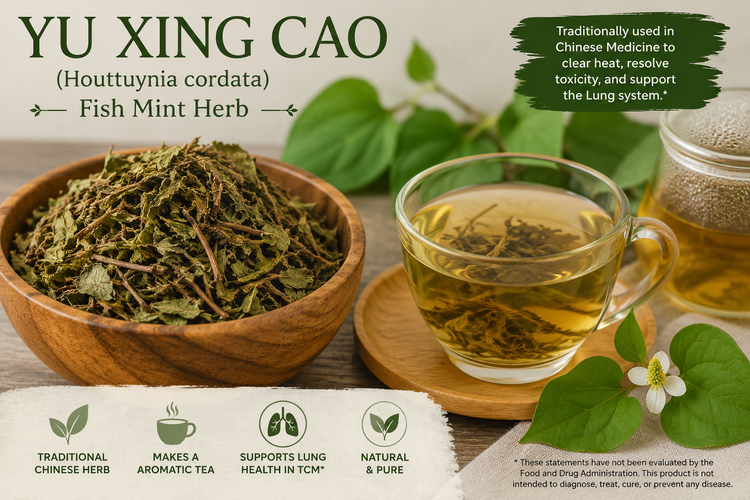
The Herb Nobody Forgets: Why Yu Xing Cao Keeps Showing Up in Lyme Disease, Bartonella, and Chinese Herbal Discussions
Posted by Written by Sarah Johnson, Certified Herbalist, 1st Chinese Herbs. Trusted since 1994. on Jun 2nd 2026
The Herb Nobody Forgets: Why Yu Xing Cao Keeps Showing Up in Lyme Disease, Bartonella, and Chinese Herbal Discussions
Quick Answer: Yu Xing Cao (Houttuynia cordata) is one of the most discussed herbs among people researching Lyme disease, Bartonella, respiratory wellness, and Traditional Chinese Medicine. It has a long history of traditional use, a distinctive fish-like aroma, and a reputation for being one of those herbs that people continue researching long after they first hear about it.
Special Blog Reader Giveaway
Because Yu Xing Cao is one of the most frequently requested herbs on our website, we are offering blog readers a coupon for a complimentary 1 lb bag of Yu Xing Cao with a qualifying purchase of $75.00 or more
Many customers first discover this herb while researching Lyme disease, Bartonella discussions, or Traditional Chinese Medicine. Others simply become curious after hearing about it repeatedly.
Read through this guide and discover why so many herbal enthusiasts keep coming back to learn more.
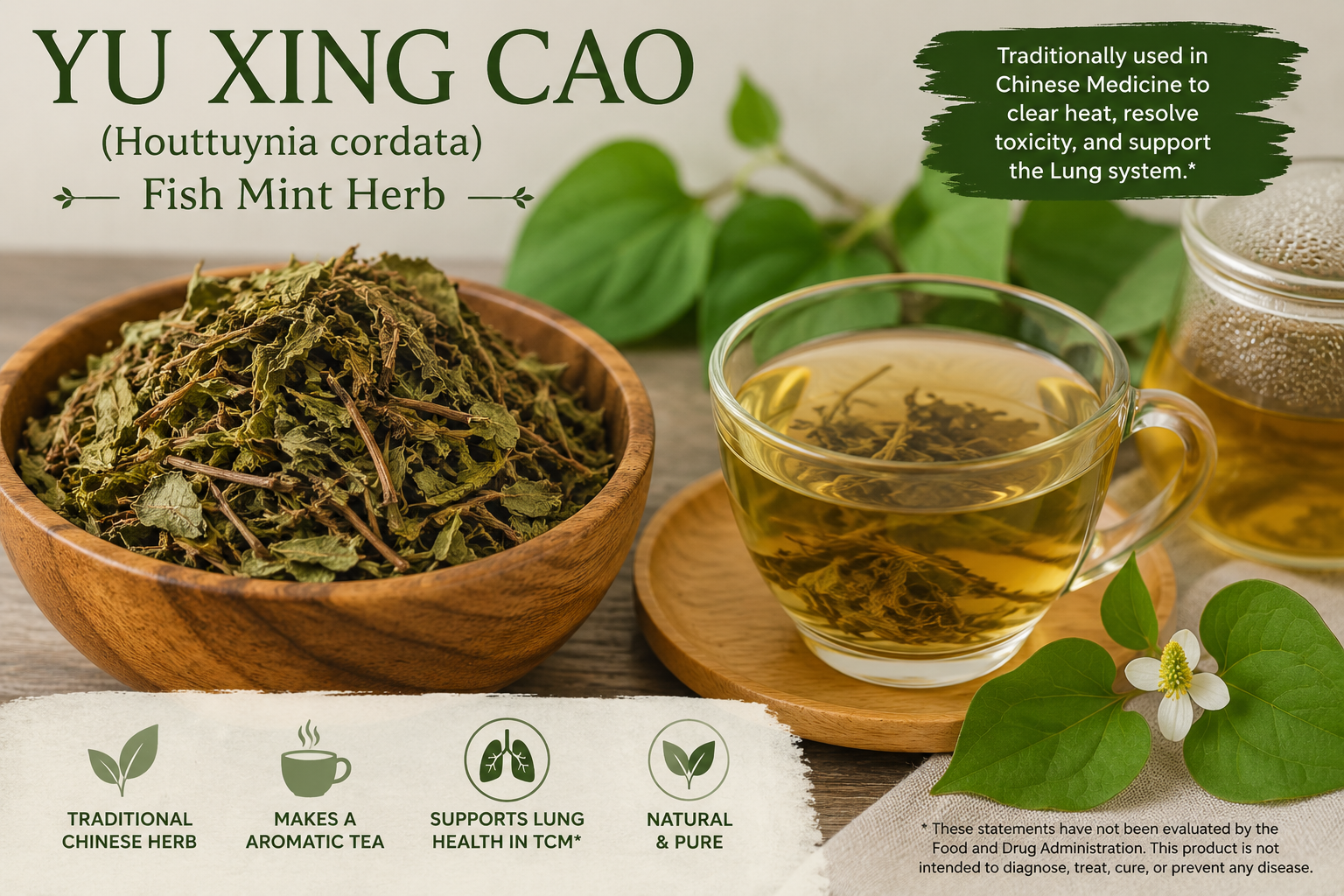 It Usually Starts With A Question
Most people do not wake up one morning and say:
"Today feels like a great day to research a fish-smelling Chinese herb."
Instead, Yu Xing Cao tends to appear unexpectedly.
Someone is researching Lyme disease.
Someone else is reading about Bartonella.
A practitioner mentions it.
A book references it.
A friend recommends it.
Then the same question appears:
"Why does everyone keep talking about this herb?"
At 1st Chinese Herbs, we have been answering that question for years.
In fact, Yu Xing Cao is one of the most interesting herbs we carry because people rarely discover it casually.
Nobody buys Yu Xing Cao because it has a beautiful name.
Nobody buys it because it smells wonderful.
And very few people buy it because it was sitting on the front shelf next to their favorite tea.
People search for Yu Xing Cao because they are trying to solve a puzzle.
They keep seeing the herb mentioned.
They keep hearing about it.
And eventually curiosity wins.
That curiosity is exactly what brought many readers to this page.
Why Does Yu Xing Cao Get So Much Attention?
The answer is surprisingly simple.
Yu Xing Cao sits at the crossroads of several very different herbal worlds.
- Traditional Chinese Medicine
- Respiratory wellness traditions
- Heat-clearing herbal categories
- Modern herbal research
- Lyme disease and Bartonella discussions
- Stephen Buhner-inspired herbal protocols
Most herbs only become well-known inside one of those communities.
Yu Xing Cao appears in all of them.
That is one reason people keep talking about it.
The other reason?
Once people begin researching it, they realize it is very different from most herbs they have encountered before.
Goji Berry tastes sweet.
Astragalus feels approachable.
Chen Pi smells like citrus.
Ginseng is famous.
Yu Xing Cao is none of those things.
Yu Xing Cao is the herb people discover after they have already moved beyond the basics.
It is often the herb that appears when someone begins digging deeper into traditional herbal categories and advanced herbal discussions.
Why Customers Keep Coming Back To Yu Xing Cao
One of the things we find most fascinating is how often customers return to Yu Xing Cao.
Not necessarily because it is the easiest herb to understand.
Not because it smells pleasant.
And certainly not because it tastes like peppermint tea.
Customers come back because the herb remains relevant to the topics they continue researching.
A customer might initially learn about Yu Xing Cao while researching Lyme disease.
Months later they encounter it again while reading about Bartonella.
Later they discover it in Traditional Chinese Medicine texts.
Then they see modern scientific papers discussing the plant.
The herb keeps showing up.
Eventually many people decide:
"I should probably learn what this herb actually is."
That is exactly why this guide exists.
What Makes Yu Xing Cao Different From Other Popular Herbs?
This is where most competitor websites stop short.
They explain what Yu Xing Cao is.
But they never explain why you might choose to learn about it instead of another herb.
Think of it this way:
- Goji Berry is often someone's first Chinese herb.
- Astragalus is often someone's first tonic herb.
- Chen Pi is often someone's first digestive herb.
- Ginseng is often someone's first energy herb.
- Yu Xing Cao is often someone's first serious deep dive into heat-clearing and toxicity-resolving herbal traditions.
That distinction matters.
Yu Xing Cao is not usually the herb people learn about first.
It is often the herb they discover when they begin asking bigger questions.
And that is exactly why it continues to attract attention year after year.
Why Lyme Disease Communities Keep Mentioning Yu Xing Cao
Let's address the question that brings many readers here.
Yu Xing Cao is frequently discussed within Lyme disease and Bartonella-related herbal communities.
Many people first encounter the herb through books, practitioner discussions, support groups, and herbal protocols.
This often leads to an important question:
"Does that mean Yu Xing Cao is a Lyme disease treatment?"
No.
Yu Xing Cao is not approved to diagnose, treat, cure, or prevent Lyme disease, Bartonella, or any other disease.
However, it continues to appear in discussions among herbalists and wellness researchers who are interested in traditional herbal approaches.
For many people, the herb becomes important not because of what a website claims.
It becomes important because they continue seeing knowledgeable herbal practitioners discuss it.
That is why understanding the herb itself is often more valuable than focusing on a single protocol.
The more you understand why Yu Xing Cao has been used traditionally, the easier it becomes to understand why it continues to appear in modern conversations today.
What Is Yu Xing Cao and How Does It Work in Traditional Chinese Medicine?
Now that we understand why so many people keep talking about Yu Xing Cao, let's answer the next question:
What exactly is this herb?
Yu Xing Cao is the Chinese name for Houttuynia cordata, a perennial plant native to parts of China, Japan, Korea, and Southeast Asia.
In Traditional Chinese Medicine, the aerial portions of the plant are traditionally used and classified as an herb that clears heat and resolves toxicity.
If you're new to Chinese herbs, that phrase probably sounds mysterious.
Most people read "clear heat and resolve toxicity" and immediately wonder if they accidentally opened a textbook written 2,000 years ago.
Let's translate it into plain English.
What Does "Clear Heat" Mean?
In TCM, "heat" does not necessarily mean a fever.
Instead, heat describes a pattern.
Traditional practitioners may associate heat patterns with things such as:
- Redness
- Irritation
- Inflammation-like presentations
- Feeling excessively warm
- Seasonal discomfort
- Certain respiratory patterns
Think of it this way:
If tonic herbs like Ginseng and Astragalus are often described as supporting and building, heat-clearing herbs are traditionally discussed when the body appears to have too much of something rather than too little.
That is why Yu Xing Cao occupies a completely different category than many popular wellness herbs.
What Does "Resolve Toxicity" Mean?
This is another phrase that often confuses modern readers.
In Traditional Chinese Medicine, "toxicity" is not the same thing as modern toxicology.
It is a traditional concept used to describe certain patterns that practitioners historically observed.
For centuries, Yu Xing Cao was included in formulas when practitioners wanted herbs traditionally associated with:
- Clearing heat
- Supporting the Lung system
- Addressing damp-heat patterns
- Supporting seasonal wellness
- Maintaining balance during periods of internal excess
This helps explain why Yu Xing Cao continues to appear in both traditional and modern herbal discussions.
Why Is Yu Xing Cao Different From Astragalus, Goji, or Ginseng?
This is one of the most important things to understand.
Many customers arrive on our website after learning about:
- Astragalus Root
- Goji Berry
- Ginseng
- Red Dates
- Chen Pi
Those herbs are often beginner-friendly.
Yu Xing Cao is different.
It is not usually the herb people start with.
It is often the herb people discover after they begin exploring deeper herbal categories and more advanced wellness discussions.
That is one reason it generates so much curiosity.
What Does Modern Science Say About Yu Xing Cao?
This is where things become especially interesting.
Researchers have spent years studying Houttuynia cordata because it contains a wide variety of naturally occurring plant compounds.
Scientists are often interested in herbs that have:
- Long histories of traditional use
- Unique chemical profiles
- Documented ethnobotanical histories
- Modern research potential
Yu Xing Cao checks all four boxes.
The Plant Compounds Researchers Study
Modern analysis has identified numerous naturally occurring compounds in Houttuynia cordata including:
- Flavonoids
- Volatile oils
- Polysaccharides
- Alkaloids
- Polyphenols
You don't need to memorize those names.
The important thing is understanding why scientists care.
These compounds help explain why researchers continue studying the plant.
Why Scientists Remain Interested
Research involving Houttuynia cordata has explored areas such as:
- Antioxidant activity
- Inflammatory pathways
- Microbial activity in laboratory settings
- Respiratory system research
- Immune-related mechanisms
- Gut and intestinal barrier research
That does not mean Yu Xing Cao has been proven to treat any disease.
It means researchers continue finding reasons to investigate the plant.
And when researchers continue studying a plant decade after decade, herbalists usually pay attention.
What Modern Science and Traditional Chinese Medicine Agree On
This is where things get fascinating.
Traditional Chinese practitioners valued Yu Xing Cao centuries before anyone could identify flavonoids, polysaccharides, or volatile oils.
Today, researchers are investigating many of the same plants that traditional practitioners found useful long ago.
The language is different.
The methods are different.
But the interest remains.
That is one reason Yu Xing Cao continues appearing in discussions among both herbalists and researchers.
Yu Xing Cao vs Japanese Knotweed
This is probably the most common comparison we receive.
Many people researching Lyme disease discover Japanese Knotweed first.
Only later do they encounter Yu Xing Cao.
| Feature | Yu Xing Cao | Japanese Knotweed |
|---|---|---|
| Traditional Category | Clear Heat & Resolve Toxicity | Move Blood & Clear Heat |
| Plant Part | Aerial Herb | Root |
| Most Known For | Lyme/Bartonella discussions | Resveratrol interest |
| Taste | Pungent | Earthy |
Simple takeaway: Japanese Knotweed is often the first herb people discover during Lyme research. Yu Xing Cao is often the herb they discover after they start digging deeper.
Yu Xing Cao vs Cat's Claw
Although both herbs appear in Lyme-related discussions, they come from completely different traditions.
| Feature | Yu Xing Cao | Cat's Claw |
|---|---|---|
| Origin | China & Asia | South America |
| Traditional System | Chinese Herbal Medicine | Amazonian Herbalism |
| Primary Interest | Heat-clearing traditions | Immune-support discussions |
Simple takeaway: People researching Lyme disease often encounter both herbs, but they are not substitutes for one another.
Yu Xing Cao vs Andrographis
If Yu Xing Cao is famous for its smell, Andrographis is famous for its bitterness.
| Feature | Yu Xing Cao | Andrographis |
|---|---|---|
| Taste Challenge | Aroma | Bitterness |
| Traditional Nature | Slightly Cold | Cold |
| Beginner Reaction | "What is that smell?" | "Wow, that's bitter." |
Simple takeaway: Both herbs tend to attract people who have moved beyond beginner herbal teas and are exploring more specialized herbs.
Yu Xing Cao vs Huang Qin
These two herbs are frequently discussed together because both belong to heat-clearing traditions in TCM.
| Feature | Yu Xing Cao | Huang Qin |
|---|---|---|
| Traditional Category | Clear Heat & Resolve Toxicity | Clear Heat & Dry Dampness |
| Taste | Pungent | Bitter |
| Traditional Focus | Lung-oriented traditions | Damp-heat traditions |
Simple takeaway: Although both herbs are heat-clearing herbs, they occupy different roles within traditional Chinese herbal medicine.
Who Should Learn About Yu Xing Cao?
One of the biggest mistakes herbal websites make is assuming every herb is for everyone.
They are not.
Some herbs are fantastic beginner herbs.
Some herbs are better suited for people who have already spent time learning about Traditional Chinese Medicine.
Yu Xing Cao falls somewhere in the middle.
You do not need to be an herbal expert to appreciate it.
But you will probably get the most value from learning about Yu Xing Cao if you have already started asking deeper questions about herbal traditions.
You May Find Yu Xing Cao Especially Interesting If:
- You are researching Lyme disease herbal discussions.
- You keep encountering Bartonella-related conversations.
- You are learning about heat-clearing herbs in Traditional Chinese Medicine.
- You enjoy studying herbs with long traditional histories.
- You are interested in herbs associated with the Lung system in TCM.
- You enjoy exploring herbs beyond the usual beginner selections.
- You like understanding why herbalists choose specific herbs for specific situations.
In other words, Yu Xing Cao tends to appeal to curious people.
People who enjoy learning.
People who see a strange herb mentioned repeatedly and eventually decide:
"There must be a reason this keeps showing up."
And usually there is.
Who Should Probably Start Somewhere Else?
This may sound strange coming from a company that sells herbs, but not every herb is the best starting point.
If you are completely new to Chinese herbs, Yu Xing Cao may not be the first herb we would recommend.
Not because it is difficult.
Not because it is dangerous.
But because there are easier herbs to understand.
If You Want A Sweet, Food-Like Herb
Start with:
- Goji Berry (Gou Qi Zi)
- Red Dates (Da Zao)
These herbs are approachable and easy to incorporate into daily life.
If You Want A Traditional Tonic Herb
Start with:
- Astragalus Root (Huang Qi)
- Codonopsis (Dang Shen)
These herbs help people understand tonic herbal traditions.
If You Want A Beginner-Friendly Tea Herb
Start with:
- Chrysanthemum Flowers (Ju Hua)
- Goji Berry
- Chen Pi
These herbs tend to be easier introductions to Chinese herbal teas.
Then, once you begin exploring more specialized herbal categories, Yu Xing Cao becomes much more interesting.
How Is Yu Xing Cao Traditionally Used?
One of the reasons customers ask so many questions about Yu Xing Cao is because they are not always sure what to do with it after they buy it.
Let's fix that.
Traditional Decoction
This is one of the most common methods.
Many traditional Chinese herbs are simmered rather than simply steeped.
A decoction generally involves:
- Adding the herb to water
- Bringing it to a gentle simmer
- Allowing the herb to cook for a period of time
- Straining and drinking the liquid
This method has been used for centuries in Traditional Chinese Medicine.
As A Tea
Some people prefer a simpler preparation.
The aroma may be stronger than expected, but many customers find the flavor milder than anticipated.
As Part Of An Herbal Formula
Traditional Chinese Medicine often combines herbs rather than relying on a single herb.
This allows practitioners to create more balanced formulas that address multiple traditional patterns simultaneously.
Powders and Capsules
Some customers prefer capsules because they avoid the aroma entirely.
Others prefer powders because they are easy to incorporate into existing wellness routines.
What Does Yu Xing Cao Taste Like?
Let's address another common question.
No.
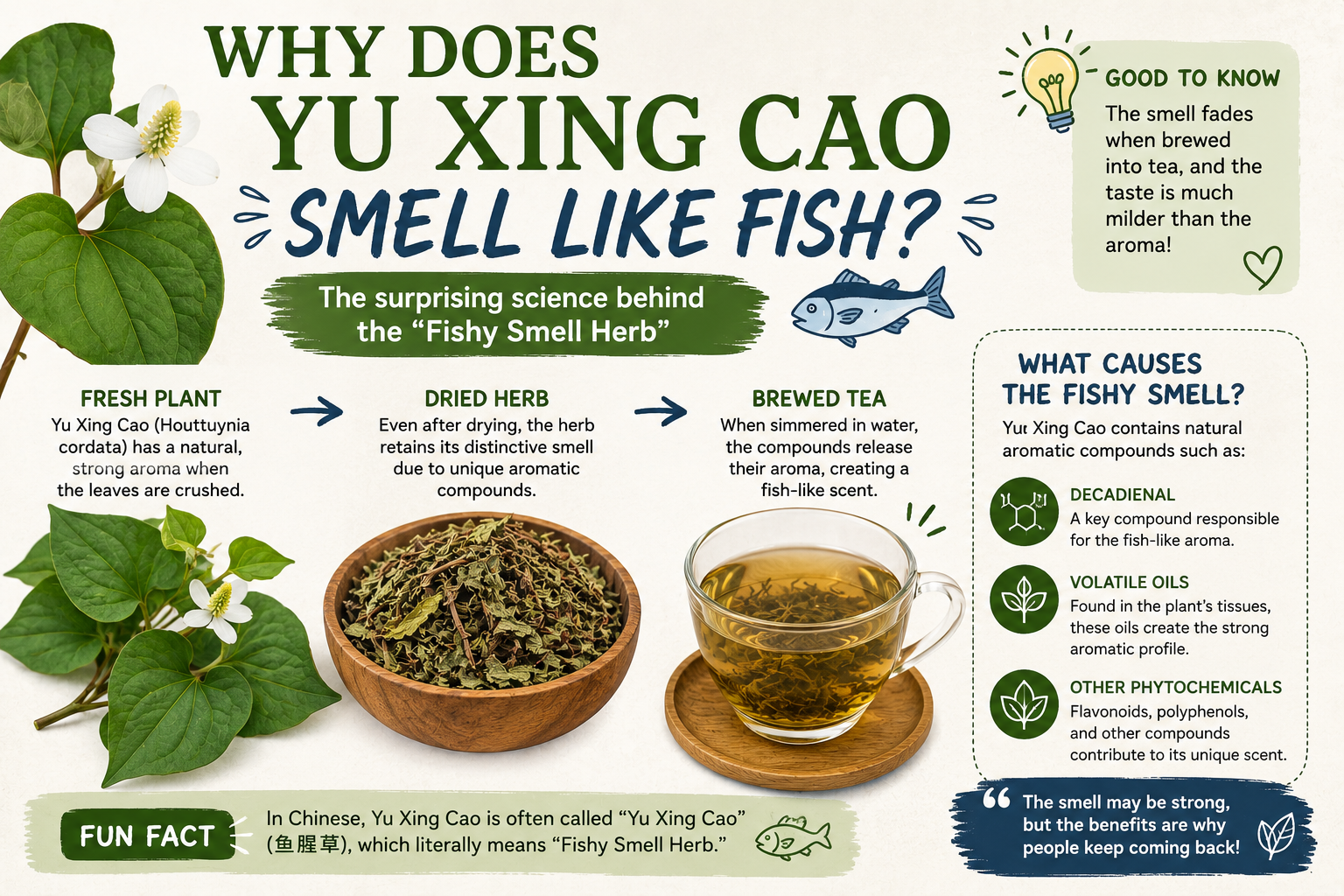
It does not taste exactly like fish.
The smell creates that impression.
The flavor is usually described as:
- Herbal
- Green
- Pungent
- Earthy
- Mildly aromatic
The aroma is usually the bigger surprise.
Many customers are relieved to discover that the taste is much less dramatic than the smell.
That may be one of the greatest marketing challenges Yu Xing Cao has ever faced.
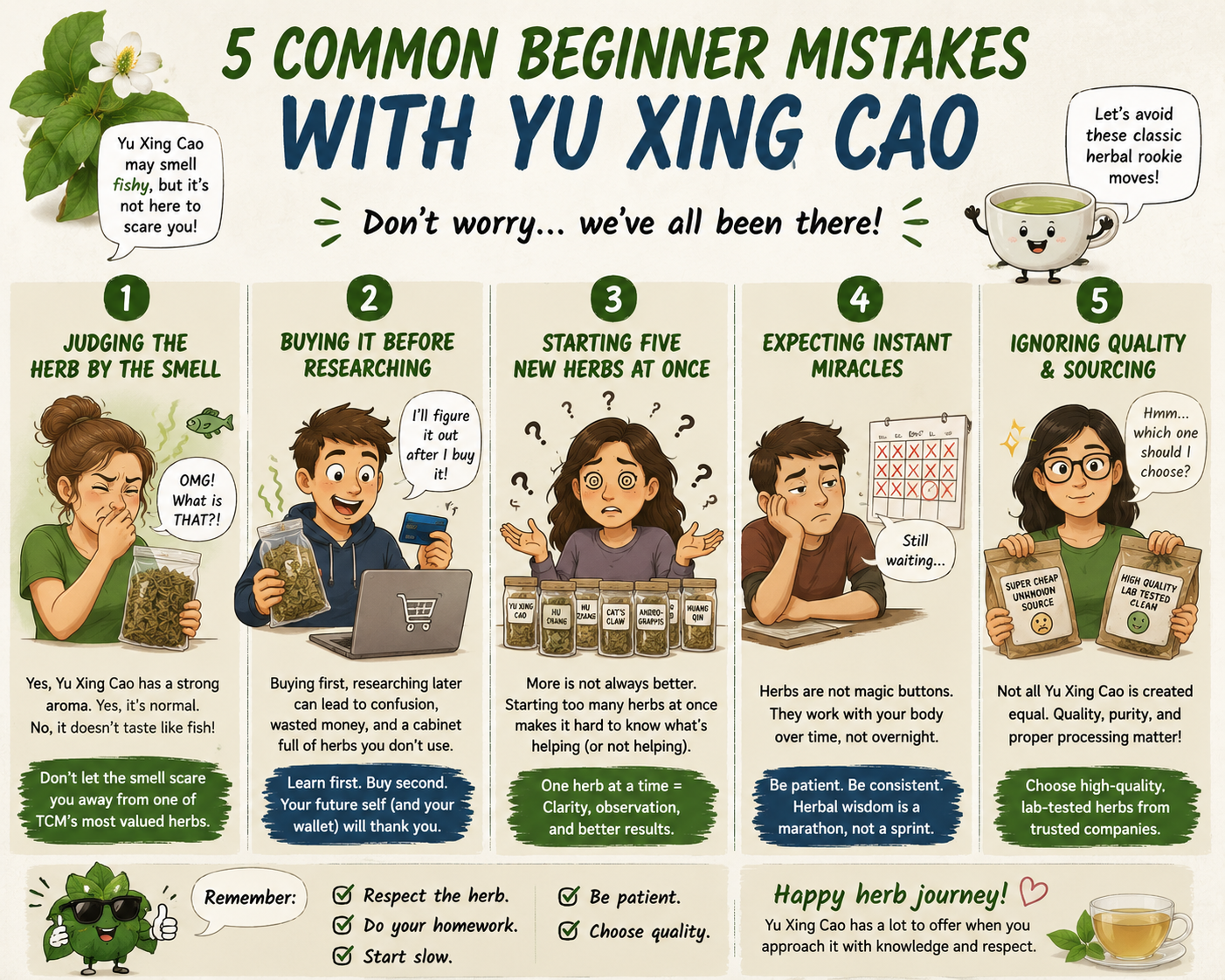
The Five Biggest Mistakes Beginners Make With Yu Xing Cao
Mistake #1: Judging The Herb By The Smell
Many people open the bag and immediately wonder if something went wrong.
Nothing went wrong.
The aroma is one of the reasons the herb received its traditional name.
It is supposed to smell distinctive.
Mistake #2: Expecting It To Taste Like Mint Tea
The common name "Fish Mint" creates some interesting expectations.
Yu Xing Cao is neither peppermint nor spearmint.
It is its own unique herb.
Mistake #3: Buying It Before Learning Why You're Interested In It
This is more common than you might think.
People hear about Yu Xing Cao.
They buy it.
Then they start researching it afterward.
A better approach is to understand why the herb interests you before purchasing it.
Mistake #4: Starting Five New Herbs At Once
This mistake affects many beginners.
If you start multiple herbs simultaneously, it becomes difficult to understand each herb individually.
One herb teaches more than five herbs taken all at once.
Mistake #5: Confusing Research With Proof
Research is valuable.
Research is exciting.
Research is not the same thing as proof.
Understanding that distinction helps create realistic expectations and better decision-making.
Why We Continue To Carry Yu Xing Cao
At 1st Chinese Herbs, we have been helping customers learn about herbs since 1994.
Thousands of herbs have passed through the herbal marketplace during that time.
Some became trends.
Some disappeared.
Some generated excitement for a year or two and then faded away.
Yu Xing Cao is different.
Customers continue asking about it.
Practitioners continue discussing it.
Researchers continue studying it.
Traditional Chinese Medicine continues teaching about it.
And people interested in Lyme disease, Bartonella discussions, and heat-clearing herbal traditions continue searching for it.
When an herb remains relevant across multiple generations of herbal learning, we pay attention.
That is one reason Yu Xing Cao remains an important part of our herbal catalog today.
Frequently Asked Questions About Yu Xing Cao
What is Yu Xing Cao used for in Traditional Chinese Medicine?
In Traditional Chinese Medicine, Yu Xing Cao is traditionally categorized as an herb that clears heat and resolves toxicity. Historically, practitioners have used it in formulas associated with Lung-system support, seasonal wellness, damp-heat patterns, and situations involving excess heat according to TCM theory.
Why does Yu Xing Cao smell like fish?
The herb naturally contains aromatic compounds that create its distinctive smell. In fact, the name Yu Xing Cao is often translated as "Fishy Smell Herb." While the aroma surprises many first-time users, the taste is usually much milder than expected.
Does Yu Xing Cao actually taste like fish?
No. Most people find that the smell is far stronger than the taste. The flavor is typically described as herbal, green, earthy, and slightly pungent.
Why is Yu Xing Cao discussed so often in Lyme disease communities?
Many people researching Lyme disease and Bartonella-related wellness discussions encounter Yu Xing Cao through herbal books, practitioner recommendations, and educational discussions. It frequently appears in conversations about traditional herbal approaches and complementary wellness practices.
However, Yu Xing Cao is not approved to diagnose, treat, cure, or prevent Lyme disease, Bartonella, or any disease.
Is Yu Xing Cao beginner-friendly?
It depends on the person.
For someone completely new to herbs, Goji Berry, Astragalus, Chrysanthemum Flowers, or Chen Pi are often easier starting points.
For someone already researching Lyme disease discussions, Bartonella conversations, or traditional heat-clearing herbs, Yu Xing Cao may become relevant much sooner.
Can Yu Xing Cao be combined with other herbs?
Traditional Chinese Medicine frequently combines herbs into formulas. The specific combination depends on the goals, pattern being addressed, and the practitioner creating the formula.
What herbs are commonly compared with Yu Xing Cao?
- Japanese Knotweed (Hu Zhang)
- Cat's Claw
- Andrographis
- Huang Qin (Scutellaria)
- Ban Lan Gen
- Astragalus Root
Each herb occupies a different role and should not be viewed as a direct replacement for the others.
How long has Yu Xing Cao been used?
Yu Xing Cao has a long history within Traditional Chinese Medicine and East Asian herbal traditions. It has been documented and used for centuries.
What part of the plant is used?
The aerial portions of the plant are typically used in traditional herbal preparations.
Why do people keep coming back to Yu Xing Cao?
Many customers tell us that the herb continues appearing in their research. They encounter it in books, educational resources, practitioner discussions, and traditional herbal literature. The more they learn, the more curious they become.
A Special Giveaway For Readers Who Made It This Far
If you've read this entire article, you are probably exactly the type of person who becomes fascinated by herbs.
You ask questions.
You enjoy learning.
You like understanding why certain herbs continue appearing in conversations year after year.
And because Yu Xing Cao is one of the herbs customers ask us about most often, we wanted to do something special.
Free 1 lb Yu Xing Cao Coupon
For a limited time, blog readers can receive a coupon for a complimentary 1 lb bag of Yu Xing Cao with a qualifying purchase of $75 or more
How It Works:
- Contact us and mention this article.
- Request the Yu Xing Cao coupon.
- Place a qualifying order.
- Add your complimentary 1 lb bag of Yu Xing Cao.
Offer Details:
- One coupon per household
- Qualifying purchase required
- Available while supplies last or expired June 30 2026
- Cannot be combined with other promotional offers unless specified
We have found that many customers who are curious about Yu Xing Cao simply want an opportunity to experience the herb and learn more about it firsthand.
Scientific Research and Further Reading
One reason Yu Xing Cao continues attracting attention is that researchers continue studying it.
Below are several peer-reviewed resources for readers interested in exploring the scientific literature.
- Comprehensive Review of Houttuynia cordata
- Pharmacological Activities of Houttuynia cordata
- Ethnopharmacological Review of Houttuynia cordata
- Therapeutic Potential and Research Review
- Respiratory System Research Involving Houttuynia cordata
Research continues to evolve. Scientific interest in Houttuynia cordata does not necessarily mean a disease claim can be made. Research should be viewed as an ongoing process rather than a final answer.
Related Articles You May Enjoy
- Japanese Knotweed (Hu Zhang): Why It Remains One of the Most Discussed Herbs in Lyme Research
- What No One Tells You About Chinese Herbs (But Should)
- How To Use Bulk Herbs: A Beginner's Guide
- Compare Chinese Herbs Side-by-Side
- 10 Vital Medicinal Herbs That Work
Final Thoughts: Why This Herb Continues To Fascinate People
Some herbs become popular because they taste good.
Some herbs become popular because everyone has heard of them.
Yu Xing Cao became popular because people keep encountering it while searching for answers.
It appears in Traditional Chinese Medicine.
It appears in herbal research.
It appears in Lyme disease discussions.
It appears in Bartonella conversations.
It appears in books, forums, practitioner discussions, and educational resources.
The herb keeps showing up.
And eventually most curious people ask the same question:
"Why does everyone keep talking about this herb?"
Hopefully this guide answered that question.
At 1st Chinese Herbs, we believe that understanding herbs is just as important as buying them.
The more you understand an herb's history, traditional uses, research, and role in herbal traditions, the more confident you become when exploring the herbal world.
Yu Xing Cao may not be the prettiest herb.
It may not be the sweetest herb.
It may never win an award for smelling wonderful.
But it has earned something far more valuable.
It has earned curiosity.
And curiosity is usually where herbal learning begins.
Important Disclaimer: This article is provided for educational purposes only. These statements have not been evaluated by the Food and Drug Administration. This content is not intended to diagnose, treat, cure, or prevent any disease. Always consult a qualified healthcare professional before using herbs, especially if you are pregnant, nursing, taking medications, or managing a medical condition.
Ready To Explore Yu Xing Cao?
Whether you are researching Traditional Chinese Medicine, learning about herbs mentioned in Lyme disease discussions, or simply expanding your herbal knowledge, Yu Xing Cao remains one of the most fascinating herbs in the Chinese materia medica.
Shop Lab-Tested Yu Xing Cao Today and discover why so many herbal enthusiasts continue talking about this unique herb.
Get Real Herbs. Feel the Difference.
Updated: Last updated: June 2, 2026