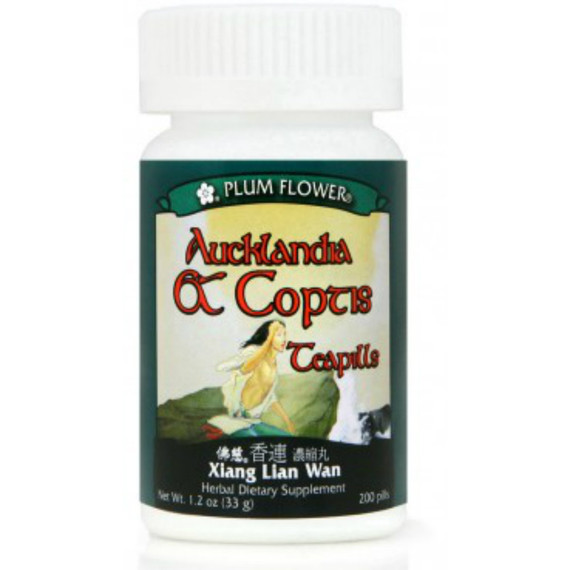


Peach Kernel Teapills – Tao Ren Wan – Plum Flower – 200 Pills
Traditional Chinese Herbal Formula | Also Known as Run Chang Wan or Lubricate the Intestines Pills
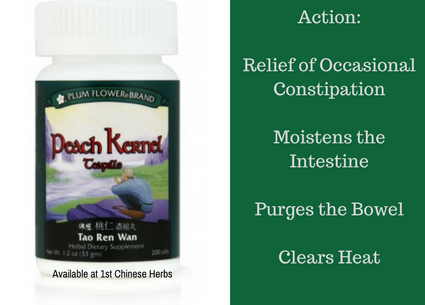
Peach Kernel Teapills, known as Tao Ren Wan (桃仁丸), are a traditional five-herb Chinese formula featuring Tao Ren (peach kernel), flax seed, Chinese rhubarb, Notopterygium, and Dang Gui.
In Traditional Chinese Medicine (TCM), this combination is traditionally associated with moistening the intestines, encouraging normal downward movement, and addressing patterns involving intestinal dryness and insufficient moisture.
Rather than relying on a single herb, Tao Ren Wan combines herbs with different traditional functions. Some provide moisture and nourishment, while others encourage movement. This combination is what distinguishes Peach Kernel Teapills from a single-herb peach kernel product.
Brand: Plum Flower®
Chinese Name: 桃仁丸
Pin Yin: Tao Ren Wan
Other Names: Peach Kernel Pills, Peach Kernel Teapills, Run Chang Wan, Lubricate the Intestines Pills
Form: Traditional Chinese teapills
Bottle Size: 200 pills
Serving Size: 8 pills
Suggested Use: 8 pills, 3 times daily, or as directed by your healthcare practitioner
What Are Peach Kernel Teapills?
Peach Kernel Teapills are a prepared form of a traditional Chinese herbal combination centered around Tao Ren (桃仁), or peach kernel.
The English name can be slightly misleading. This is not simply peach kernel made into pills. Tao Ren is combined with four additional herbs: Ya Ma Zi, Da Huang, Qiang Huo, and Dang Gui.
Together, the five herbs form a traditional formula designed around the TCM concepts of moistening, nourishing, moving, and clearing.
The teapill form provides the traditional herbal combination in small, convenient pills without requiring the preparation of a raw-herb decoction.
What Is Tao Ren Wan Traditionally Used For?
Traditional Chinese Medicine does not select formulas solely according to a Western disease or symptom name. Instead, practitioners traditionally look at the person's overall pattern.
Tao Ren Wan is traditionally associated with patterns in which the intestines lack sufficient moisture and normal downward movement has become sluggish.
From a TCM perspective, the formula brings together several complementary actions:
-
Moistening herbs help address dryness.
-
Nourishing herbs support Blood and fluids.
-
Moving herbs help prevent excessive stagnation.
-
Downward-directing herbs support the formula's traditional intestinal focus.
This is why understanding the entire formula is more useful than looking at Tao Ren alone.
What Are the Ingredients in Peach Kernel Teapills?
Plum Flower Peach Kernel Teapills contain five primary herbal ingredients:
| Pin Yin Name | Common Name | Botanical Name | Traditional Role in the Formula |
|---|---|---|---|
| Tao Ren | Peach Kernel | Prunus persica seed | Traditionally used to invigorate Blood and moisten the intestines. |
| Ya Ma Zi | Flax Seed | Linum usitatissimum seed | An oil-rich seed traditionally incorporated where moisture and lubrication are desired. |
| Da Huang | Chinese Rhubarb | Rheum palmatum root & rhizome | Traditionally associated with clearing accumulation and encouraging downward movement. |
| Qiang Huo | Notopterygium | Notopterygium incisum root & rhizome | A traditional Chinese herb whose role is understood in the context of the complete herbal combination. |
| Dang Gui | Chinese Angelica Root | Angelica sinensis root | Traditionally used to nourish and invigorate Blood and is also associated with moistening the intestines. |
Other Ingredients
Maltose, microcrystalline cellulose, activated carbon, hydrated magnesium silicate, and China wax.
Allergen information: Contains peach kernel.
Why Is Peach Kernel the Lead Herb?
Tao Ren literally refers to the kernel or seed found inside the peach pit.
Although most Americans think of peaches primarily as food, the kernel has a long history of use in Chinese herbalism.
In TCM, Tao Ren is traditionally associated with two particularly important actions: invigorating Blood and moistening the intestines.
Those traditional properties help explain why Tao Ren appears at the center of this particular formula.
It is important, however, not to treat the traditional properties of Tao Ren as if they describe the entire formula. Tao Ren Wan contains five herbs specifically combined to work together.
How Do the Five Herbs Work Together Traditionally?
This is where Tao Ren Wan becomes more interesting than its simple ingredient list suggests.
Tao Ren (Peach Kernel) provides the formula's namesake herb and contributes traditional moistening and Blood-moving properties.
Ya Ma Zi (Flax Seed) is naturally rich in oils and complements Tao Ren's moistening character.
Da Huang (Chinese Rhubarb) contributes a distinctly downward-moving quality and is traditionally associated with clearing accumulation.
Dang Gui (Chinese Angelica Root) provides a nourishing component. In Chinese herbalism, Dang Gui is particularly well known for its traditional relationship with Blood while also possessing a moistening character.
Qiang Huo (Notopterygium) adds another traditional herbal action to the balanced combination rather than turning the product into a simple two- or three-herb moistening formula.
The result is a formula built around balance rather than a single aggressive action: moisture, nourishment, movement, and downward direction are combined within one traditional herbal preparation.
Peach Kernel Teapills vs. Peach Kernel as a Single Herb
These products should not be confused.
| Peach Kernel Teapills | Single-Herb Peach Kernel |
|---|---|
| Five-herb traditional formula | One individual herb |
| Contains Tao Ren plus four complementary herbs | Contains Tao Ren only |
| Ready-to-use teapill format | Usually sold as whole, cut, powdered, or extract herb |
| Traditional formula ratios are already established | Allows the herb to be incorporated into other preparations |
| No brewing required | Preparation depends upon product form |
If you are looking specifically for Tao Ren Wan, choose the teapill formula rather than assuming any peach kernel product is equivalent.
How Do You Take Peach Kernel Teapills?
The manufacturer's standard suggested use is:
Take 8 pills, 3 times per day, or as directed by your healthcare practitioner.
Because traditional Chinese formulas are chosen according to individual patterns, more is not necessarily better. Follow the product label and discuss appropriate use with a qualified healthcare professional if you are uncertain whether this formula is appropriate for you.
Each bottle contains 200 teapills, providing approximately 25 standard 8-pill servings.
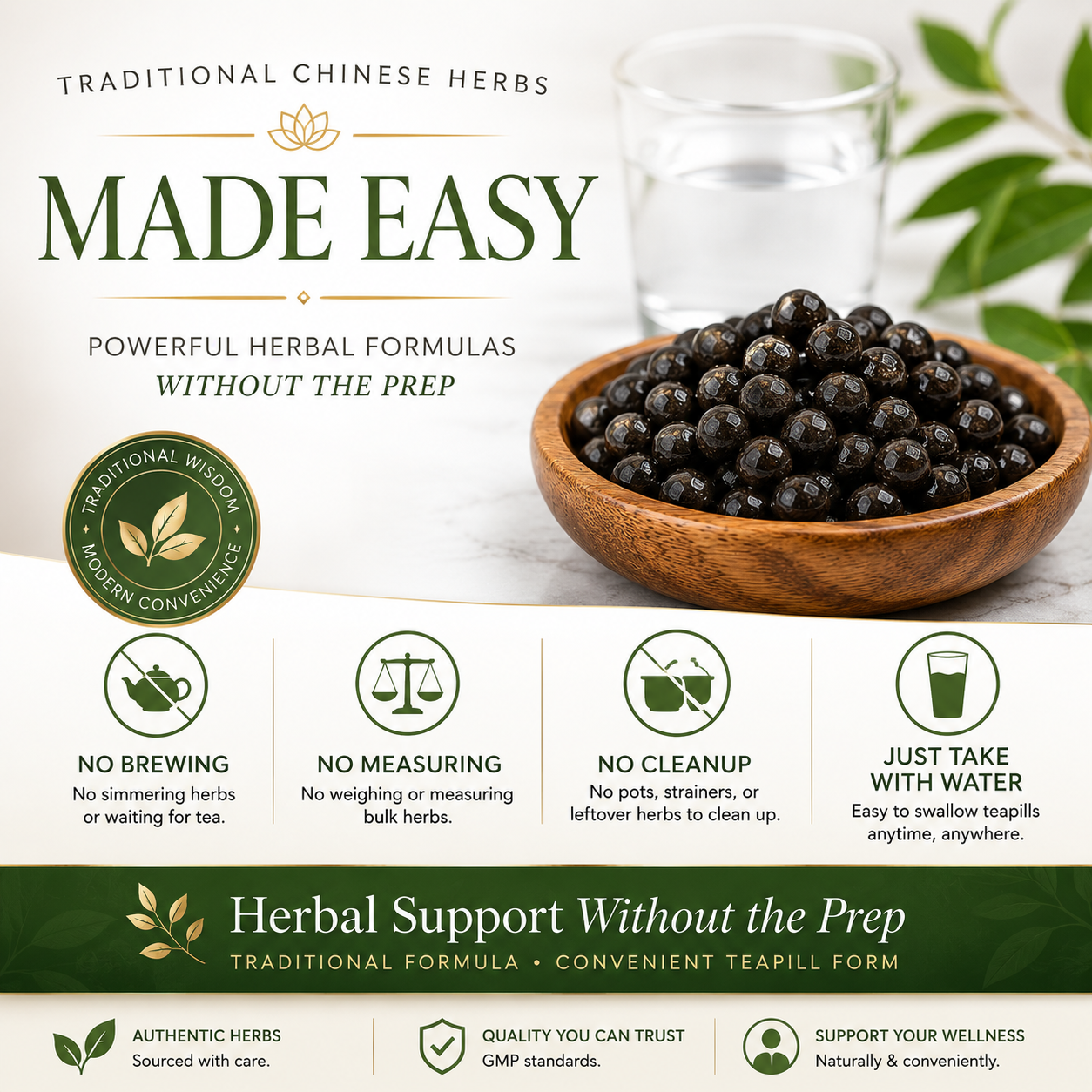
Why Are They Called “Teapills” If You Don't Make Tea?
This is one of the most common questions people have when first encountering Chinese teapills.
Despite the name, you do not brew Peach Kernel Teapills as tea.
Teapills are small prepared herbal pills designed to make traditional Chinese herbal formulas more convenient. They are swallowed with water according to the directions on the product label.
For people who do not want to prepare a traditional herbal decoction, teapills provide a portable and easy-to-use alternative.
Important Safety Information
Do not use during pregnancy.
Use caution while nursing.
This product contains peach kernel.
Keep out of reach of children.
If you take prescription medications, have a medical condition, are preparing for surgery, or are unsure whether Tao Ren Wan is appropriate for you, consult your physician, pharmacist, or qualified healthcare practitioner before use.
Because this formula contains multiple botanicals, potential herb-drug interactions should be considered based on the complete formula rather than evaluating peach kernel alone.
What Does Modern Research Say About These Herbs?
Modern scientific research and Traditional Chinese Medicine are different systems of evidence. Research on an individual ingredient does not prove that Tao Ren Wan treats a particular medical condition, nor can findings about one herb automatically be applied to the complete five-herb formula.
However, several ingredients in Peach Kernel Teapills have been the subject of published scientific research.
Tao Ren – Peach Kernel
A scientific review examines Persicae Semen (Tao Ren), including its traditional uses, phytochemistry, pharmacology, toxicology, and clinical applications.
PubMed PMID: 39073515
https://pubmed.ncbi.nlm.nih.gov/39073515/
Ya Ma Zi – Flax Seed
A published review examines flax and flaxseed oil, including historical use, pharmacology, interactions, adverse effects, toxicology, and dosing.
PubMed PMID: 17761128
https://pubmed.ncbi.nlm.nih.gov/17761128/
Da Huang – Chinese Rhubarb
A comprehensive review discusses the phytochemistry and pharmacology of several Rheum species, including Rheum palmatum.
PubMed PMID: 38852474
https://pubmed.ncbi.nlm.nih.gov/38852474/
Qiang Huo – Notopterygium
A systematic review examines the ethnopharmacology, phytochemistry, and pharmacology of Notopterygium incisum.
PubMed PMID: 28336469
https://pubmed.ncbi.nlm.nih.gov/28336469/
Dang Gui – Chinese Angelica Root
A review of Angelica sinensis discusses its botanical profile, traditional use, phytochemistry, chemical analysis, and modern research.
PubMed PMID: 27211015
https://pubmed.ncbi.nlm.nih.gov/27211015/
Research note: These references are provided for educational purposes. Research involving individual botanical ingredients, isolated compounds, laboratory models, or different herbal preparations should not be interpreted as clinical evidence for the finished Peach Kernel Teapills formula.
Frequently Asked Questions About Peach Kernel Teapills
Are Peach Kernel Teapills the same as Tao Ren Wan?
Yes. Tao Ren Wan is the Pin Yin name used for this Plum Flower Peach Kernel Teapills formula.
Is Run Chang Wan another name for Peach Kernel Teapills?
Run Chang Wan, Lubricate the Intestines Pills, Peach Kernel Pills, and Tao Ren Wan are names you may encounter when searching for this product. Because similarly named traditional formulas can have different ingredient combinations, always compare the actual ingredient label rather than relying on the English name alone.
Are Peach Kernel Teapills made only from peach kernel?
No. Despite the name, this is a five-herb formula containing Tao Ren, Ya Ma Zi, Da Huang, Qiang Huo, and Dang Gui.
Does this formula contain actual peach kernel?
Yes. Tao Ren is Prunus persica seed, commonly called peach kernel.
Does it contain Chinese rhubarb?
Yes. The formula contains Da Huang (Rheum palmatum) root and rhizome.
Does it contain Dang Gui?
Yes. Dang Gui (Angelica sinensis) root is one of the five herbal ingredients.
Do Peach Kernel Teapills have to be brewed?
No. They are prepared herbal pills and are taken according to the directions on the bottle. They are not loose herbs that need to be simmered into tea.
Can Peach Kernel Teapills be used during pregnancy?
No. The manufacturer's information states that this formula is contraindicated during pregnancy. Caution is advised while nursing.
Why Buy Peach Kernel Teapills From 1st Chinese Herbs?
When purchasing a traditional Chinese herbal formula, knowing exactly what you are buying matters.
At 1st Chinese Herbs, we believe customers should have access to more than a product name and an Add to Cart button. Our goal is to provide clear botanical identification, traditional-use information, ingredient details, safety information, and educational resources so you can make a more informed decision.
We have specialized in Chinese and Western herbs since 1994, and our focus remains straightforward: quality herbs, knowledgeable service, and useful herbal education.
Questions about this product? Contact us before ordering. We would rather help you understand what you are buying than have you choose a formula based solely on its name.
Proposition 65 Information
Official California Proposition 65 Website:
https://www.p65warnings.ca.gov/
Learn More About Proposition 65 and Herbal Products at 1st Chinese Herbs:
https://1stchineseherbs.com/understanding-prop-65-california/
The presence of a Proposition 65 warning does not necessarily mean that a product violates federal safety standards. Proposition 65 warning requirements are specific to California and are based on exposure thresholds established under California law.
Important Disclaimer
The information provided on this page is for educational purposes only and is based in part on the traditional use of herbs in Traditional Chinese Medicine.
Traditional-use descriptions are not intended to imply that this product has been clinically proven to produce the same effects under modern medical standards.
These statements have not been evaluated by the Food and Drug Administration. This product is not intended to diagnose, treat, cure, or prevent any disease.
Consult a qualified healthcare professional before using dietary supplements, particularly if you are pregnant, nursing, taking prescription medications, have a medical condition, or are preparing for surgery.