

Solitary Hermit Teapills – Du Huo Ji Sheng Wan
Traditional Chinese Formula for Stiff, Achy Joints, Lower Back & Knees
Do your lower back, knees, hips, or legs feel stiff and achy, particularly when the weather is cold or damp?
Solitary Hermit Teapills (Du Huo Ji Sheng Wan) is a classic Traditional Chinese Medicine formula traditionally used when joint and lower-body discomfort occurs along with a pattern TCM describes as Wind-Cold-Damp obstruction combined with underlying deficiency.
Rather than relying on one herb, this traditional 14-herb formula combines herbs traditionally used to dispel Wind-Damp, support comfortable movement, nourish Blood, tonify Qi, and strengthen the Liver and Kidney systems according to TCM theory.
For someone already familiar with Chinese herbal formulas for joints, Du Huo Ji Sheng Wan is one of the classic formulas worth knowing.
What Is Du Huo Ji Sheng Wan?
Du Huo Ji Sheng Wan (独活寄生丸) is a traditional Chinese herbal formula also known as:
-
Solitary Hermit Teapills
-
Du Huo Ji Sheng Wan
-
Tu Huo Ji Sheng Wan
-
Angelica Pubescens and Taxillus Pills
-
Du Huo Ji Sheng Tang
The formula is traditionally associated with Bi Zheng, commonly translated as an obstruction or painful-obstruction pattern.
In plain English, the traditional pattern may include aching, stiffness, heaviness, or reduced comfortable movement, particularly involving the lower back, knees, and legs.
Cold or damp weather may be part of the traditional symptom picture.
What makes Du Huo Ji Sheng Wan distinctive is that it does more than address the Wind-Damp component of the pattern. It also contains herbs traditionally used to nourish and strengthen someone whose discomfort occurs together with underlying weakness or deficiency.
 Product Details at a Glance
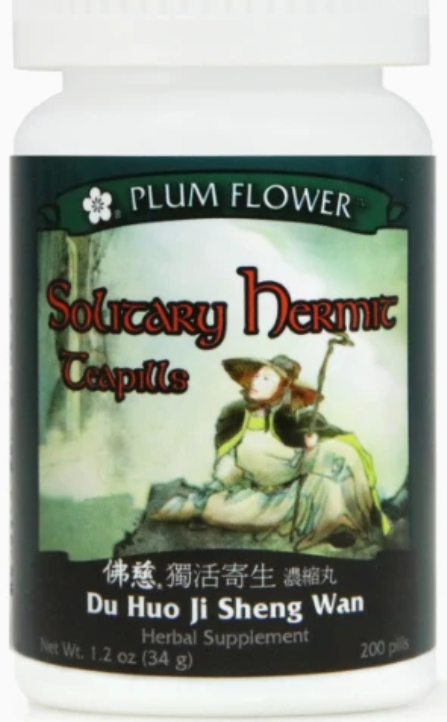
Traditional Name: Du Huo Ji Sheng Wan
English Name: Solitary Hermit Teapills
Brand: Plum Flower
Form: Prepared herbal teapills
Bottle Size: 200 teapills
Formula Size: 14 traditional herbs
Label Directions: 8 teapills, 3 times daily
Approximate Supply: About 8 days when used at label directions
Traditional Pattern: Wind-Cold-Damp obstruction with underlying deficiency
Traditional Focus: Lower back, knees, joints, tendons and bones
Preparation Required: None — swallow with water
Origin: China
What's in Solitary Hermit Teapills?
Du Huo Ji Sheng Wan is a balanced traditional formula containing herbs from several functional groups.
| Pinyin Name | Botanical Ingredient | Traditional Role |
|---|---|---|
| Sang Ji Sheng | Taxillus chinensis stem & leaf | Traditionally dispels Wind-Damp and supports tendons and bones |
| Shu Di Huang | Rehmannia glutinosa root, prepared | Nourishes Blood and Yin |
| Dang Shen | Codonopsis pilosula root | Tonifies Qi |
| Dang Gui | Angelica sinensis root | Nourishes and supports Blood |
| Fu Ling | Poria cocos sclerotium | Supports Spleen Qi and fluid balance |
| Du Huo | Angelica pubescens root | Traditionally dispels Wind-Damp, especially from the lower body |
| Huai Niu Xi | Achyranthes bidentata root | Traditionally strengthens tendons and bones and guides the formula downward |
| Du Zhong | Eucommia ulmoides bark, salt-fried | Traditionally tonifies Liver and Kidney and strengthens the lower back |
| Bai Shao | Paeonia lactiflora root | Nourishes Blood |
| Fang Feng | Saposhnikovia divaricata root | Traditionally dispels Wind |
| Qin Jiao | Gentiana macrophylla root | Traditionally clears Wind-Damp from the channels |
| Rou Gui | Cinnamomum cassia bark | Warms and supports circulation according to TCM theory |
| Chuan Xiong | Ligusticum chuanxiong rhizome | Traditionally invigorates Blood |
| Gan Cao | Glycyrrhiza uralensis root | Harmonizes the formula |
Other ingredients: Talcum, botanical wax.
Why Are There 14 Herbs?
This is where Du Huo Ji Sheng Wan differs from a simple single-herb joint formula.
Traditional Chinese Medicine looks at the overall pattern, not simply the location of discomfort.
The formula combines several traditional strategies:
Dispel Wind and Damp: Du Huo, Sang Ji Sheng, Fang Feng and Qin Jiao help address the traditional obstruction pattern.
Support the lower back, tendons and bones: Du Zhong, Sang Ji Sheng and Huai Niu Xi have traditional roles associated with the Liver and Kidney systems and musculoskeletal strength.
Nourish Blood: Shu Di Huang, Dang Gui and Bai Shao provide the nourishing side of the formula.
Support Qi: Dang Shen and Fu Ling help support the underlying Qi component.
Encourage movement within the formula: Chuan Xiong and Rou Gui complement the nourishing herbs while Gan Cao helps harmonize the overall combination.
This combination is why Du Huo Ji Sheng Wan is traditionally considered especially appropriate when stiffness or aching occurs together with weakness or deficiency, rather than being viewed simply as a formula for temporary discomfort.
Why Teapills & How Do I Use Them?
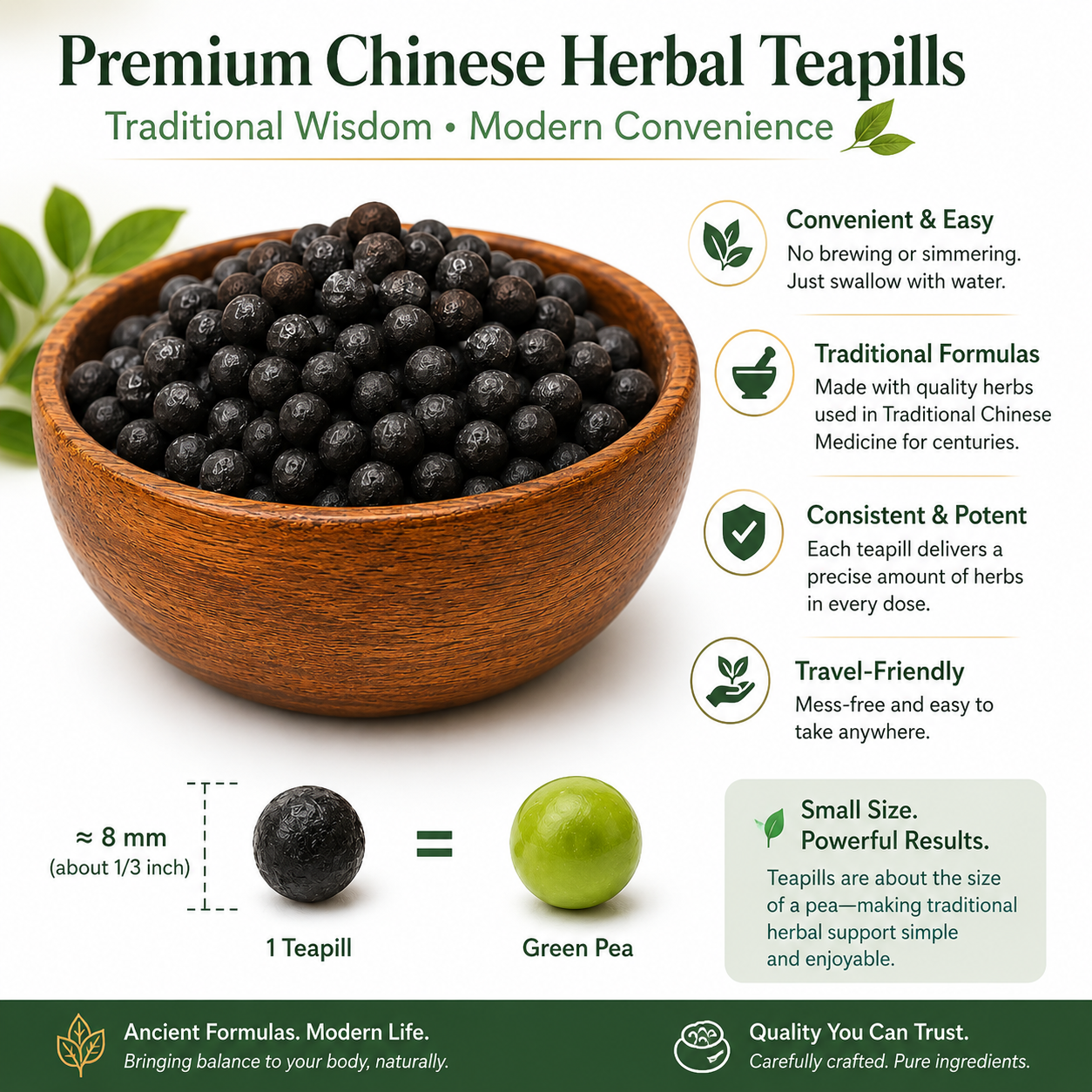
A traditional 14-herb formula can be time-consuming to prepare from individual bulk herbs.
Teapills make it much easier.
The herbs have already been combined and prepared into small pills, so there is no measuring 14 separate herbs, simmering a decoction, straining herbs, or drinking several cups of herbal tea each day.
Bottle directions: Take 8 teapills, 3 times daily.
Swallow the teapills with water. If you have a sensitive stomach, you may prefer taking them with food.
At the label dosage of 24 teapills per day, one 200-count bottle provides approximately 8 days of use.
Follow the product label unless your qualified healthcare professional or Traditional Chinese Medicine practitioner has recommended otherwise.
When Is Du Huo Ji Sheng Wan Traditionally Considered?
A practitioner may consider this formula when the traditional pattern includes some combination of:
-
Aching or stiffness involving the lower back and knees
-
Joint stiffness or uncomfortable movement
-
Heavy or tired-feeling legs
-
Discomfort traditionally associated with cold or damp conditions
-
Tendon or bone weakness according to TCM theory
-
A combination of obstruction and underlying deficiency
The pattern matters. Not every type of joint or back discomfort represents the traditional pattern associated with Du Huo Ji Sheng Wan.
Du Huo Ji Sheng Wan Research
Du Huo Ji Sheng Tang/Wan has also attracted modern scientific research. These studies are provided for educational purposes and do not establish that this product diagnoses, treats, cures, or prevents osteoarthritis or any other disease.
PubMed research:
Du Huo Ji Sheng Tang and cartilage degradation – animal study
Du Huo Ji Sheng Tang, inflammation and cartilage – animal study
Du Huo Ji Sheng Tang and joint-protective mechanisms – laboratory and animal research
Chinese herbal prescribing patterns for osteoarthritis in Taiwan
Du Huo Ji Sheng Tang and human mesenchymal stem cells – laboratory research
Angelica pubescens (Du Huo) – phytochemistry and pharmacology review
Research into traditional formulas includes laboratory, animal, observational, and other types of studies. Results from these studies should not be interpreted as proof that this product treats a medical condition.
Safety & Cautions
Do not use during pregnancy or while nursing.
Because Du Huo Ji Sheng Wan contains multiple herbs, consult your physician, pharmacist, or qualified herbal practitioner before use if you take prescription medications or have an existing medical condition.
If you have persistent, severe, unexplained, or worsening joint or back pain, seek appropriate medical evaluation rather than attempting to manage it solely with herbal products.
Frequently Asked Questions
Is Solitary Hermit the same as Du Huo Ji Sheng Wan?
Yes. Solitary Hermit is the English product name used for this Plum Flower formula. Du Huo Ji Sheng Wan is its commonly used Pinyin name.
Is Du Huo Ji Sheng Wan just for joints?
Traditionally, the formula is selected according to an overall TCM pattern rather than for one particular joint. The traditional pattern commonly involves the lower back, knees, legs, tendons, and bones along with Wind-Cold-Damp obstruction and underlying deficiency.
Is Du Zhong the main ingredient?
Du Zhong is an important herb in the formula, but Du Huo Ji Sheng Wan is a 14-herb traditional formula rather than a single-herb product. Du Huo (Angelica pubescens) is the namesake herb.
Do I have to brew these herbs?
No. That's one of the advantages of teapills. The traditional herbs have already been prepared into small pills that are swallowed with water.
How many teapills are in the bottle?
Each bottle contains 200 teapills.
How long does one bottle last?
The bottle directions state 8 teapills three times per day, or 24 per day. At that dosage, a 200-count bottle lasts approximately 8 days.
What do the teapills look like?
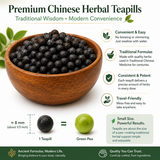
Plum Flower teapills are small, round prepared herbal pills designed to be swallowed with water. Their small size eliminates the need to prepare a traditional herbal decoction.
A Classic Formula for a Very Specific TCM Pattern
Du Huo Ji Sheng Wan has remained part of the Chinese herbal tradition because it brings together two important approaches: addressing Wind-Cold-Damp obstruction while simultaneously nourishing and strengthening the underlying system according to TCM theory.
For customers who recognize that traditional pattern and want the convenience of a prepared formula, Plum Flower Solitary Hermit Teapills provide all 14 traditional herbs in an easy-to-use 200-count bottle.
These statements have not been evaluated by the Food and Drug Administration. This product and information are not intended to diagnose, treat, cure, or prevent any disease. Information on this page describes traditional Chinese herbal theory and is provided for educational purposes.
1 Review
-
Excellent product
This formula is very well made and effective.