
The Two Most Dangerous Words in Gardening and Herbalism: “I’ll Remember”
Posted by Written by Sarah Johnson, Certified Herbalist, 1st Chinese Herbs. Trusted since 1994. on Jun 3rd 2026
The Two Most Dangerous Words in Gardening and Herbalism: “I’ll Remember”
Or: How I Accidentally Took My Energy Herb Before Bed, My Sleep Herb During the Day, Lost Track of My Seedlings, and Started a Bean Invasion.... What A Day To Remember
Quick Answer: If you use bulk herbs, loose teas, seeds, starter plants, or homemade blends, label everything immediately. Energy-style teas, calming herbs, seedlings, and mystery jars can look far too similar once they are out of their original packaging. A simple label can save you from late-night herbal surprises, sleepy afternoons, and garden chaos.
Before we begin, put the kettle on. Not for chamomile. We are not making that mistake today.
I’m talking about a proper afternoon tea. Maybe a nice Oolong with a slice of lemon. Maybe some Spiced Chai
Maybe something clearly labeled so you do not accidentally spend the night designing a greenhouse with a drawbridge, a tea room, and possibly a moat.
Because that is exactly where this story is headed.
And it all started with three dangerous words:
“I’ll remember.”
The Lie We Tell Ourselves
You know the lie. I know the lie. Every gardener knows the lie. Every herbalist knows the lie.
Every person with seventeen mystery containers in the freezer knows the lie.
It happens when you look at something and think:
“I don’t need to label that. I’ll remember.”
No. No, we will not. The older I get, the less I trust my memory and the more I trust masking tape. (Well, that is how I label my jars with green masking tape)
A Lifelong Character Flaw
Now, many of you know that at the time I am writing this, I am 67 years old. You would think by now I would have learned.
You would think after decades of gardening, growing herbs, planting seedlings, storing seeds, drying herbs, organizing jars, and occasionally reorganizing the same shelf three times while looking for something that was right in front of me, I would have figured this out.
I have not. The funny thing is that failing to label things is not a new problem.
It is not an age problem. It is not a memory problem. It is a personality trait. A lifelong little hiccup in my personality.
I have been doing this for as long as I can remember. Every spring, I confidently tell myself:
“I’ll remember what those seedlings are.”
Every summer I discover I will not. Every fall I find something in the garden and wonder:
“Now what exactly was your original purpose?”
Every winter I discover a mystery jar and begin a detective investigation worthy of its own television series.
At this point, not labeling things has become less of a mistake and more of a recurring hobby.
Present Me Continues to Believe Future Me Is Brilliant
The problem is that Present Me is incredibly optimistic. Present Me looks at a jar and says:
“I don’t need a label.”
Present Me looks at a tray of seedlings and says:
“I’ll know exactly what those are.”
Present Me plants pole beans and says:
“That should be plenty of room.”
Future Me would like a word.
Future Me is the one standing in the garden three months later staring at a jungle of bean vines that appear to be attempting interstate travel.
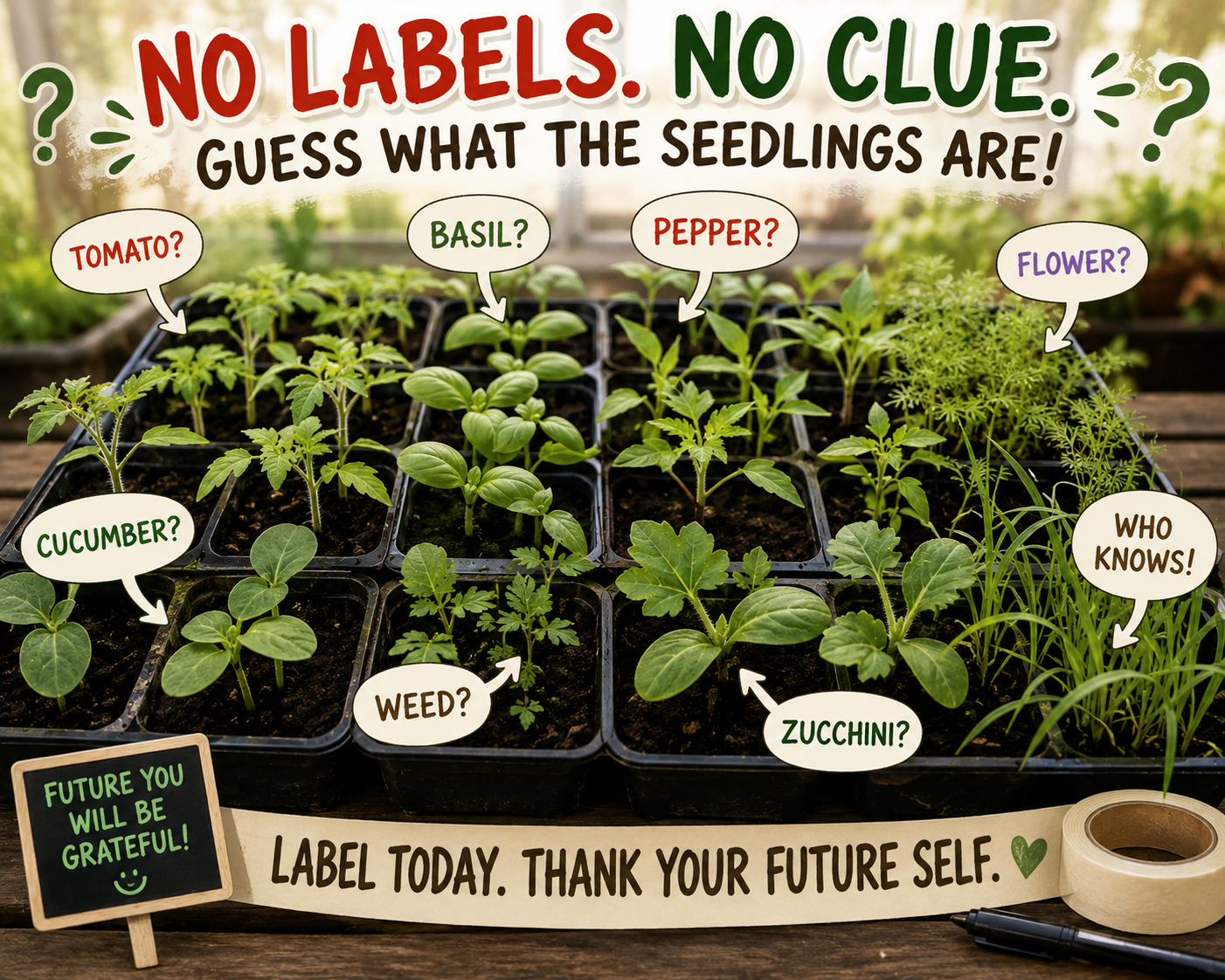
Future Me is the one looking at mystery seedlings trying to determine whether they are tomatoes, peppers, basil, flowers, or a weed that somehow earned indoor privileges.
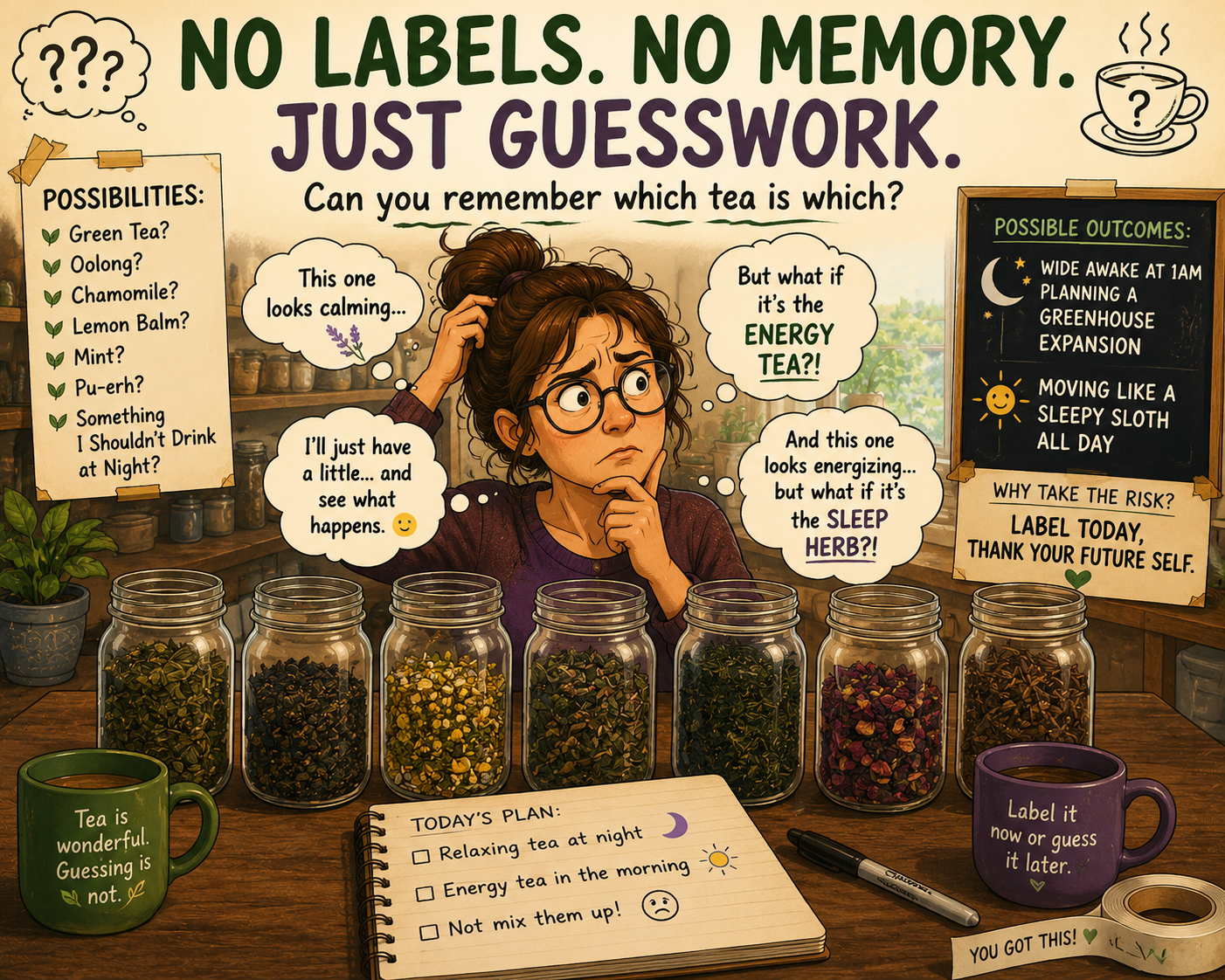
Future Me is the one holding two jars of herbs and realizing there is absolutely no way to know which one is supposed to help me relax and which one is supposed to help me tackle a Saturday chore list.
This is why labels matter. Not because we are fancy. Because Future Us cannot be trusted.
The Great Herbal Mix-Up
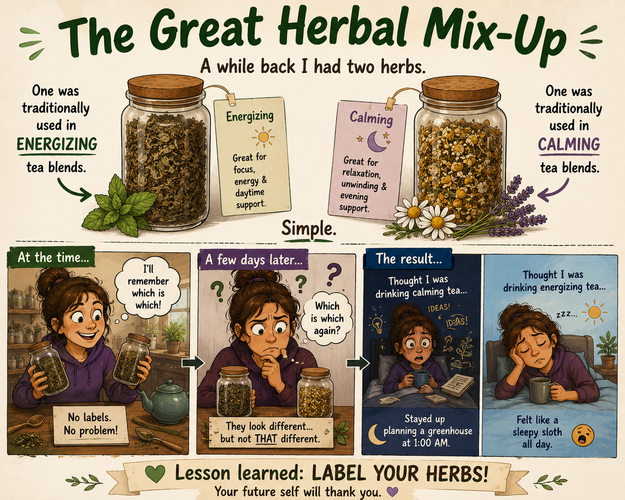
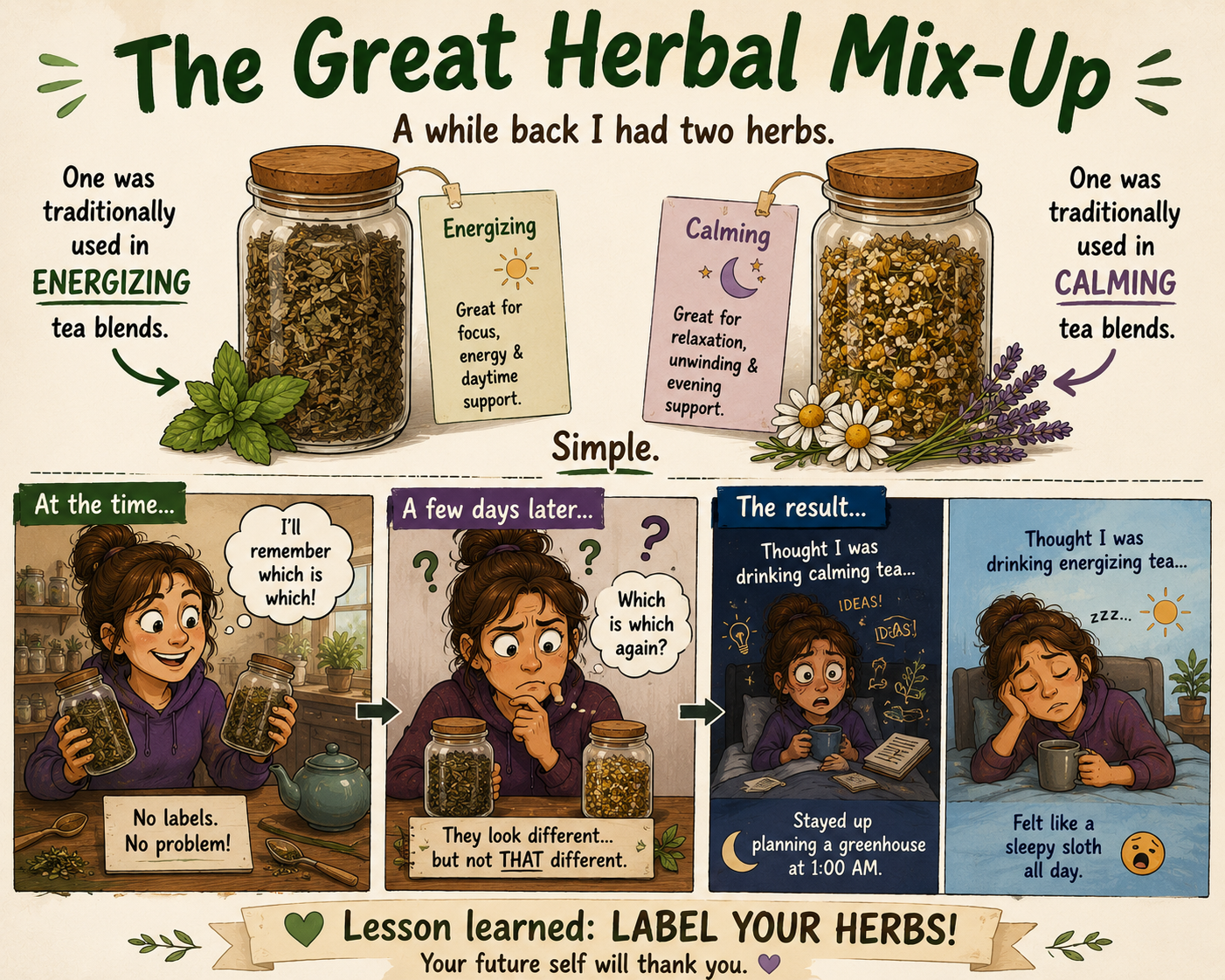
A while back I had two herbs. One was traditionally used in energizing tea blends.
One was traditionally used in calming tea blends. Simple.
At least that is what I thought. The herbs looked similar enough that I should have labeled them.
Did I? Of course not.
Because apparently I was operating under the belief that my memory had achieved superhero status.
A few days later I walked into the kitchen, looked at the jars, and immediately realized I had no idea which herb was which.
Now a sensible person would stop right there. A sensible person would investigate.
A sensible person would pull out notes, check the packaging, smell carefully, compare textures, and use basic adult judgment. I was not that sensible person. I guessed.
The Night Everything Went Wrong
That evening I brewed what I believed was my relaxing tea.
I settled into bed expecting peace. Calm. Tranquility. Maybe even eight glorious hours of sleep.
Instead, my brain apparently received a memo marked:
URGENT. ALL DEPARTMENTS REPORT IMMEDIATELY.
At 9:30 PM I wanted to reorganize the pantry.
At 10:00 PM I was planning next year’s garden.
At 11:00 PM I was researching greenhouse designs.
By midnight I had expanded the blueberry patch another twenty feet in my head.
By 1:00 AM I was mentally pricing lumber.
At 2:00 AM I was considering whether a greenhouse should have a moat.
Not because it needed one.
Because it seemed like a good idea at the time.
That was my first clue that perhaps I had not chosen the relaxing herb.
The Following Morning
The next day I drank the other herb. The one that was supposedly energizing. Surely this would fix everything.
Instead, I spent the day moving with all the enthusiasm of a sleepy sloth on vacation. Coffee was not helping.
Tea was not helping. Fresh air was not helping. At one point I seriously considered taking a nap in a chair that was not even comfortable.
That is when realization hit me. I had switched the herbs. The calming herb had become the energizing herb.
The energizing herb had become the calming herb. And I had spent twenty-four hours wondering why my body seemed to be following instructions from the wrong manual.
Why Mixing Up Herbs Matters
Here is where the funny story becomes an actual herbal lesson. Not all herbs are the same.
Not all teas are the same. And some herbs are about as different as a rocking chair and a lawn mower.
One is for slowing down. The other is for getting things done. Mixing them up can make your evening very productive and your daytime very questionable.
Energy Teas vs Relaxing Teas: Why Labels Matter
When people first begin using loose teas or bulk herbs, they often assume they will be able to identify everything by sight or smell.
That confidence lasts until the third unlabeled jar.
After that, everything starts looking like dried leaves, twigs, roots, flowers, or “something I definitely bought for a reason.”
Traditional Daytime Tea Favorites
These are the types of teas many people enjoy earlier in the day, especially when they want to feel more alert, focused, or ready to tackle a project.
| Tea or Herb | Why People Use It During the Day | Flavor Personality |
|---|---|---|
| Oolong Tea | A classic afternoon tea with a smooth, balanced character. | Toasty, floral, sometimes creamy. |
| Pu-erh Tea | Often enjoyed after meals or as a deeper, earthy daytime tea. | Earthy, rich, bold. |
| Green Tea | A lighter daytime tea many people enjoy for focus and routine. | Fresh, grassy, clean. |
| Yerba Mate | Often chosen by people who want a stronger daytime tea experience. | Bold, green, slightly bitter. |
| Astragalus Root | A traditional tonic herb often used in daytime soups, teas, and broths. | Mild, root-like, slightly sweet. |
These are generally the teas you want before cleaning the garage, organizing the pantry, answering emails, or convincing yourself that expanding the garden is a reasonable decision.
They are not usually the teas you want right before bed unless your evening goal is to mentally redesign your entire property.
Traditional Evening and Relaxing Tea Favorites
These are the teas many people associate with slowing down, unwinding, and preparing for a quieter evening.
| Tea or Herb | Why People Use It in the Evening | Flavor Personality |
|---|---|---|
| Chamomile | A classic evening tea many people associate with winding down. | Floral, soft, apple-like. |
| Lemon Balm | Often used in relaxing tea blends for its bright, gentle taste. | Lemony, green, mild. |
| Lavender | Used in small amounts for floral relaxation-style blends. | Floral, aromatic, strong if overused. |
| Chrysanthemum | A gentle floral tea often used in traditional Chinese tea culture. | Light, floral, refreshing. |
| Albizzia Bark | A traditional herb often discussed in relation to calm and emotional balance. | Woody, earthy, slightly sweet. |
These are generally the teas you want when your brain needs to stop acting like it has a clipboard and a list of unfinished tasks. Which is exactly why labeling matters.
Then I Remembered the Seedlings
And that is when things got worse. Because I do not only do this with herbs. I do it with plants too.
Every spring I start seeds. Every spring I tell myself:
“I’ll remember what those are.”
Every spring I am wrong. Without fail. I will be standing in front of a tray of seedlings staring at tiny green leaves.
Tomato? Pepper? Basil? Flower? Weed? Tiny alien life form?
Nobody knows. Certainly not me.
And that is how you end up treating a weed like a precious heirloom vegetable for six weeks.
The Great Bean Disaster
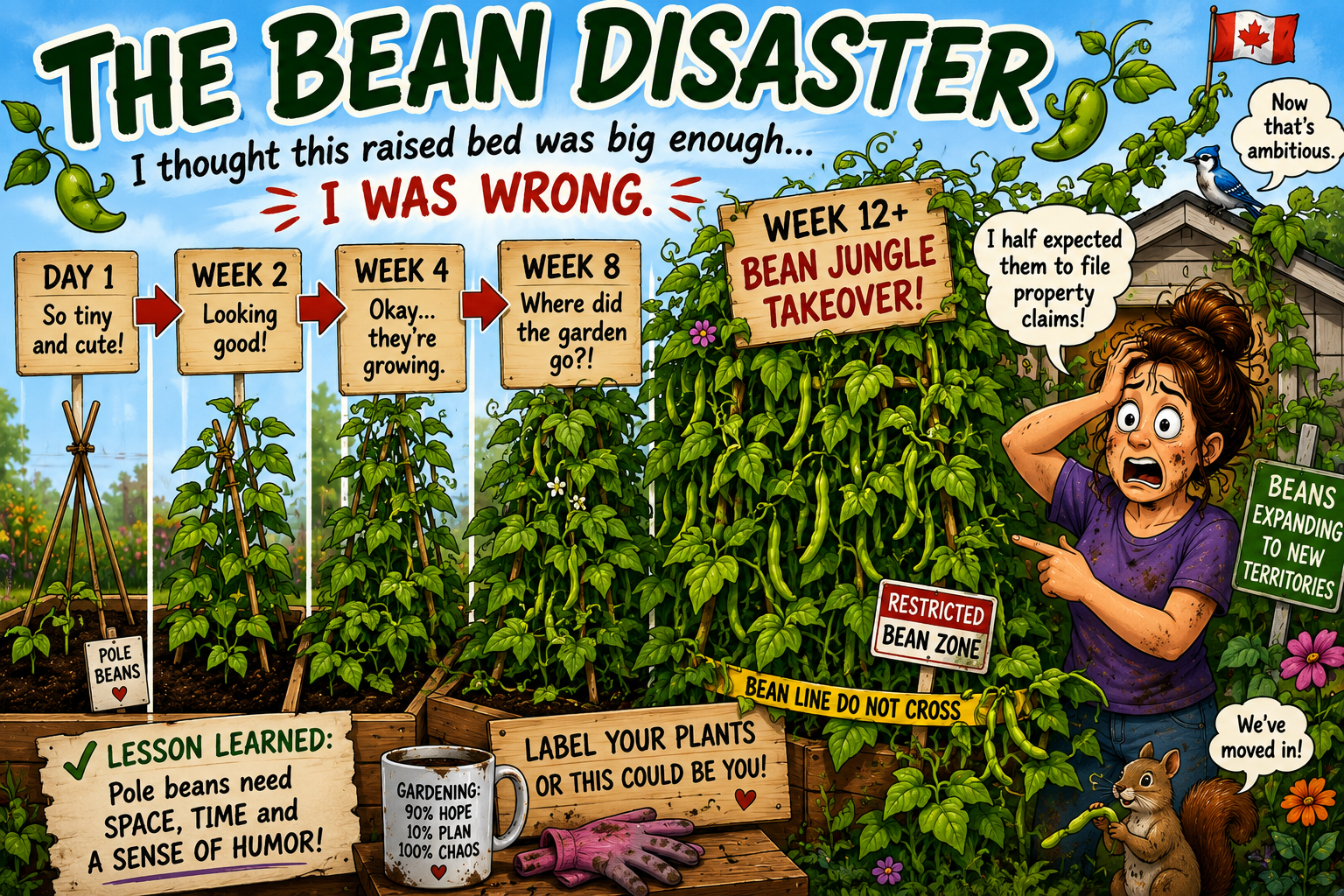
The beans deserve their own chapter. One year I planted pole beans.
Now, if you have never grown pole beans, let me explain something.
Pole beans do not simply grow. Pole beans conquer.
They see a trellis and immediately begin plotting world domination.
Apparently I forgot that. Because I planted them in a raised bed that was far too small.
At first everything looked fine. A week later they were growing nicely.
A month later they had taken over the bed. Two months later they appeared to be expanding into neighboring territories. I half expected them to demand property taxes.
One vine was making a serious attempt at reaching Canada. (And we are 19 miles away from Canada)
Another appeared to be evaluating the roof. The entire situation could have been avoided if I had remembered one important detail:
Pole beans need space.
Apparently much more space than I gave them.
My Gardening Hall of Shame
Since we are already confessing things, here are a few additional accomplishments.
- I have forgotten to label pepper seedlings.
- I have protected a weed because I thought it was a rare flower.
- I have watered volunteer plants I did not actually want.
- I have mixed up squash varieties.
- I have forgotten where I planted something.
- I have found seeds in my pocket months later.
- I have discovered mystery herbs I purchased years ago.
- I have looked at a jar and thought, “This was important at some point.”
I am not proud of any of these.
But I suspect I am not alone.
The Unofficial Herbal Confession Booth
Have you ever:
- Found an unlabeled herb?
- Planted something and forgotten what it was?
- Started seeds without labels?
- Discovered mystery food in the freezer?
- Made tea and realized halfway through it was not what you thought?
- Looked at a plant and wondered if it was intentional?
- Saved original packaging for three weeks and then threw away the one bag you actually needed?
If you checked even one box, welcome to the club.
Membership is free. Confusion is included.
How to Label Herbs So Future You Does Not Suffer
Here is the system I recommend, mostly because I have learned the hard way what happens without one.
1. Label the Herb Name
Use the common name and the Chinese name if you know both.
Example:
Astragalus Root / Huang Qi
2. Add the Date Purchased
This helps you rotate herbs and avoid the dreaded mystery jar from three years ago.
3. Add the Form
Is it cut?
Powder?
Whole?
Granules?
This matters more than people think.
4. Add a Simple Use Note
For example:
- Daytime tea
- Evening tea
- Soup herb
- Decoction herb
- For formulas only
You do not need to write a novel on the jar.
Just enough to keep Future You from making a poor bedtime decision.
5. Keep Original Packaging Until You Are Certain
Original packaging is not clutter.
It is evidence.
Do not throw away the evidence until the herb is properly labeled.
How to Label Seedlings So the Garden Does Not Become a Guessing Game
Seedlings are even worse than herbs because at least herbs usually stay in the jar.
Plants grow. They wander. They lean. They climb.
They disguise themselves as other plants until you are standing there in July wondering how the zucchini ended up where the cucumbers were supposed to be.
For Seedlings, Label:
- Plant name
- Variety
- Date started
- Expected size
- Whether it climbs, sprawls, bushes, or causes trouble
That last category is important.
Some plants absolutely cause trouble.
Pole beans know who they are.
The Real Lesson
This story is not really about herbs.
Or seedlings. Or beans. It is about confidence. The dangerous kind.
The kind that says:
“I’ll remember.”
Because every gardener says it.
Every herbalist says it.
Every cook says it.
And every single one of us eventually discovers that Future Me is not nearly as reliable as Present Me believes.
The Moral of the Story
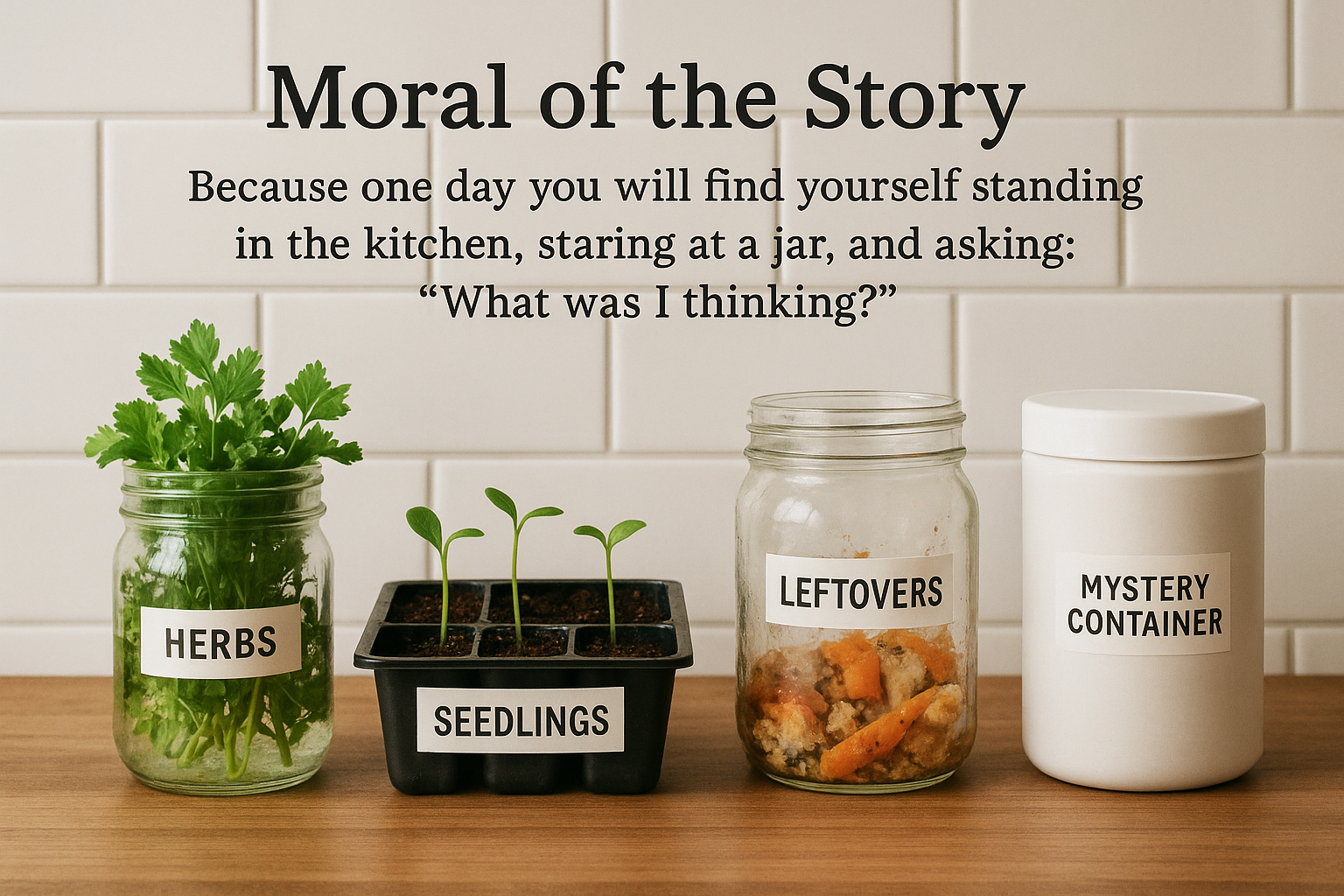
Label the herbs.
Label the seedlings.
Label the leftovers.
Label the mystery container.
Label everything.
(Do you see the theme here..... Label)
Because one day you will find yourself standing in the kitchen, staring at a jar, and asking:
“What was I thinking?”
And the answer will almost always be:
“I thought I’d remember.”
And that is usually where the trouble starts.
Need Help Learning Bulk Herbs?
If you are new to bulk herbs, loose teas, or traditional Chinese herbs, start simple. Keep the original package, label your jars, and learn one herb at a time.
Helpful next steps:
Your Turn
What is the funniest gardening, herbal, or kitchen mistake you have ever made?
Did you mix up herbs?
Lose track of seedlings?
Grow a bean jungle?
Accidentally nurture a weed?
Send us your story.
After the Midnight Greenhouse Planning Session and the Great Bean Expansion Project, I promise you will not be the most embarrassing story we receive.
Sarah
1st Chinese Herbs
Trusted Since 1994
Get Real Herbs. Feel the Difference.
Update June 3, 2026 (Yes, I remembered to label this)
Important Note: This article is for educational and entertainment purposes only. Herbal products are not intended to diagnose, treat, cure, or prevent disease. Always consult a qualified healthcare professional before using herbs, especially if you are pregnant, nursing, taking medications, or managing a medical condition.