

Kun Bu – Laminaria japonica, Whole Pieces, 500 Grams
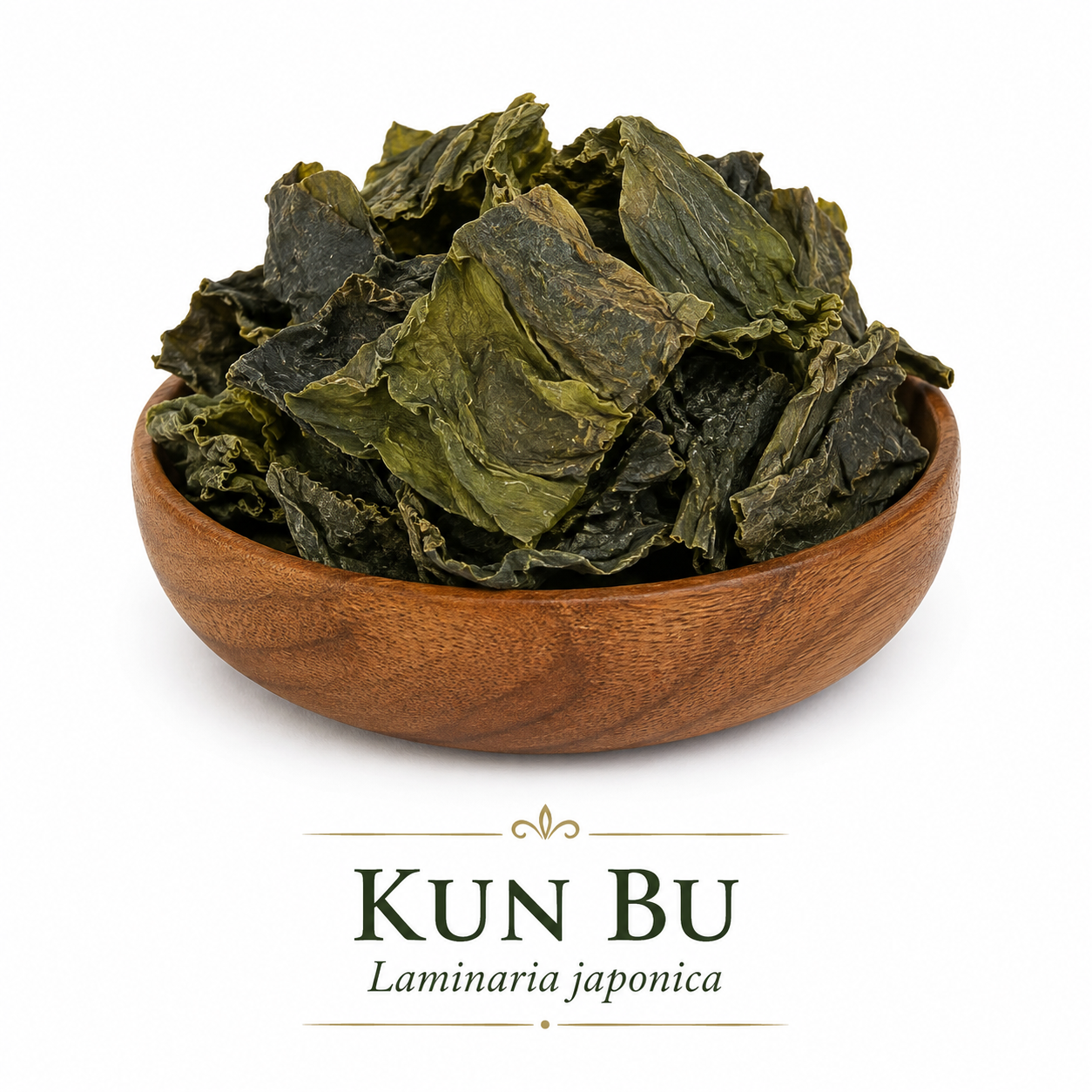 Authentic whole Kun Bu with naturally irregular pieces, a distinctive marine aroma, and the salty character traditionally associated with this Chinese sea herb.
Kun Bu is a geo-authenticated, sulfur-free brown seaweed sourced from China and packaged in a generous 500-gram bag (1.1 pounds). It is intended for customers, herbal students, and practitioners looking for the traditional whole herb rather than a powdered kelp supplement or a uniform culinary product.
Each piece reflects the natural character of the harvested seaweed. Length, width, thickness, color, and shape will vary. That variation is expected and is part of purchasing Kun Bu in a minimally processed whole form.
Product Details Kun Bu
| Pinyin Name | Kun Bu |
|---|---|
| Chinese Name | 昆布 |
| Botanical Name on Product | Laminaria japonica |
| Accepted Botanical Synonym | Saccharina japonica |
| Common Description | Japanese kelp, brown seaweed, traditional Chinese sea herb |
| Traditional Category | Herbs that traditionally transform phlegm and soften hardness |
| Traditional Flavor | Salty |
| Traditional Nature | Cold |
| Traditional Meridians | Liver, Stomach, and Kidney |
| Brand | Plum Flower |
| Form | Whole dried pieces; sizes and shapes are not uniform |
| Package Size | 500 grams, approximately 1.1 pounds |
| Country of Origin | China |
| Processing | Sulfur-free |
| Authentication | Geo-authenticated |
| Ingredients | 100% Laminaria japonica |
What Is Kun Bu?
Kun Bu is a traditional Chinese sea herb made from dried brown seaweed. This product is labeled Laminaria japonica, a name still commonly used in herbal commerce. Modern taxonomic references generally accept Saccharina japonica as the updated botanical name for the same species.
Unlike roots, bark, flowers, or seeds, Kun Bu grows in a marine environment. It develops broad, blade-like sections that are harvested and dried into pieces. These pieces may be folded, curled, thick, thin, broad, narrow, or partially broken.
Kun Bu is also known outside Chinese herbalism as a type of kelp. However, the terms kelp, kombu, and Kun Bu should not automatically be treated as interchangeable. Species, sourcing, processing, form, and intended use can differ.
Traditional Chinese Herbal Characteristics
Traditional Chinese herbalism describes herbs according to qualities such as flavor, temperature, meridian entry, and traditional category. These classifications describe how practitioners historically understood and selected an herb. They are not the same as modern medical diagnoses or drug actions.
What does “salty” mean traditionally?
In traditional herbal language, the salty flavor is associated with softening hardness and supporting the movement of accumulated material. Kun Bu’s naturally marine and salty character is therefore central to its traditional classification.
What does “cold” mean traditionally?
A cold nature indicates that Kun Bu was traditionally selected within formulas for patterns described as involving heat or firm accumulation. This does not mean the herb simply feels cold when touched or consumed.
 How Has Kun Bu Traditionally Been Used?
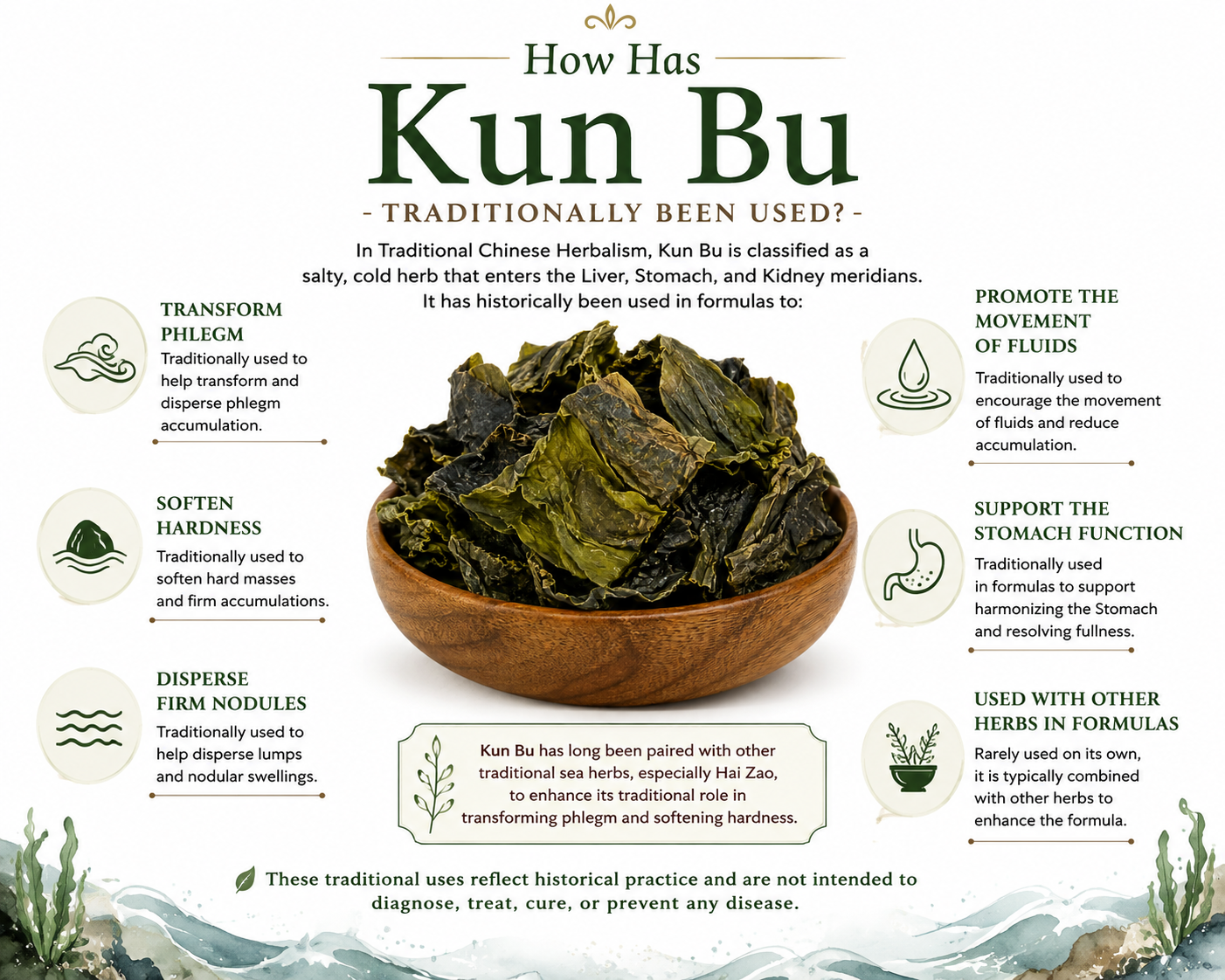
In Traditional Chinese Medicine, Kun Bu has historically been placed in the category of herbs said to transform phlegm, soften hardness, and disperse firm accumulations. It has also traditionally been used in formulas intended to encourage the movement of fluids.
Practitioners do not generally choose Kun Bu simply because someone wants “kelp” or a source of minerals. It is traditionally selected according to an overall pattern, the other herbs in the formula, and the individual’s constitution.
Kun Bu is frequently discussed alongside Hai Zao because both are salty, cold sea herbs with overlapping traditional roles. Even so, they are separate herbs and may contribute differently to a traditional formula.
Who Is This Kun Bu Best For?
- Customers following a traditional formula that specifically calls for Kun Bu.
- Practitioners preparing customized Chinese herbal formulas.
- Students learning to identify whole traditional herbs.
- Customers who prefer whole pieces rather than powdered kelp.
- Buyers looking for sulfur-free, geo-authenticated Kun Bu.
- This product may not be the right choice for someone simply seeking a general iodine supplement, a culinary seasoning, or a uniform powdered ingredient.
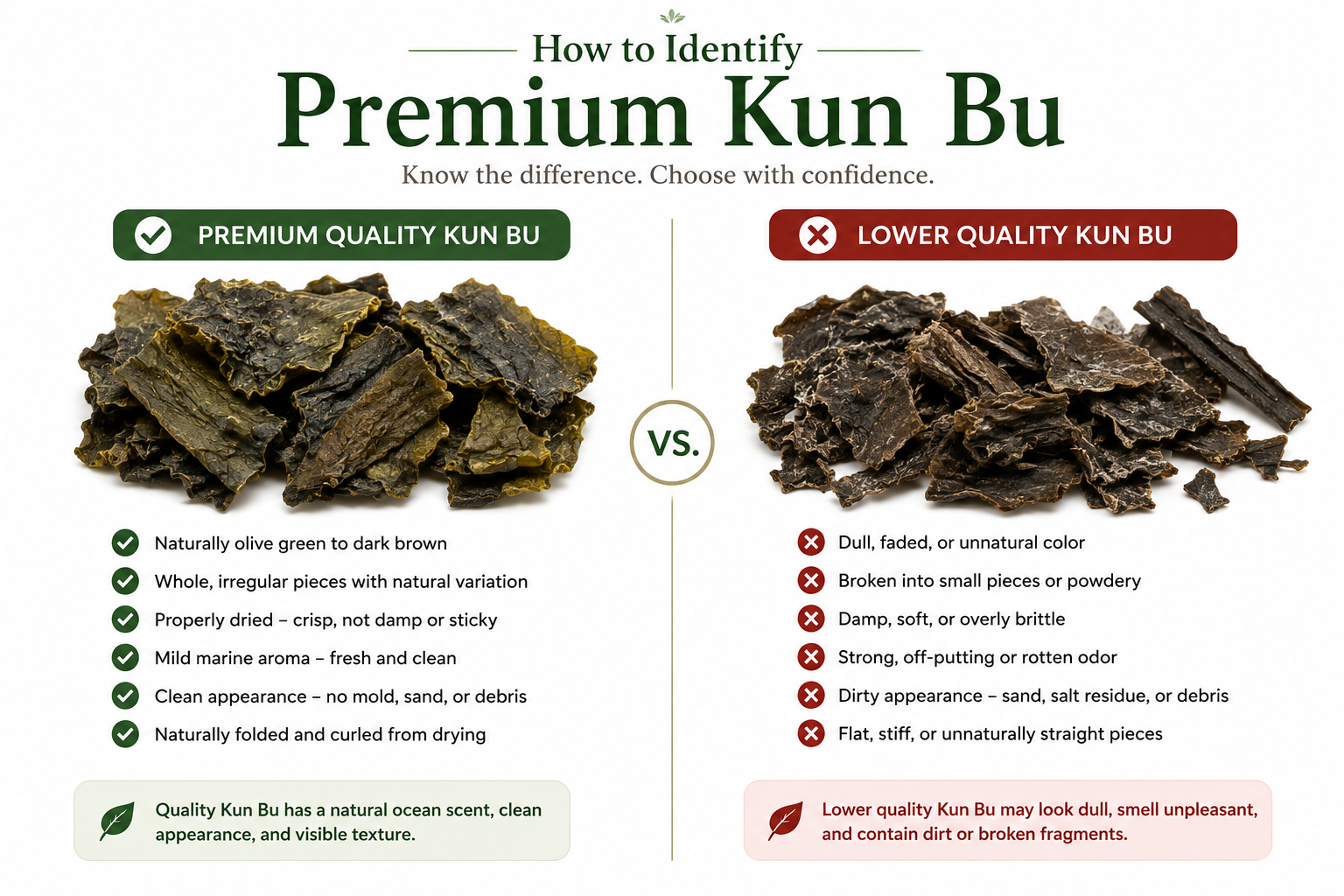
What Does Quality Kun Bu Look Like?
Quality whole Kun Bu should look like a naturally harvested and dried marine ingredient. It should not look perfectly uniform.
- Color may range from olive-brown to deep brown or nearly black-brown.
- Pieces may be broad, narrow, curled, folded, thick, or thin.
- A natural ocean-like or marine aroma is expected.
- The material should feel properly dried rather than wet or slimy.
- Minor salt or natural marine residue may be present.
- Some breakage and uneven edges are normal.
Signs that deserve closer inspection
- Visible mold.
- Unusual dampness inside the package.
- A rotten, sour, or strongly fermented odor.
- Signs of insect activity or improper storage.
What Does Kun Bu Taste Like?
Kun Bu has a noticeable salty, mineral, and ocean-like taste. Some people may also notice savory or mildly earthy undertones. The exact intensity varies according to the thickness of the pieces, the batch, and the method of preparation.
Its marine taste is normal and is one reason Kun Bu is traditionally classified as a salty herb. Customers who dislike ocean-flavored ingredients should be aware that Kun Bu does not taste like a mild root or neutral herbal tea.
How Is Whole Kun Bu Traditionally Prepared?
Whole Kun Bu is commonly used as part of a traditional water-based herbal preparation. Before use, inspect the pieces and follow the instructions supplied by the practitioner who selected the formula.
A brief rinse may be used to remove loose surface salt or natural marine residue. Because the pieces are irregular, they may be cut into smaller portions when a formula requires easier measuring or more even preparation.
Kun Bu is commonly combined with other herbs rather than used as a casual stand-alone tea. Preparation time and order can vary according to the formula.
Buying Tips for Whole Kun Bu
- Choose whole pieces when visual identification and traditional bulk preparation matter to you.
- Do not expect every piece to be the same length, width, or thickness.
- Confirm the botanical name rather than relying only on the words kelp or kombu.
- Look for clear information about processing, origin, ingredient, and form.
- Store the opened bag tightly sealed and away from humidity.
Kun Bu Compared With Similar Products
| Product | What It Is | Why the Difference Matters |
|---|---|---|
| Kun Bu | A traditional Chinese sea herb. This product contains whole Laminaria japonica pieces. | Best chosen when a traditional formula or practitioner specifically calls for Kun Bu. |
| Hai Zao | A separate traditional Chinese sea herb with overlapping but not identical traditional uses. | Kun Bu and Hai Zao are sometimes paired, but they should not automatically be substituted for one another. |
| Culinary Kombu | Seaweed sold primarily for soups, broths, seasoning, or food preparation. | Culinary sourcing, species, processing, cut, and intended use may differ from a traditional bulk herb. |
| Kelp Powder or Supplement | Ground or concentrated kelp sold for convenience or nutritional supplementation. | Powder does not allow the customer to inspect whole-piece identity and may be standardized or blended differently. |
What You Need To Know
The important lesson is not simply that Kun Bu is kelp.
The important lesson is that not every kelp product is the same. Botanical species, whole versus powdered form, processing, sourcing, and intended use all matter.
A package labeled “kelp” may be appropriate for cooking or general supplementation, but a traditional formula calling for Kun Bu is asking for a specifically identified herbal ingredient.
What Does Modern Research Examine?
Modern studies of Laminaria and Saccharina species have examined naturally occurring iodine, alginates, fucoidan, laminarin, minerals, and other marine polysaccharides.
Much of this research involves isolated constituents, laboratory models, foods, supplements, or concentrated extracts. Those findings should not be interpreted as proof that whole dried Kun Bu can diagnose, prevent, treat, or cure a disease.
One especially relevant area of research concerns iodine variability. Studies have shown that iodine content can differ greatly among seaweed species, products, harvest conditions, and preparation methods. This variability is important when evaluating frequent use, thyroid concerns, or combined use with other iodine-containing products.
Frequently Asked Questions About Kun Bu
What meridians is Kun Bu traditionally associated with?
Kun Bu is traditionally associated with the Liver, Stomach, and Kidney meridians.
What is the traditional flavor and nature of Kun Bu?
Kun Bu is traditionally described as salty in flavor and cold in nature.
Is Kun Bu the same as kelp?
Kun Bu is a traditional herbal name for certain brown seaweeds. This Plum Flower product contains Laminaria japonica, which is a kelp species. However, not every product labeled kelp is necessarily the same species or prepared for the same purpose.
Why is Laminaria japonica also called Saccharina japonica?
Laminaria japonica is an older botanical name still widely used in herbal commerce. Modern taxonomy generally accepts Saccharina japonica as the updated name.
Why are the whole pieces different sizes?
Kun Bu is a naturally harvested seaweed. Growth, harvesting, drying, folding, cutting, and normal breakage create pieces with different lengths, widths, thicknesses, and shapes.
Should Kun Bu smell like the ocean?
Yes. A natural marine or ocean-like aroma is expected. A rotten, moldy, or strongly sour smell is not typical.
Is whole Kun Bu better than powder?
Neither form is automatically better. Whole pieces allow visual inspection and suit traditional bulk preparations. Powder may be more convenient but does not provide the same visible identity.
Is Kun Bu the same as culinary kombu?
They may sometimes come from the same or related kelp species, but culinary kombu is sold primarily as food. Sourcing, preparation, labeling, cut, and intended use may differ.
How should Kun Bu be stored?
Keep it tightly sealed in a cool, dry, dark place away from steam, humidity, direct sunlight, and strong odors.
Kun Bu Safety and Cautions
Kun Bu naturally contains iodine, and the amount in kelp can vary considerably. It should not be treated as though every piece or batch provides an identical iodine level.
Consult a qualified healthcare professional before use if you have a thyroid condition, kidney disease, heart disease, iodine sensitivity, or another significant health condition.
Professional guidance is also important for people taking thyroid medication, lithium, iodine-containing products, anticoagulants, diuretics, potassium products, or other prescription medications.
Do not use during pregnancy or nursing unless specifically approved by a qualified healthcare professional familiar with your complete health history.
Keep out of reach of children. Stop use and seek professional guidance if an unexpected reaction occurs.
Continue Learning
Research References
- AlgaeBase. Saccharina japonica. Accepted botanical name with Laminaria japonica listed as the basionym. View Taxonomy Reference
- Teas J, Pino S, Critchley A, Braverman LE. Variability of iodine content in common commercially available edible seaweeds. Thyroid. 2004. View on PubMed
- Smyth PPA. Iodine, seaweed, and the thyroid. European Thyroid Journal. 2021. View on PubMed
- Leung AM, Braverman LE. Iodine-induced thyroid dysfunction. Current Opinion in Endocrinology, Diabetes and Obesity. 2012. View on PubMed