Understanding Herbal Extracts: Powdered Extracts

Understanding Herbal Extracts: Powdered Extracts, Ratios, Quality & Uses

Exploring the World of Herbal Powdered Extracts

Herbal powdered extracts bring together traditional botanical knowledge and modern extraction methods. From familiar Chinese herbs such as Astragalus (Huang Qi) and Ginseng (Ren Shen) to Schisandra (Wu Wei Zi) and Goji Berry (Gou Qi Zi), concentrated herbal extracts offer a convenient way to explore botanical ingredients in a compact, easy-to-store form.

But what exactly makes an herbal extract different from a regular herb powder? What do labels such as 5:1, 6:1, 10:1, or 20:1 mean? And how can you compare different manufacturers?

At 1st Chinese Herbs, family-owned since 1994, we believe understanding the products you purchase is an important part of choosing quality herbs.

This guide explains how powdered extracts are manufactured, how to interpret concentration ratios, what to look for on product labels, and how to store herbal extracts properly.

Understanding herbal extracts and how to use them

What Is an Herbal Powdered Extract?

An herbal powdered extract is a botanical preparation made by extracting selected constituents from plant material and processing the resulting extract into a dry powder.

Unlike ordinary ground herbs, which generally contain the milled botanical material, extract powders undergo additional manufacturing steps.

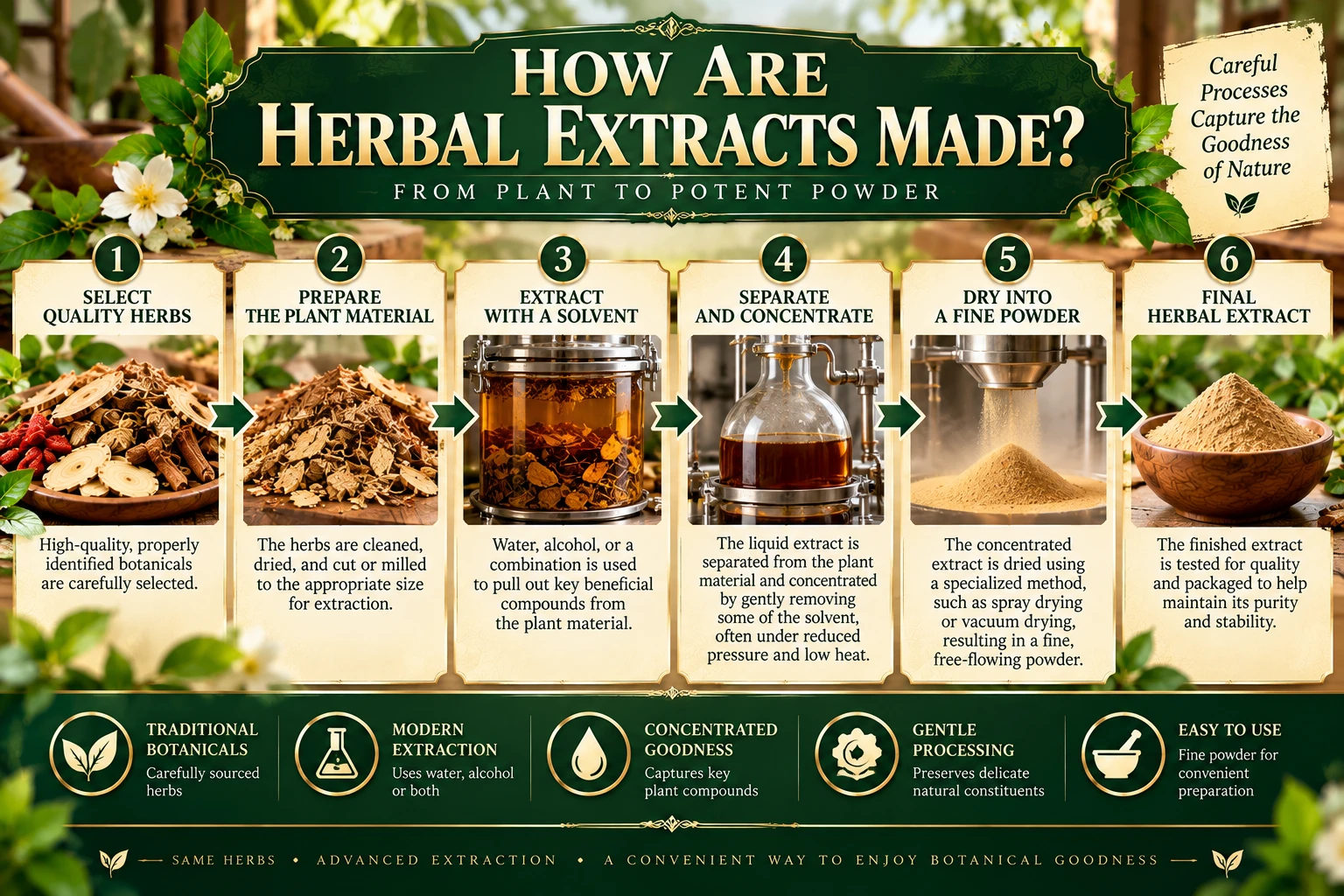
These steps may include:

  1. Selecting and identifying the botanical material.

  2. Preparing the appropriate plant parts for extraction.

  3. Extracting selected constituents using water, alcohol, or another suitable solvent.

  4. Separating the liquid extract from the remaining plant material.

  5. Concentrating the extracted solution.

  6. Drying the concentrate into a powdered form.

  7. Testing and packaging the finished product according to the manufacturer's procedures.

The resulting extract may have a different chemical composition from the original botanical material.

Important: Not all herbal extracts are standardized, and a concentrated extract is not automatically more effective than the whole herb.

What is the process of making herbal extracts

How Are Herbal Powdered Extracts Made?

The manufacturing process begins with the botanical ingredient itself.

1. Botanical Identification

Manufacturers identify the botanical species and plant part used in production.

This is especially important in Chinese herbal medicine because different species or plant parts may have different traditional uses and chemical compositions.

2. Preparation of Plant Material

Depending on the botanical and manufacturing process, herbs may be cleaned, dried, sliced, crushed, or milled before extraction.

3. Extraction

A suitable extraction solvent is used to obtain selected soluble constituents.

Common extraction methods include:

Water extraction: Frequently used for water-soluble botanical constituents.

Alcohol extraction: Used to extract certain constituents that may not dissolve as readily in water.

Water-alcohol extraction: Combines solvents to obtain a broader selection of compounds, depending on the botanical.

Other specialized methods: Some manufacturers use techniques such as supercritical carbon dioxide extraction.

Different methods produce different extract profiles.

4. Concentration

After extraction, the liquid may be concentrated by removing some of the solvent.

Manufacturers may use controlled temperatures and reduced pressure, depending on the process and the stability of the ingredients.

5. Drying and Powder Production

The concentrated extract is dried using a method appropriate for the product, such as spray drying or vacuum drying.

Some manufacturers use carriers or processing aids to improve powder flow, stability, or handling.

For this reason, customers should check whether a powdered extract contains additional ingredients.

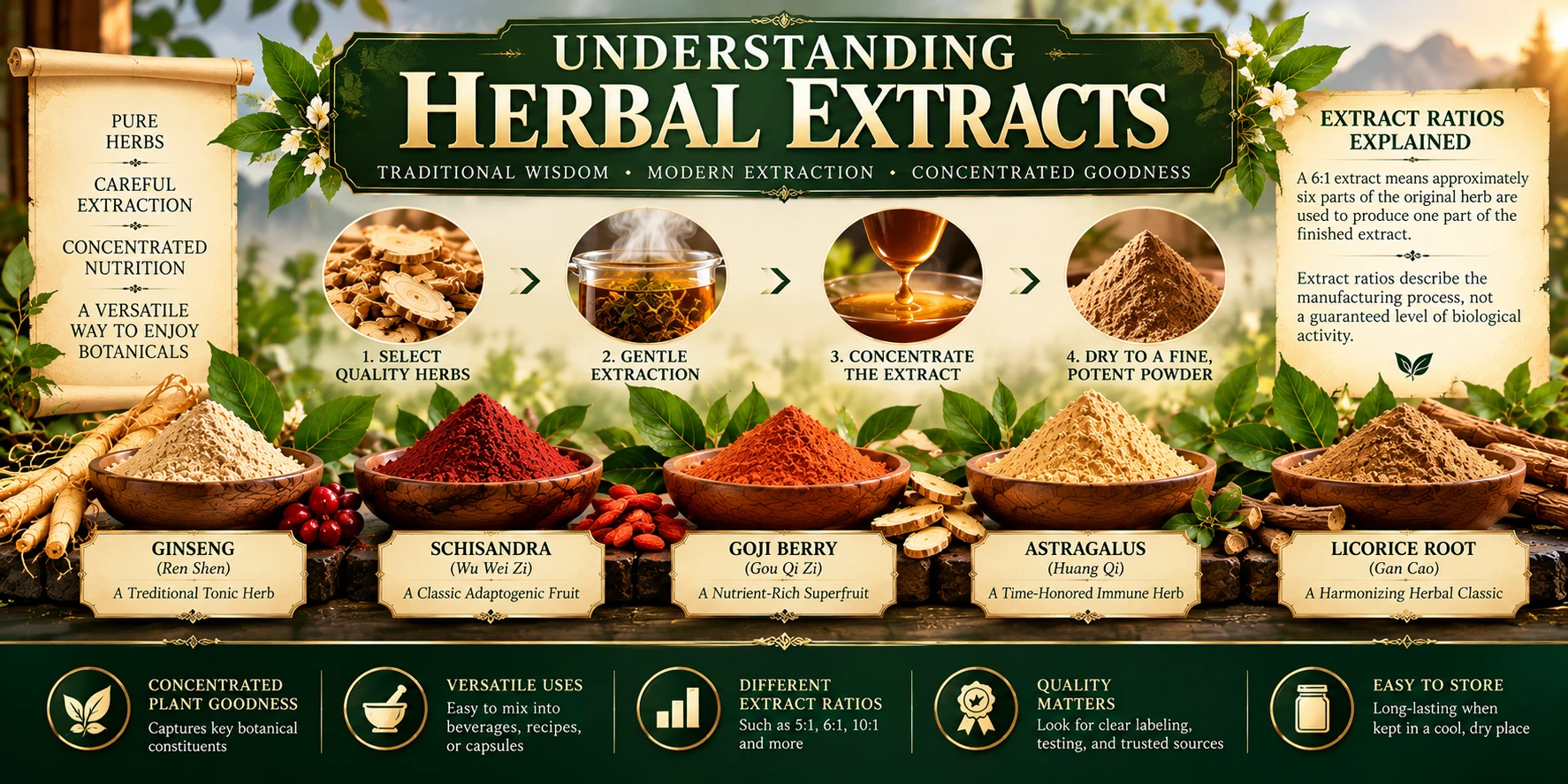
Understanding Herbal Extract Ratios: What Does 6:1 Mean?

One of the most common questions customers ask concerns the numbers printed on extract labels.

You may see:

5:1 extract

6:1 extract

10:1 extract

20:1 extract

These ratios generally describe the relationship between the quantity of starting botanical material and the quantity of finished extract.

For example, a 6:1 extract may indicate that approximately six parts of starting botanical material were used to produce one part of finished extract.

However, the exact meaning depends on the manufacturer's specifications and labeling conventions.

Does 6:1 Mean Six Times Stronger?

Not necessarily.

A 6:1 extract does not automatically contain six times the amount of every naturally occurring constituent, nor does it guarantee six times the biological activity or effectiveness of the original herb.

Extraction selectively concentrates some compounds while leaving others behind.

The finished composition depends on the botanical, extraction solvent, manufacturing process, and any added carriers.

The key takeaway: Extract ratios describe aspects of manufacturing concentration, not guaranteed therapeutic potency.

Extract Ratio vs. Standardized Extract: What's the Difference?

Although these terms are sometimes confused, they describe different characteristics.

Extract type What the label tells you
5:1 extract A manufacturing ratio associated with starting botanical material and finished extract
10:1 extract A higher stated manufacturing ratio, not necessarily greater effectiveness
Standardized extract An extract manufactured to contain a specified amount or range of one or more identified constituents
Non-standardized extract An extract without a declared standardized constituent level

A standardized extract may list a marker compound or group of compounds on its label.

Examples include certain ginsenosides in ginseng products or silymarin content in milk thistle extracts.

The presence of a standardized marker does not, by itself, establish clinical effectiveness or overall product quality.

When comparing extracts, consider the full specifications rather than relying on the ratio alone.

Regular Herb Powder vs. Concentrated Herbal Extract

These products are not identical.

Regular herb powder is generally made by grinding dried botanical material into a fine consistency. It contains the milled plant material, including constituents that may not be extracted into water or alcohol.

Concentrated extract powder is produced through an extraction process and contains the constituents obtained through that method, along with any carriers or additional ingredients used in manufacturing.

Neither form is universally better.

The appropriate choice depends on the botanical, intended preparation, product specifications, and professional guidance where applicable.

Five Traditional Chinese Herbs Commonly Available in Extract Forms

Chinese herbal traditions include a wide variety of roots, fruits, seeds, flowers, and other botanical ingredients.

The following five herbs are well known in traditional Chinese herbal literature and are useful examples when learning about powdered extracts.

1. Ginseng Extract — Ren Shen

Ginseng is one of the best-known botanicals associated with traditional Chinese herbal practices.

Different ginseng products may be prepared from white or red ginseng and may vary in species, processing, and constituent content.

When comparing ginseng extracts, check the botanical name, plant part, processing method, extract ratio, and any declared standardized constituents.

Learn More About Ginseng — Ren Shen

2. Schisandra Extract — Wu Wei Zi

Schisandra fruit is traditionally known as the five-flavor fruit, reflecting its distinctive flavor profile in Chinese herbal literature.

Schisandra extract products may differ in extraction method and constituent specifications.

Customers should confirm the botanical species and whether the product is a regular fruit powder or a concentrated extract.

Explore Schisandra Fruit — Wu Wei Zi

3. Goji Berry Extract — Gou Qi Zi

Goji berries are familiar ingredients in Chinese culinary and herbal traditions.

They are used in various traditional food and botanical preparations.

Goji berry products may be sold as whole dried berries, regular powders, or concentrated extracts.

These forms are not necessarily interchangeable, so review the product description carefully.

Discover Goji Berry — Gou Qi Zi

4. Astragalus Root Extract — Huang Qi

Astragalus root has a long history in traditional Chinese herbal practices.

It may be sold in sliced, cut, powdered, or extracted forms.

When comparing Astragalus products, confirm the botanical species, root material, processing method, and any stated extraction ratio.

Explore Astragalus Root — Huang Qi

5. Licorice Root Extract — Gan Cao

Licorice root is a familiar ingredient in traditional Chinese herbal formulas.

Licorice products vary in composition, processing, and concentration.

An important safety consideration is that glycyrrhizin-containing licorice products can affect blood pressure and potassium levels and interact with certain medications.

Licorice extracts should not be assumed suitable for everyone simply because they are botanical products.

Learn About Licorice Root — Gan Cao

How to Choose a Quality Herbal Powdered Extract

When comparing herbal extracts, consider these six factors.

1. Botanical identity: Look for the common name, scientific name, and correct plant part.

2. Manufacturer information: Choose products with clear brand and supplier information.

3. Extraction specifications: Check the ratio, extraction method, and standardized constituents when provided.

4. Ingredient transparency: Review any carriers, excipients, or other ingredients.

5. Testing documentation: Ask about available testing for identity, microbial contaminants, heavy metals, or other relevant quality measures. Testing varies by product and manufacturer.

6. Organic certification: If organic status matters to you, confirm that the specific product carries appropriate certification. Not every herbal extract is certified organic.

What is a certificate of analysis

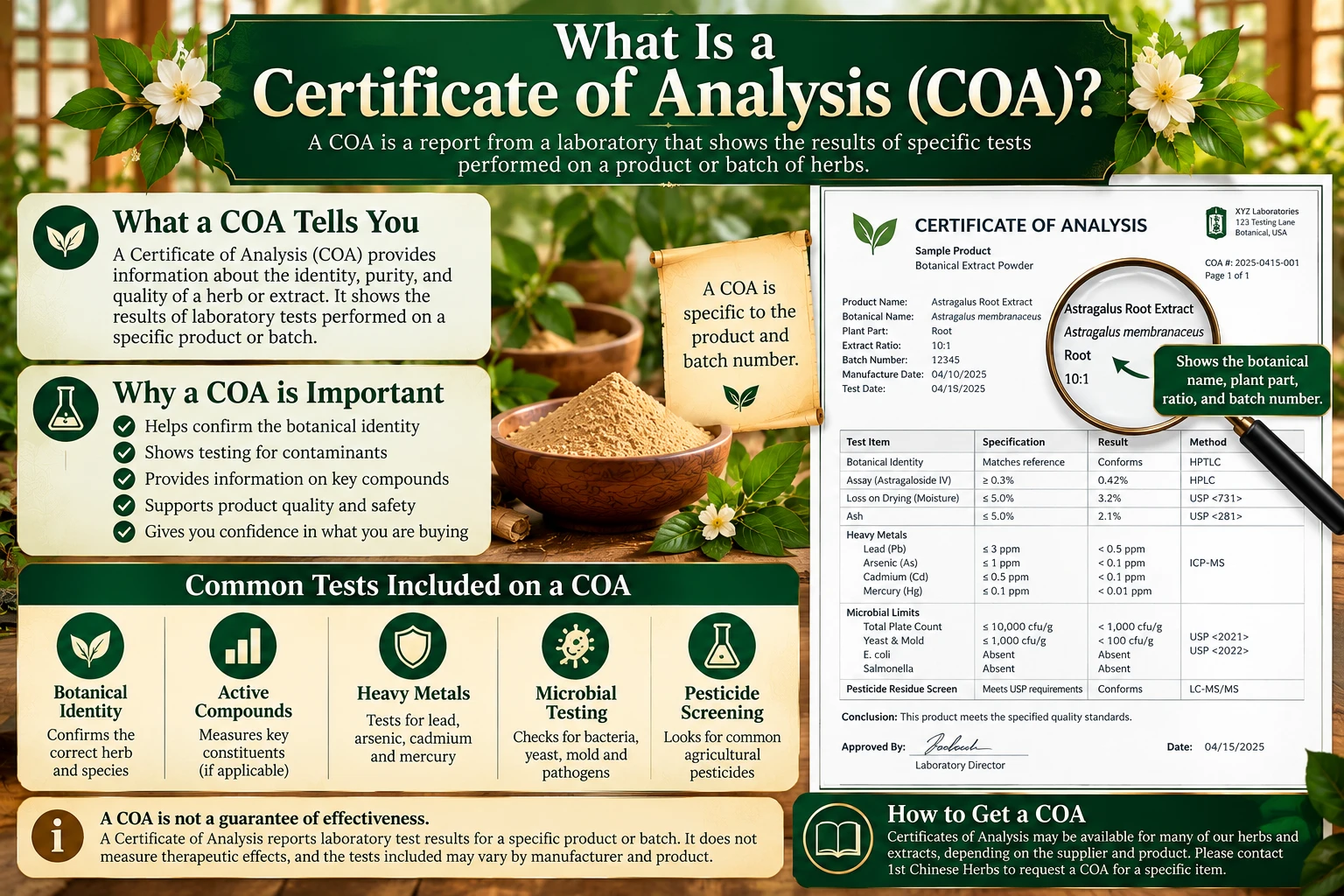
What Is a Certificate of Analysis?

A Certificate of Analysis, commonly called a COA, is a document reporting results for specified tests associated with a product or batch.

Depending on the product, it may include information about identity, marker compounds, microbiological limits, heavy metals, or other quality specifications.

A COA is not automatically a guarantee of safety or effectiveness. Its value depends on the tests performed, methods used, results, and whether the document applies to the actual product lot.

At 1st Chinese Herbs, product-specific documentation may be available upon request, depending on the supplier.

How Can Herbal Powdered Extracts Be Prepared?

Preparation methods vary considerably by botanical and manufacturer.

Some products are intended to be mixed with water or another beverage. Others may have specialized preparation instructions.

Certain food-grade extracts may also be suitable for culinary applications, depending on the product.

Always follow the manufacturer's directions. Do not assume that every concentrated extract is suitable for direct consumption, smoothies, cooking, or interchangeable use with ordinary herb powders.

Because extracts differ in concentration and composition, there is no universal serving size that applies to all herbs or extraction ratios.

How to Store Herbal Powdered Extracts

Proper storage helps protect herbal extract quality.

  • Keep powders in clean, dry, securely sealed containers.

  • Store away from excessive heat, moisture, and direct sunlight.

  • Avoid introducing moisture with wet measuring utensils.

  • Keep the original product label and lot information.

  • Follow manufacturer-specific storage and expiration instructions.

  • Discard products showing mold, moisture damage, or other signs of spoilage.

Shelf life varies by botanical, packaging, formulation, and storage conditions.

Important Safety Considerations

Herbal extracts contain botanical constituents that may interact with medications or be unsuitable for certain individuals.

Concentrated extracts can differ significantly from traditional whole-herb preparations.

People who are pregnant or nursing, taking prescription medications, managing chronic health conditions, or considering herbal products for children should seek individualized professional guidance.

Do not combine multiple extracts solely because they are described as natural.

Botanical origin does not guarantee safety.

Frequently Asked Questions About Herbal Powdered Extracts

Are herbal extracts the same as powdered herbs?

No. Regular powdered herbs generally contain ground plant material. Powdered extracts undergo an additional extraction process.

Is a 10:1 extract better than a 5:1 extract?

Not automatically. Extract ratios alone do not establish overall quality, effectiveness, or suitability. Compare botanical identity, manufacturing details, ingredients, and relevant specifications.

Are all herbal extracts standardized?

No. Some extracts contain specified levels of identified constituents, while others are sold without standardized marker claims.

Are herbal powdered extracts organic?

Some are certified organic, but certification varies by manufacturer and product. Check the individual listing.

How quickly do herbal extracts work?

There is no universal answer. Absorption, biological effects, and individual responses vary depending on the botanical, formulation, and person. Extract ratios do not predict how quickly a product will produce an effect.

Can different herbal extracts be combined?

Combining extracts may introduce interactions or increase exposure to certain constituents. Consult a qualified healthcare professional before combining products, particularly if you take medications.

Can herbal extracts be mixed into tea or smoothies?

Some products are suitable for beverages, but others require different preparation methods. Follow the specific product instructions.

What does a Certificate of Analysis tell me?

A COA reports results for specified product or batch tests. The information varies depending on the manufacturer and testing program.

How long do powdered extracts last?

Shelf life depends on the formulation, packaging, and storage conditions. Follow the manufacturer's best-by or expiration information.

Does a higher extract ratio mean a stronger product?

Not necessarily. A higher ratio does not automatically mean higher concentrations of every constituent or greater biological effectiveness.

Explore Herbal Extracts at 1st Chinese Herbs

Understanding the differences between whole herbs, regular powders, and concentrated extracts can help you shop with greater confidence.

Whether you're comparing extraction ratios, researching traditional Chinese botanicals, or exploring different herbal preparations, we encourage you to review the details of each product before purchasing.

Discover the World of Chinese Herbal Extracts

Explore our selection of botanical products and compare available brands, extract ratios, ingredients, and package sizes.

Shop Our Herbal Extracts and Powdered Botanicals

1st Chinese Herbs — Family-Owned Since 1994


Important Information: This article is provided for general educational purposes and does not constitute medical advice. Herbal products may have contraindications or interact with medications. Consult a qualified healthcare professional before using herbal supplements, particularly if you have a medical condition, take medications, or are pregnant or nursing.

Recommended For You View all