
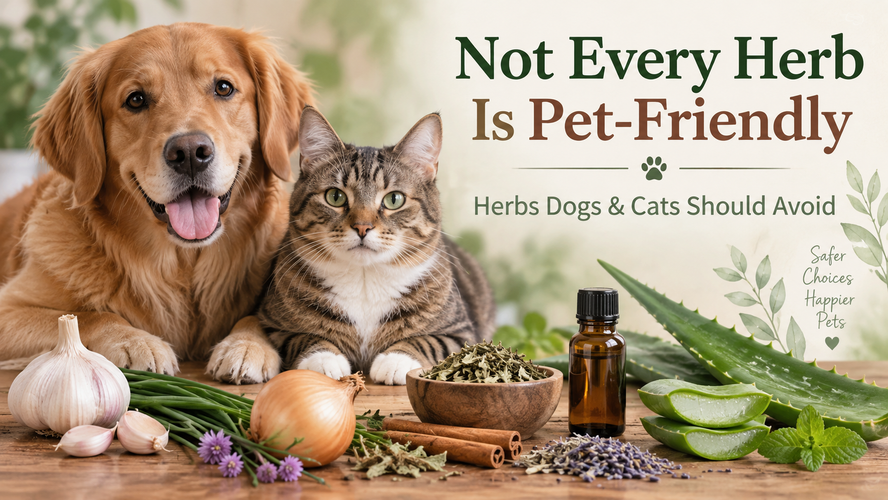
Herbs That Are Not Safe for Dogs and Cats: A Pet Owner's Guide
Posted by Written by Sarah Johnson, Certified Herbalist, 1st Chinese Herbs. on Sep 16th 2026
Herbs That Are Not Safe for Dogs and Cats: A Pet Owner's Guide
Western Herbs, Chinese Herbs & Essential Oils Pet Owners Should Know About
Natural doesn't always mean pet-safe.
Herbs that people commonly use in foods, teas, supplements, Traditional Chinese Medicine, and natural household products aren't automatically safe for dogs and cats.
Animals can process certain plant compounds differently than humans do. The plant species, plant part, amount, preparation, concentration, and whether the animal is a dog or cat can all affect safety.
A dried herb can also be very different from a concentrated extract or essential oil. This guide focuses on herbs and concentrated herbal products with recognized safety concerns for dogs and cats. It is intentionally not an exhaustive list.
Did Your Pet Already Eat Something?
If you think your dog or cat has swallowed or been exposed to a potentially toxic herb, essential oil, supplement, or household product, don't wait for symptoms before contacting your veterinarian or an emergency veterinary service.
If possible, keep the package. Be prepared to provide:
- The exact product and complete ingredient list
- Botanical name, if available
- Concentration or extract strength
- Approximately how much your pet was exposed to
- When the exposure occurred
- Your pet's approximate weight
Do not induce vomiting unless a veterinarian or animal poison professional specifically tells you to do so.
Quick Guide: Herbs & Herbal Products to Keep Away From Dogs and Cats
This quick-reference chart identifies the specific form of concern. That's important because a concentrated essential oil is not necessarily equivalent to the dried culinary herb.
| Herb or Product | Dogs | Cats | Form of Concern | Why It's a Concern |
|---|---|---|---|---|
| Garlic — Da Suan — Allium sativum | Do not give | Do not give | Fresh, cooked, dried & powdered | Oxidative damage to red blood cells |
| Onion — Allium cepa | Do not give | Do not give | Fresh, cooked, dried & powdered | Can cause hemolytic anemia |
| Chives — Allium schoenoprasum | Do not give | Do not give | Plant & concentrated forms | Member of the toxic Allium group |
| Leeks — Allium spp. | Do not give | Do not give | Plant & concentrated forms | Member of the toxic Allium group |
| Aloe Vera | Avoid unsupervised ingestion | Avoid unsupervised ingestion | Especially latex/whole-leaf material | Certain constituents can cause gastrointestinal and other adverse effects |
| Tea Tree / Melaleuca | Keep away | Keep away | Concentrated essential oil | Neurological and systemic toxicity documented |
| Pennyroyal | Keep away | Keep away | Essential oil | Serious liver and neurological toxicity |
| Wintergreen | Keep away | Keep away | Essential oil | Concentrated methyl salicylate exposure |
| Birch | Keep away | Keep away | Essential oil | Concentrated methyl salicylate exposure |
| Eucalyptus | Keep concentrated oil away | Keep concentrated oil away | Essential oil | Concentrated essential-oil exposure can be toxic |
| Cinnamon / Cassia | Keep concentrated oil away | Keep concentrated oil away | Essential oil | Concentrated oil presents a different exposure than culinary cinnamon |
Why Can an Herb Be Safe for Me but Not My Pet?
Humans, dogs, and cats don't metabolize every chemical compound in exactly the same way. Something with a long history of human use may therefore be inappropriate for another species.
Concentration matters too.
Dried Herb → Powdered Herb → Concentrated Extract → Essential Oil
These preparations aren't automatically interchangeable. A few drops of concentrated essential oil may expose an animal to plant constituents at concentrations dramatically different from those encountered in an herbal tea.
This is one reason human herbal dosing should never simply be reduced according to a pet's body weight.
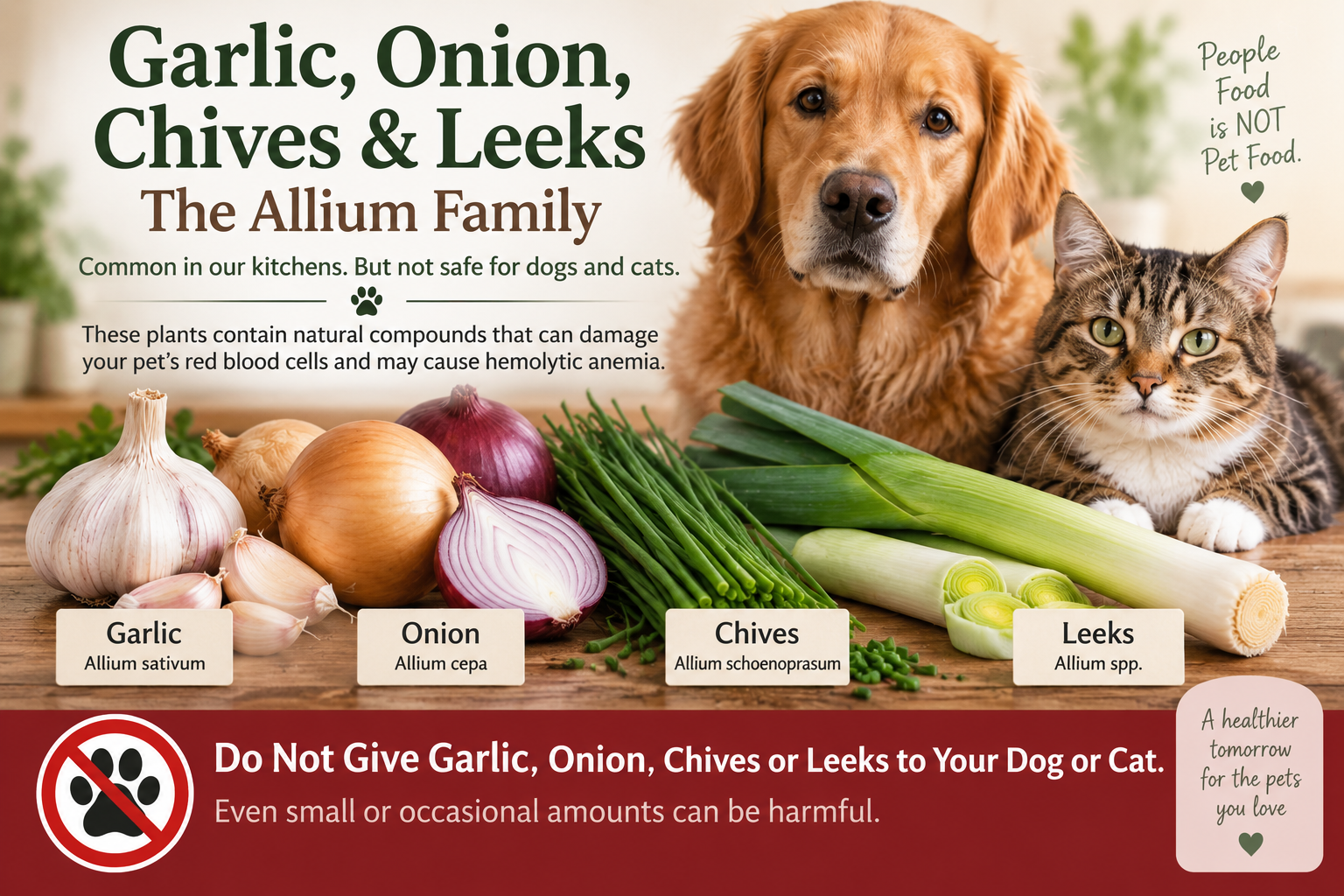
Garlic, Onion, Chives & Leeks: The Allium Family
Garlic, onion, chives, and leeks provide some of the clearest examples of familiar human foods and herbs that shouldn't automatically be shared with pets.
These plants belong to the Allium group and contain sulfur-containing compounds capable of causing oxidative damage to red blood cells. Significant exposure can result in hemolytic anemia. Both dogs and cats can be affected, with cats particularly susceptible.
Cooking Doesn't Necessarily Make Them Safe
The concern isn't limited to a dog or cat eating a raw onion.
Veterinary reports include exposures involving:
- Raw plants
- Cooked plants
- Dehydrated products
- Powders
- Granules
Processing doesn't necessarily eliminate the toxic effect of Allium species. Concentrated powders and dehydrated products can also make it easy to underestimate how much plant material is actually present.
Garlic — Da Suan (大蒜)
Garlic is also known in Chinese herbalism as Da Suan.
Traditional human use does not establish safety for dogs or cats.
Research has demonstrated oxidative damage to canine red blood cells from garlic-derived compounds, and veterinary literature documents garlic-associated hemolytic injury in dogs.
Essential Oils Are Not the Same as Dried Herbs
This distinction is extremely important.
Essential oils are highly concentrated preparations. An essential oil shouldn't automatically be treated as though it were simply another form of the dried herb.
Tea Tree Oil — Melaleuca
Tea tree oil provides a particularly well-documented example.
A veterinary study examined 443 dogs and cats exposed to 100% tea tree oil. Reported signs included lethargy or central nervous system depression, weakness, loss of coordination, and tremors.
Do not apply concentrated tea tree oil directly to a dog or cat.
Pennyroyal Oil
Pennyroyal provides an even more serious example of why the word natural shouldn't automatically be interpreted as safe.
A published veterinary case described a dog treated with pennyroyal oil for fleas. The animal developed serious toxicity and subsequently died.
Products intended for humans should not automatically be used as natural flea treatments for pets.
What About Aloe Vera?
Aloe demonstrates why the exact plant part and preparation matter.
The inner gel, latex, and whole-leaf preparations aren't chemically identical. Aloe contains several groups of naturally occurring compounds, and anthraquinones and other constituents found particularly in latex and whole-leaf material can be problematic.
Pet owners should not allow dogs or cats to chew aloe plants or consume human aloe preparations unless a veterinarian has determined that the specific product is appropriate.
What About Chinese Herbs?
Traditional Chinese herbal medicine deserves special consideration.
Chinese herbal formulas were developed within a system of traditional human herbal practice. The fact that an herb is traditional, natural, or commonly used by humans doesn't automatically establish that it is appropriate for a dog or cat.
Chinese herbal formulas may also contain numerous ingredients.
Do not take a human Chinese herbal formula and simply reduce the serving according to your pet's weight.
Veterinary Chinese herbal medicine does exist. However, veterinary practice considers the individual animal, formula, ingredients, medications, health conditions, and appropriate animal-specific dosing.
If Chinese herbs are being considered for your dog or cat, work with a veterinarian knowledgeable about veterinary herbal medicine.
Check the Other Ingredients Too
Sometimes the greatest concern isn't the herb printed prominently on the front of the package.
Human herbal products can contain:
Sweeteners • Flavorings • Alcohol • Preservatives • Essential Oils • Carriers • Other Inactive Ingredients
Always read the entire ingredient panel before considering any human product for an animal.
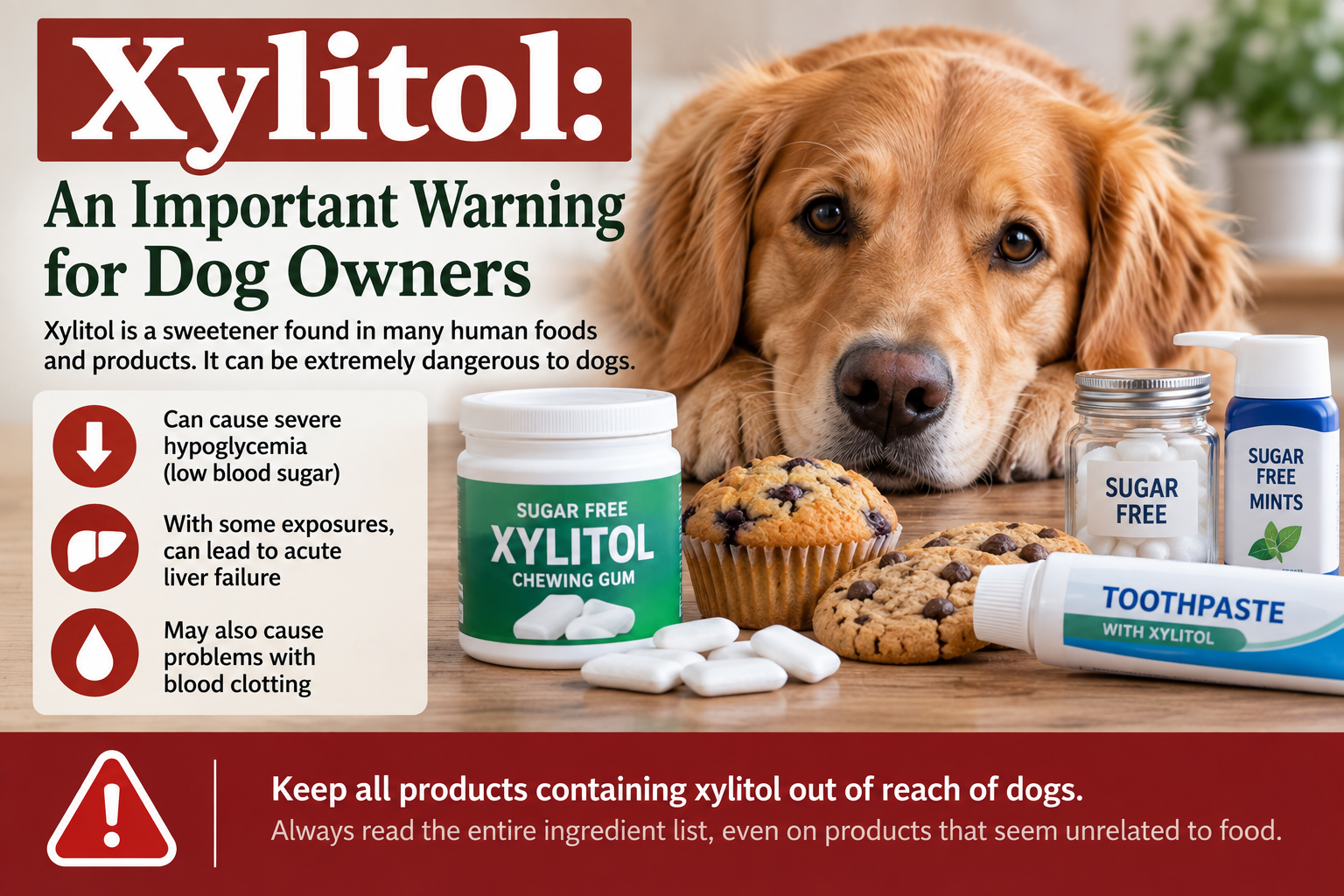
Xylitol: An Important Warning for Dog Owners
Xylitol isn't an herb, but it deserves mention because it can appear as a sweetener in human products.
Xylitol can be extremely dangerous to dogs.
In dogs, xylitol ingestion can cause severe hypoglycemia and, with some exposures, acute liver failure and problems with blood clotting.
So when examining an herbal supplement for a pet, don't stop reading after the active ingredients.
Natural Cleaning Products Count Too
Herbs and plant extracts aren't found only in things we eat.
They can also appear in:
Household cleaners • Room sprays • Diffusers • Air fresheners • Shampoos • Flea products • Fragrances
A label saying natural, herbal, botanical, or plant-based isn't proof that the product is appropriate around dogs or cats.
This is especially important with concentrated essential oils.
Keep cleaning products and concentrated oils where pets cannot lick, chew, spill, or walk through them. Don't apply human essential-oil preparations directly to your pet unless your veterinarian specifically recommends that product and concentration.
What If an Herb Isn't on This List?
Not Listed Does NOT Mean Pet-Safe
We've intentionally kept this list conservative. There are thousands of medicinal plants, extracts, supplements, and traditional formulas for which good safety information in dogs and cats may be limited.
We would rather leave an herb off this list than label it dangerous—or safe—without adequate evidence.
If you can't find an herb in this guide, don't assume its absence means that it has been proven safe.
Before Giving Your Pet Anything From Your Herbal Cabinet
Before giving your dog or cat a Western herb, Chinese herb, extract powder, tincture, teapill, essential oil, or herbal formula, ask your veterinarian about the exact product and preparation.
Be particularly careful when your pet:
- Takes prescription medication
- Has liver or kidney problems
- Is very young or elderly
- Is pregnant or nursing
- Has an existing medical condition
- Would be receiving a concentrated extract
- Would be receiving several herbs simultaneously
A safe human serving cannot simply be converted into a pet serving according to body weight.
Frequently Asked Questions
Can I give my dog Chinese herbs?
Don't assume a Chinese herb intended for humans is appropriate for your dog. Chinese herbal medicine is used in veterinary practice, but formula selection, dosage, interactions, and the individual animal should be evaluated by a qualified veterinarian.
Are Chinese herbs safe for cats?
Some herbs may be used by veterinarians in cats, but that doesn't mean every Chinese herb or human Chinese formula is safe for them. Veterinary guidance is particularly important when using concentrated extracts or multi-herb formulas.
Is garlic safe for dogs in small amounts?
Garlic can cause oxidative red-blood-cell damage in dogs. Concentrated or repeated exposure can be particularly concerning. Because susceptibility and exposure vary, garlic shouldn't be added to a dog's diet without veterinary guidance.
Are essential oils safe around cats?
Don't assume an essential oil is safe simply because it comes from a familiar herb. Concentrated essential oils can present risks to cats, and direct application is particularly concerning. Tea tree oil toxicity in cats and dogs has been documented in veterinary literature.
Does natural mean pet-safe?
No. Garlic, pennyroyal oil, tea tree oil, and many other substances are natural but can cause toxicity in animals.
What should I do if my pet eats an herb?
Contact your veterinarian or an emergency veterinary service promptly if the herb or amount could be dangerous or if you're unsure. Keep the package and ingredient list available. Don't induce vomiting unless instructed by a veterinary professional.
PubMed Research & Further Reading
The following research is provided for educational purposes and further reading. These studies and reviews should not be interpreted as instructions for treating an animal at home.
- Garlic-Derived Compounds and Oxidative Damage to Canine Red Blood Cells — PubMed
- Household Food Items Toxic to Dogs and Cats — PubMed Central
- Concentrated Tea Tree Oil Toxicosis in Dogs and Cats: 443 Cases — PubMed
- Toxicity of Melaleuca Oil Applied Topically to Dogs and Cats — PubMed
- Pennyroyal Oil Toxicosis in a Dog — PubMed
- Potential Side Effects of Herbal Preparations in Domestic Animals — PubMed
- Herbal Medicine: Potential for Intoxication and Drug Interactions — PubMed
- Xylitol Toxicosis in Dogs: An Update — PubMed
- Clinical Application of Chinese Herbal Medicine in Small Animal Practice — PubMed
Important Veterinary Safety Notice
This article is provided for educational purposes only and is not veterinary medical advice.
Whether a plant or herbal product causes toxicity can depend on the exact botanical species, plant part, preparation, concentration, dose, route of exposure, animal species, body size, health status, and other medications or supplements being used.
If you suspect your dog or cat has been exposed to a potentially toxic herb, essential oil, supplement, or household product, contact your veterinarian or an emergency veterinary service promptly.