NuHerbs Lab Tested
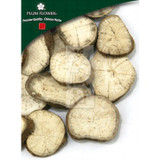
Artemisia Annua (Qing Hao) - Cut Form 1 lb. - Nuherbs Brand Lab Test
Qing Hao (Sweet Wormwood) – Cut Bulk Chinese Herb | Lab Tested Artemisia annua | Traditional Chinese Herb | Single Ingredient
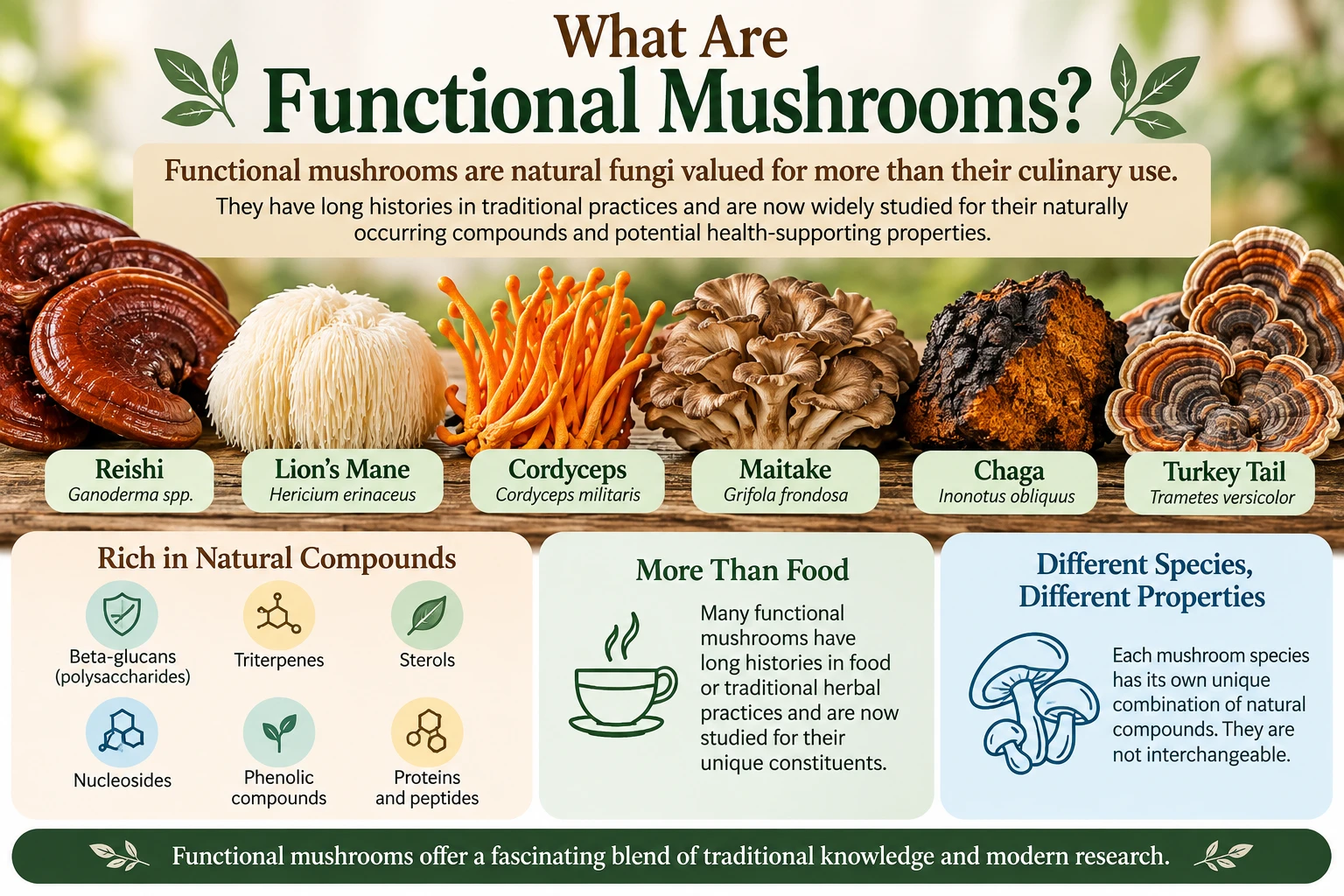
Quick Answers: Functional mushrooms are mushrooms and fungi commonly used in foods, teas, powders, extracts and supplements. Popular examples include Reishi, Lion's Mane, Cordyceps, Maitake, Chaga and Turkey Tail. Products can differ considerably by species, fungal material and preparation.
Mushrooms are suddenly everywhere—coffee, tea, powders, capsules, drink mixes and extracts. Names like Reishi, Cordyceps, Lion's Mane, Maitake and Shiitake are appearing on products that look very different from one another.
But here's the part that can get confusing:
Two products labeled "functional mushrooms" may contain completely different ingredients and preparations.
One might contain dried mushroom pieces. Another may be mushroom powder. Another could contain mycelium grown on a substrate, while another is a concentrated extract.
So before asking which mushroom to buy, start with a simpler question:
What am I actually buying?
This guide explains the major functional mushrooms, the difference between whole mushrooms, powders and extracts, what fruiting body and mycelium mean, and what to look for on a mushroom label.

"Functional mushroom" is a popular marketplace term rather than a precise medical or botanical classification.
It generally refers to mushrooms and other fungi valued for more than conventional culinary use. Many have long histories in food or traditional herbal practices and are now being studied for their naturally occurring compounds.
Researchers have identified mushroom constituents including:
Beta-glucans and other polysaccharides
Triterpenes
Sterols
Nucleosides
Phenolic compounds
Proteins and peptides
The important thing to remember is that mushrooms are not interchangeable.

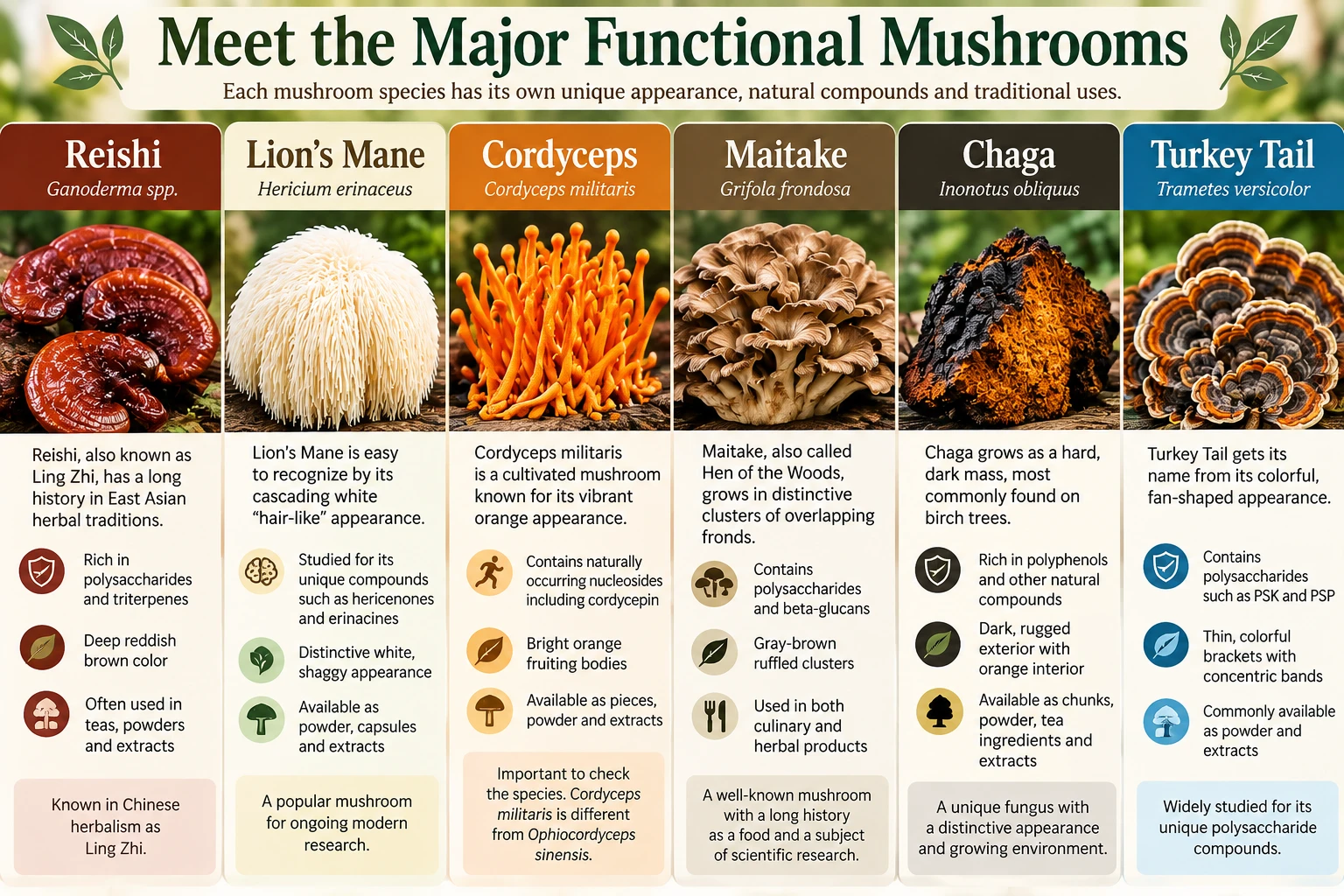
Hericium erinaceus is one of the easiest mushrooms to recognize. Instead of a traditional cap and stem, Lion's Mane develops cascading white structures that resemble shaggy hair.
Researchers have investigated Lion's Mane and naturally occurring compounds associated with its fruiting body and mycelium, including compounds commonly discussed as hericenones and erinacines.
When comparing Lion's Mane products, check whether you're purchasing fruiting body, mycelium, powder or extract.
Reishi has a long history in East Asian herbal traditions and is known in Chinese herbalism as Ling Zhi.
Reishi is associated with Ganoderma species and contains naturally occurring compounds including polysaccharides and triterpenoids that continue to receive scientific attention.
When shopping for Reishi, look beyond the common name. Check the species, fungal material and whether the product is whole, powdered or extracted.
Cordyceps is particularly important because "Cordyceps" does not describe one single commercial product.
Two names consumers frequently encounter are:
Cordyceps militaris
Ophiocordyceps sinensis
They are different fungal species.
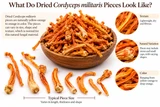
Cordyceps militaris can be cultivated and is recognizable for its characteristic orange appearance. Researchers have investigated naturally occurring compounds in C. militaris, including cordycepin, nucleosides and polysaccharides.
If a product simply says "Cordyceps", keep reading the label. Look for the actual species and product form.
Maitake, also known as Hen of the Woods, grows in distinctive clusters of overlapping fronds.
Unlike some functional mushrooms, Maitake is also well established as a culinary mushroom. Researchers have studied its naturally occurring polysaccharides and beta-glucan-containing fractions.
Most people first encounter Shiitake as food, but it is also frequently included in discussions of functional mushrooms.
Shiitake is a useful reminder that the line between a "culinary mushroom" and a "functional mushroom" isn't always clear. A mushroom can have a long history as food while also attracting scientific interest.
Turkey Tail gets its name from its colorful, fan-shaped appearance.
Its scientific name is Trametes versicolor. It has attracted considerable scientific interest, particularly for specific polysaccharide-containing preparations.
No. Common functional mushrooms such as Reishi, Lion's Mane, Maitake, Shiitake and Cordyceps militaris are not the same as mushrooms containing psilocybin.
No. Plain mushroom powder may simply be dried fungal material that has been ground. An extract has undergone an extraction process.
Not automatically. They are different fungal materials. What matters is knowing what the product contains and whether it is clearly identified.
No. They are different fungal species.
No. An extract ratio alone does not establish overall quality.
No. Research on isolated compounds or specialized extracts cannot automatically be applied to every product containing that mushroom.
Functional mushrooms are fascinating. They have histories in food and traditional herbal practices, contain interesting natural compounds and continue to attract scientific research.
But their growing popularity has also created a confusing marketplace.
The words "functional mushroom" alone don't tell you the species, fungal material, product form, concentration or quality.
Whether you're considering Reishi, Lion's Mane, Cordyceps, Maitake, Shiitake, Chaga or Turkey Tail, remember one simple principle:
Know what is actually in the package.
Clear identification and transparent product information are more useful than spectacular promises.
Medicinal Mushrooms – Bioactive Components, Nutritional Value and Functional Foods
PMID: 37513265
https://pubmed.ncbi.nlm.nih.gov/37513265/
Clinical Research on Medicinal Mushrooms
PMID: 34823005
https://pubmed.ncbi.nlm.nih.gov/34823005/
Lion's Mane Research Review
PMID: 40959699
https://pubmed.ncbi.nlm.nih.gov/40959699/
Reishi Clinical Evidence Review
PMID: 40510787
https://pubmed.ncbi.nlm.nih.gov/40510787/
Cordyceps militaris Research
PMID: 41432716
https://pubmed.ncbi.nlm.nih.gov/41432716/
Functional mushrooms and mushroom supplements may not be appropriate for everyone. Consult a qualified healthcare professional before using dietary supplements if you have a medical condition, take medications, are pregnant or nursing, are preparing for surgery, or have mushroom or fungal allergies.
Research discussed on this page may involve extracts, isolated compounds, cultured fungal material, laboratory studies, animal studies or specialized preparations. These findings should not automatically be interpreted as establishing the effects of commercially available mushroom products.
These statements have not been evaluated by the Food and Drug Administration. This information is not intended to diagnose, treat, cure, or prevent any disease.