
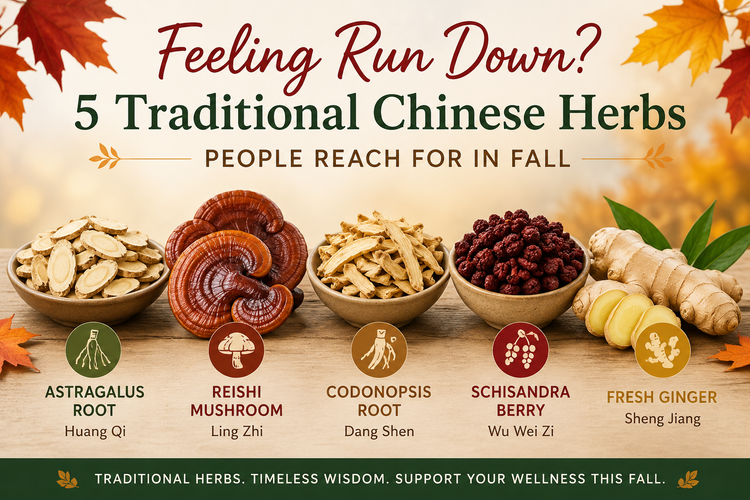
Feeling Run Down? 5 Traditional Chinese Herbs People Reach for in Fall
Posted by 1st Chinese Herbs Research Team on Aug 24th 2026
Feeling Run Down? 5 Traditional Chinese Herbs People Reach for in Fall
Fall is almost here. The days get shorter, temperatures start dropping, schedules get busier—and sometimes we simply feel tired, run down, or not quite ourselves.
In Traditional Chinese Medicine, seasonal changes have long been considered an important time to pay attention to the body's balance and vitality.
Here are five traditional Chinese herbs people often become interested in as fall approaches.
1. Astragalus Root — Huang Qi
Astragalus, known as Huang Qi, is one of the best-known herbs in Chinese herbalism.
Traditionally, Huang Qi is used to tonify Qi and support what Chinese herbalism calls Wei Qi, often translated as "defensive Qi."
Astragalus has a mild, slightly sweet flavor. Sliced Astragalus root can be simmered in water or added to soups and broths, while powders and extracts offer convenient alternatives.
Why people reach for it in fall: Astragalus has a long history of traditional use for supporting Qi, vitality, and the body's defenses.
Research:
PubMed – Astragalus membranaceus Review
2. Reishi Mushroom — Ling Zhi
Reishi isn't a new wellness trend.
Known as Ling Zhi, this remarkable mushroom has been valued in Chinese herbal traditions for centuries.
Reishi is traditionally associated with nourishing and supporting the body and is often incorporated into broader wellness routines.
It is available as whole or sliced mushroom, powder, and concentrated extracts.
Why people reach for it: Its long history of traditional use makes Reishi one of the most recognizable medicinal mushrooms in the world.
Research:
PubMed – Ganoderma lucidum (Reishi) Review
3. Codonopsis Root — Dang Shen
Feeling like your energy isn't what it normally is?
Codonopsis, known as Dang Shen, is traditionally classified as a Qi-tonifying herb.
You'll find it both as an individual herb and as an ingredient in numerous traditional Chinese herbal formulas.
Why people reach for it: Dang Shen is traditionally used to nourish Qi and support everyday vitality.
Research:
PubMed – Codonopsis pilosula Review
4. Schisandra Berry — Wu Wei Zi
These small berries have one of the most interesting names in Chinese herbalism.
Wu Wei Zi means "Five Flavor Fruit."
Traditionally, the name refers to the berry possessing the five flavors recognized in Chinese herbalism: sour, bitter, sweet, pungent, and salty.
Schisandra has a long history of use and can be found by itself as well as in traditional herbal formulas.
Why people reach for it: Schisandra is traditionally used as a nourishing and balancing herb and is an interesting addition to a well-stocked Chinese herbal pantry.
5. Fresh Ginger — Sheng Jiang
One traditional Chinese herb may already be sitting in your kitchen.
Fresh ginger, called Sheng Jiang, has an important place in traditional Chinese herbalism.
Its warming and aromatic nature makes ginger particularly appealing when the weather starts getting colder.
Fresh ginger is also incredibly easy to use. Slice it into hot water for a simple tea or add it to soups, broths, and everyday cooking.
Why people reach for it: Its warming nature makes fresh ginger a natural favorite as temperatures begin to fall.
Which Fall Herb Is Right for You?
You don't need a cabinet filled with dozens of herbs to begin exploring Chinese herbalism.
Start by learning about a few versatile herbs and understanding their traditional uses.
Astragalus, Reishi, Codonopsis, Schisandra, and Ginger are five excellent herbs to get to know as summer turns to fall.
At 1st Chinese Herbs, you'll find traditional Chinese herbs in many different forms, including whole and cut herbs, powders, concentrated extracts, mushrooms, teas, and traditional herbal formulas.
Fall is coming. Take a look at your herbal pantry now and see what you may want to have on hand before the colder weather arrives.
This information is provided for educational purposes and describes traditional herbal uses. These statements have not been evaluated by the Food and Drug Administration. This information and these products are not intended to diagnose, treat, cure, or prevent any disease. Consult a qualified healthcare professional before using herbal products, particularly if you take medications, are pregnant or nursing, or have a medical condition.