Whats Does Unsulfured Mean When Buying Herbs?
Posted by 1st Chinese Herbs Research Team. on Sep 7th 2026
What Does Unsulfured Mean When Buying Herbs?
If you've been shopping for Chinese or Western herbs, you may have seen the word “unsulfured.”
But what does it actually mean—and should it matter when choosing an herb?
The simple answer:
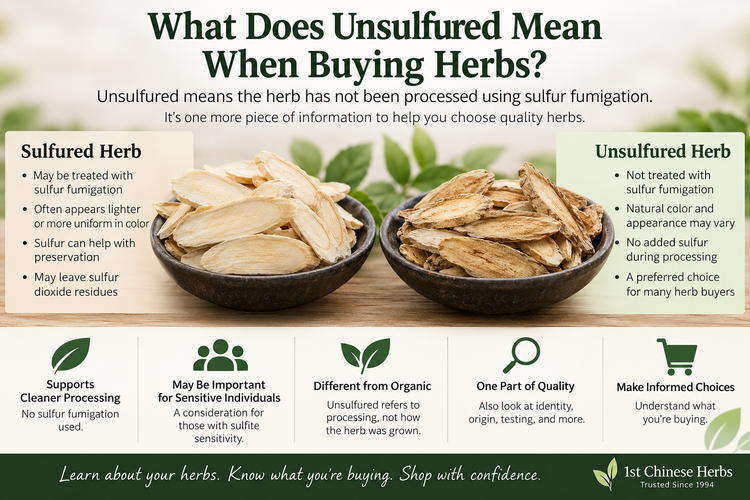
Unsulfured means the herb has not been processed using sulfur fumigation.
Here's what you should know before you buy.
Why Is Sulfur Used on Some Herbs?
Herbs are agricultural products. After harvesting, they need to be properly dried and stored.
Sulfur fumigation has traditionally been used on some dried herbs, including certain Chinese herbal materials. It can help with preservation and may also make some herbs appear lighter or more uniform in color.
However, sulfur fumigation can leave sulfur dioxide residues, and research has found that the process may alter some chemical constituents in certain herbs.
This is one reason some herb buyers prefer unsulfured herbs when they are available.
What About Sulfite Sensitivity?
This can be particularly important for people who know they are sensitive to sulfites.
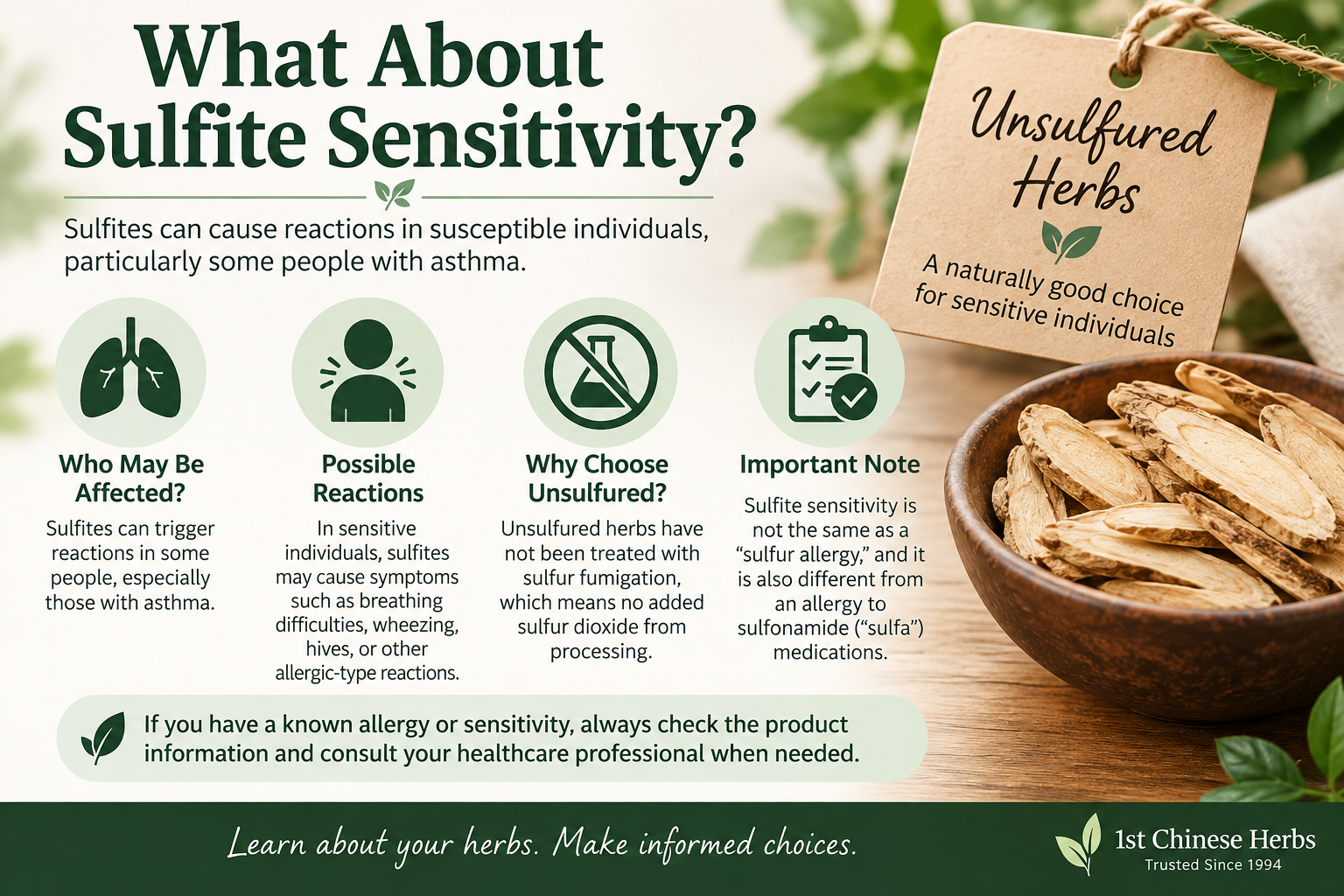
Sulfur dioxide is a sulfiting agent, and sulfites can cause reactions in susceptible individuals, particularly some people with asthma.
There is an important distinction:
Sulfite sensitivity is not the same as a “sulfur allergy,” and it is also different from an allergy to sulfonamide (“sulfa”) medications.
If you have a known allergy or sensitivity, don't rely only on the word “unsulfured.” Check the individual product information and speak with your healthcare professional if you're unsure about what you should avoid.
Is Unsulfured the Same as Organic?
No. They mean different things.
Unsulfured tells you something about how the herb was processed.
Organic refers to how an agricultural product was grown and handled under applicable organic standards.
An herb can be:
-
Unsulfured but not certified organic
-
Certified organic without an unsulfured claim
-
Both organic and unsulfured
That's why it's important to read the individual product description.
Should I Choose Unsulfured Herbs?
When an unsulfured option is available, many customers prefer it because the herb has not undergone sulfur fumigation.
However, unsulfured is only one part of herb quality.
You should also consider the correct botanical identity, plant part, source, freshness, processing, testing, and organic certification when applicable.
Think of “unsulfured” as one useful piece of information—not the entire quality story.
Why Might an Unsulfured Herb Look Different?
This surprises some people who are new to buying herbs.
An unsulfured herb may not always look as bright or uniform as you expect.
But herbs aren't manufactured products. They are plants, and natural variation is normal.
Color, size, shape, aroma, and appearance can vary depending on where an herb was grown, when it was harvested, how it was dried, and the particular harvest.
So don't assume that the brightest or most perfectly uniform-looking herb is automatically the best quality.
What Else Should I Look for When Buying Herbs?
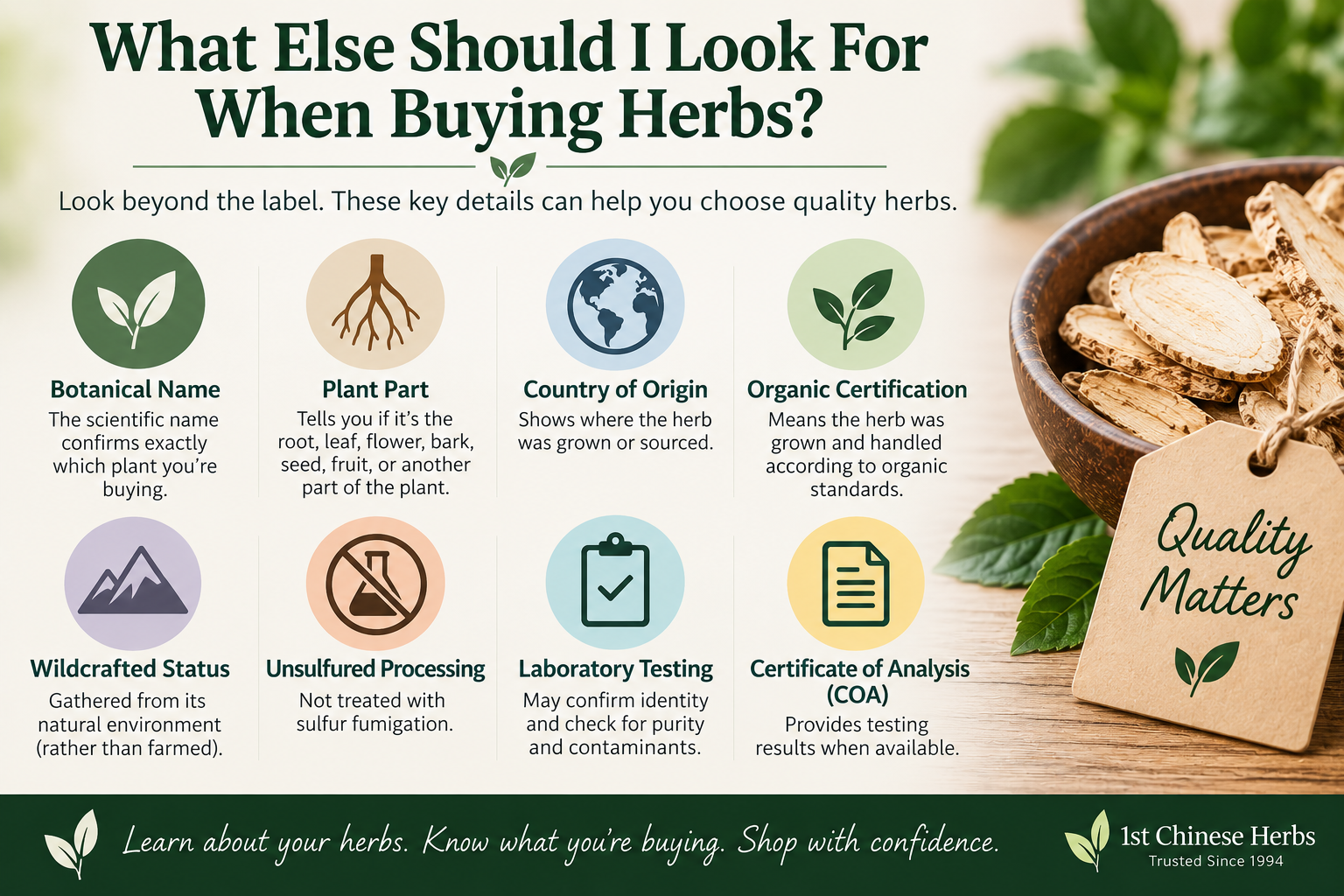
When comparing herbs, don't rely on just one word such as “unsulfured.” Here are a few other things worth checking:
-
Botanical name — The scientific name of the plant. This helps confirm exactly which plant species you're buying, especially when several herbs share similar common names.
-
Plant part — Tells you whether the product contains the root, leaf, flower, bark, seed, fruit, or another part of the plant. Different parts of the same plant are not always interchangeable.
-
Country or region of origin — Tells you where the herb was grown or sourced. Growing conditions, climate, soil, and traditional growing regions can all be relevant when evaluating botanical materials.
-
Organic certification — Indicates that the herb was produced and handled according to recognized organic standards. Look for actual certification rather than assuming “natural” means organic.
-
Wildcrafted status — Means the herb was gathered from its natural growing environment rather than cultivated as a farm crop. Wildcrafted does not automatically mean organic.
-
Unsulfured processing — Means sulfur fumigation was not used during the processing of the herb.
-
Laboratory testing — Testing can be used to evaluate things such as botanical identity, microbial contaminants, heavy metals, pesticide residues, or other quality specifications, depending on the herb and supplier.
-
Certificate of Analysis (COA) availability — A COA is a document containing testing or quality results for a product or batch. When available, it can provide additional information about what was tested and the results.
You don't have to become an herbal expert to buy herbs. Knowing what these basic terms mean simply helps you ask better questions, compare products, and understand what you're purchasing.
The Easy Way to Remember It
Unsulfured = the herb was not processed using sulfur fumigation.
It doesn't automatically mean organic, and it doesn't tell you everything about an herb's quality.
It does give you one more useful piece of information about how your herb was processed.
At 1st Chinese Herbs, we've been serving herbal customers since 1994. We believe buying herbs shouldn't require you to understand a dictionary full of unfamiliar terminology.
Our goal is to help you learn about your herbs, understand what you're buying, and make more informed choices.
Learn about your herbs. Know what you're buying. Shop with confidence.
Educational information is provided for general informational purposes only and is not intended to diagnose, treat, cure, or prevent any disease.
Research & Further Reading
- Sulfur Fumigation Processing of Traditional Chinese Medicinal Herbs: Beneficial or Detrimental? – PubMed — Reviews sulfur fumigation and its potential effects on the chemical profiles and quality of Chinese herbs.
- Effects of Sulfur Fumigation on the Efficacy and Safety of Medicinal Herbs – PubMed — A 2022 meta-analysis examining research on how sulfur fumigation may affect medicinal herbs.
- Sulfur Dioxide Residues in Chinese Medicinal Materials – PubMed — Discusses sulfur dioxide residues, fumigation practices, and quality standards for Chinese herbal materials.