
Why Does the Same Herb Cost More? 9 Things to Check Before You Buy
Posted by 1st Chinese Herbs Guest Writer Nancy and the 1st Chinese Herbs Research Team on Sep 16th 2026
Why Does the Same Herb Cost More on One Website? 9 Things You're Actually Paying For
Two bags can have the same herb name on the front—and still not be the same product. Here's how to compare bulk herbs before deciding which one is really the better value.
You search for an herb online.
One website has it for $11.99.
Another has it for $18.95.
Another wants $31.00.
They all say the same herb.
So why wouldn't you simply buy the cheapest one?
Sometimes that makes perfect sense.
But sometimes you're comparing products that look identical in a search result while being surprisingly different once you start asking a few questions.
The botanical species may be different. The plant part may be different. One may be sliced while another is powdered. One supplier may provide extensive testing and documentation while another provides almost no information at all.
Before deciding which herb is the better deal, ask one important question:
Am I actually comparing the same product?
1. Start With the Botanical Name
This is one of the simplest—and most important—things to check.
Common names can be confusing because the same common name may be used for more than one plant.
For example, seeing "Skullcap" on a product isn't enough information to identify exactly what you're buying.
Chinese Skullcap is generally identified as Scutellaria baicalensis, while American Skullcap is Scutellaria lateriflora.
Those aren't interchangeable simply because both contain the word skullcap.
What should you look for?
Common Name + Botanical Name
If you're comparing two products, make sure they're actually the same botanical species before comparing their prices.
2. What Part of the Plant Are You Buying?
Root? Leaf? Flower? Bark? Seed? Fruit? Rhizome? Aerial portions?
The plant part matters.
An herb may have several parts used for completely different purposes, and sometimes those parts even have different names within traditional herbal systems.
If one website sells the root and another sells a different portion of the same plant, comparing the two prices doesn't tell you much.
Before buying, ask: Does the seller clearly identify the plant part?
A good listing shouldn't make you guess.
3. Whole Herb, Cut Herb, Powder—or Extract?
Here's another place where price comparisons can become misleading.
Imagine these four listings:
- Astragalus Root Slices (Age of the root)
- Astragalus Cut & Sifted Root
- Astragalus Root Powder
- Astragalus Extract Powder
All four may appear when someone searches for Astragalus.
But they're not the same product.
A whole or sliced herb is different from a powder, and both are different from a concentrated extract.
Even extracts themselves can vary. You may encounter:
5:1 Extract • 10:1 Extract • 20:1 Extract
So before deciding one seller is expensive, make sure you're comparing the same preparation and form.
4. Compare the Actual Amount You're Getting
This sounds obvious.
It isn't always.
One seller may list 4 ounces. Another may sell 100 grams. Another may sell 1 pound.
And sometimes the attractive price you see in a search result applies only to the smallest package.
A 100-gram bag is approximately 3.5 ounces, while a 4-ounce bag contains approximately 113 grams.
That difference isn't enormous, but it's enough to make a straight price comparison inaccurate.
Better way to compare: Calculate the price per ounce or price per 100 grams.
Suddenly, the listing with the lowest price tag may not actually be the cheapest.
5. Where Did the Herb Come From?
Country of origin doesn't automatically tell you whether an herb is good or bad.
But it is useful information.
Some herbs have long histories of cultivation in particular regions. Growing conditions, harvesting practices and supply chains can vary considerably.
The important issue here is transparency.
Does the seller tell you where the herb came from?
If origin information matters to you and you can't find it, ask.
A reputable herbal supplier should be willing to provide reasonable information about what they're selling.
6. Organic, Wildcrafted or Conventionally Grown?
These descriptions aren't interchangeable.
Certified organic has a specific meaning and requires certification.
Wildcrafted generally describes plant material harvested from a wild environment rather than cultivated agricultural production.
Conventionally grown herbs may still be perfectly suitable products, but they shouldn't be represented as organic unless they meet the applicable certification requirements.
And don't automatically assume that wildcrafted means better.
Wild harvesting raises additional questions about identification, sustainability, collection practices and environmental contamination.
What matters most is knowing what you're actually buying.
7. Was the Herb Sulfur-Treated?
This is particularly relevant when shopping for some Chinese herbs.
Sulfur fumigation has historically been used during the processing of certain herbal materials for purposes such as preservation, appearance and discouraging insects or mold.
That doesn't mean every Chinese herb has been sulfur-treated.
It also doesn't mean you should assume a product is unsulfured simply because the listing doesn't mention sulfur.
A useful question to ask the seller:
"Is this herb sulfur-treated or unsulfured?"
This is another reason two seemingly identical herbs may not actually represent identical purchasing choices.
8. What Testing Has Been Done?
This is one of the things consumers rarely see when they're simply looking at two photographs of bags online.
Testing costs money. Quality-control programs cost money. Maintaining supplier documentation costs money.
Depending on the herb, supplier and quality program, testing may address areas such as:
Identity • Microbial Testing • Heavy Metals • Pesticides • Other Contaminants
Not every test is appropriate or necessary for every product or every lot, so be cautious when a company simply advertises something vague like:
"Tested for everything."
That's not particularly useful.
Instead, ask:
What testing was performed?
And even better:
Can documentation be provided?
9. Is a COA Available?
COA stands for Certificate of Analysis.
It sounds technical, but the basic concept isn't complicated.
A COA provides documentation related to a particular material or lot and may contain information such as:
- Product identity
- Lot or batch number
- Specifications
- Testing performed
- Test results
The exact information varies.
A COA doesn't magically guarantee that a product is perfect, and consumers shouldn't treat the letters COA as a universal seal of quality.
But documentation gives you something extremely valuable:
Information you can evaluate.
That's very different from simply being told:
"Trust us. Our herbs are the best."
We would rather give you information and let you make an informed decision.
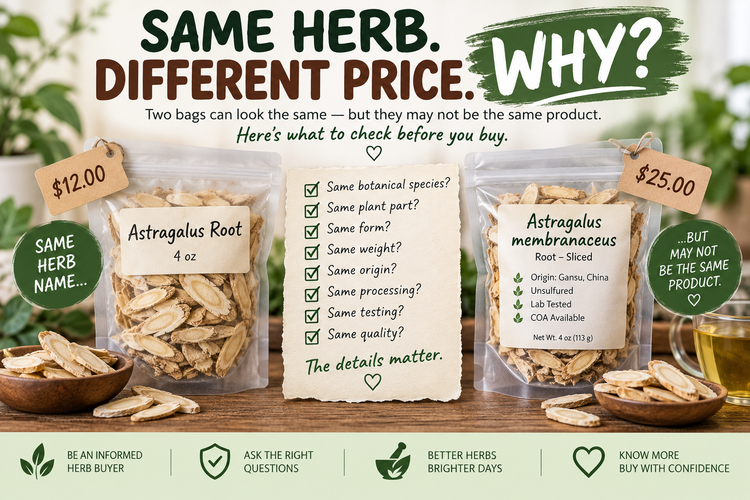
The $12 Herb vs. the $25 Herb
Now let's return to our original question.
Suppose you find these two listings:
Herb A — $12
Astragalus Root
4 oz
That's all the listing tells you.
Herb B — $25
Astragalus membranaceus
Root
Sliced
Age of root when applicable
4 oz
Country of origin identified
Processing information available
Quality testing information available
COA available upon request
Full
Botanical Name
Pin Yin Name if Chinese Traditional Herb
Does that automatically mean Herb B is better?
No.
And that's an important distinction.
Price alone doesn't prove quality, either.
An expensive herb isn't automatically superior.
But you have considerably more information with which to evaluate the second product.
That's the real difference.
Don't ask only, "Which one is cheaper?"
Ask: "Am I actually comparing the same thing?"
The 60-Second Herb Comparison Checklist
The next time you're comparing herbs online, open both product pages and check these nine things:
| What to Compare | Product A | Product B |
|---|---|---|
| Botanical name | ✓ / ? | ✓ / ? |
| Plant part | ✓ / ? | ✓ / ? |
| Whole, cut, powder or extract | ✓ / ? | ✓ / ? |
| Actual package weight | ✓ / ? | ✓ / ? |
| Country of origin | ✓ / ? | ✓ / ? |
| Organic, wildcrafted or conventional | ✓ / ? | ✓ / ? |
| Sulfur-processing information | ✓ / ? | ✓ / ? |
| Testing information | ✓ / ? | ✓ / ? |
| COA/documentation available | ✓ / ? | ✓ / ? |
Here's the interesting part:
You don't have to know everything about herbs to use this checklist.
You simply need to know what questions to ask.
A Few Red Flags Worth Noticing
A low price isn't a red flag by itself.
Neither is a high price evidence of quality.
Instead, pay attention when you repeatedly can't determine basic information about what you're buying.
- No botanical name
- No plant part
- No indication whether you're buying whole herb, powder or extract
- No package weight that's easy to find
- Big promises but very little product information
- No reasonable way to contact the seller with a product question
A pretty package tells you very little about what's inside it. Information tells you much more.
What About Reviews?
Reviews can be useful—but they have limits.
A customer can tell you that the package arrived quickly, that the herb had a strong aroma, or that the slices looked good.
Those are legitimate observations.
But a customer review generally can't establish botanical identity, contaminant levels or laboratory results.
That's why reviews shouldn't substitute for product information and appropriate quality documentation.
Use reviews for what they're good at. Use documentation for what it's good at.
Why Does Natural Herb Color Sometimes Vary?
Herbs are agricultural products.
They don't come off an assembly line looking identical forever.
Color, aroma, size and appearance can sometimes vary according to factors such as:
Growing Conditions • Harvest • Plant Maturity • Processing • Cut Size • Storage
Variation doesn't automatically mean something is wrong.
At the same time, unusual appearance shouldn't simply be ignored.
If something about an herb you receive concerns you, ask the supplier.
That's another reason buying from a company you can actually contact matters.
The Cheapest Herb Can Be a Great Buy
We want to make one point particularly clear.
More expensive does not automatically mean better.
Sometimes you'll find exactly the herb you want from a reputable supplier at an excellent price.
Wonderful.
The purpose of this guide isn't to convince you to choose the expensive option.
It's to help you recognize when you're comparing equivalent products—and when you aren't.
If two sellers offer genuinely comparable herbs with the transparency and documentation you want, price becomes a perfectly reasonable factor in deciding between them.
Become a Better Herb Buyer
You don't need a degree in botany.
You don't need to memorize hundreds of Latin plant names.
And you certainly don't need to become suspicious of every bag of herbs on the Internet.
You just need a better way to shop.
Start with: What plant is this?
Then ask:
- What plant part am I buying?
- What form is it in?
- How much am I getting?
- Where did it come from?
- How was it processed?
- What quality information is available?
Those questions turn shopping from:
"Which bag is cheapest?"
into:
"Which product gives me the combination of identity, quality, transparency and value I'm looking for?"
That's a much more useful comparison.
At 1st Chinese Herbs, We Think You Should Be Able to Ask Questions
We sell Chinese and Western herbs in numerous forms, and we know herbal terminology can sometimes make shopping unnecessarily confusing.
Our goal isn't for you to buy something simply because we tell you it's good.
We want you to understand what you're buying.
Look at the botanical name. Check the plant part. Compare the preparation. Read the product information. Ask about testing. Request a COA when available.
And if something doesn't make sense, ask us.
Because the more you understand about herbs, the better equipped you are to choose the product that's right for what you're looking for.
Remember the 60-Second Rule
Botanical Name • Plant Part • Form • Weight • Origin • Growing Method • Processing • Testing • Documentation
Nine quick checks can tell you considerably more about an herb than the price printed beside it.