
Why Kidney Health Matters
Posted by 1st Chinese Herbs Research Team. on Aug 26th 2026
Why the Kidneys Matter: Strength, Energy, the Low Back & Legs
Your kidneys are remarkable organs that work quietly every day to help keep your body in balance.
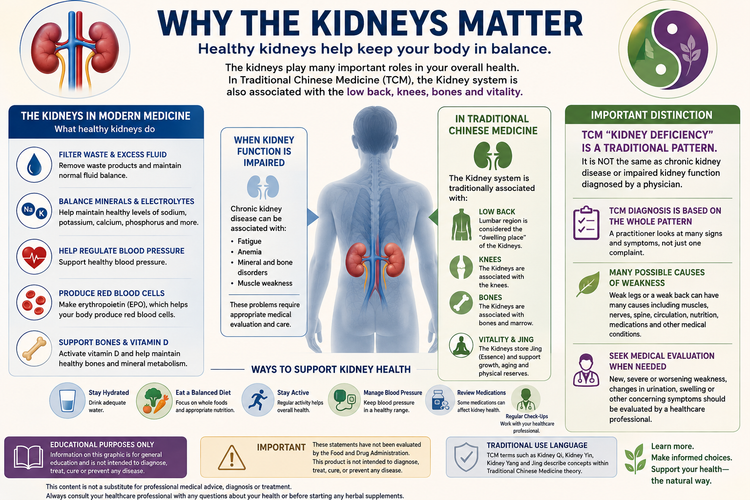
Most people know that the kidneys filter the blood and produce urine. But their role extends much further. Healthy kidneys help regulate fluids and minerals, participate in blood pressure regulation, help the body produce red blood cells, and activate vitamin D needed for normal bone health.
Because the kidneys are involved in so many important functions, maintaining kidney health is an important part of maintaining overall health and well-being.
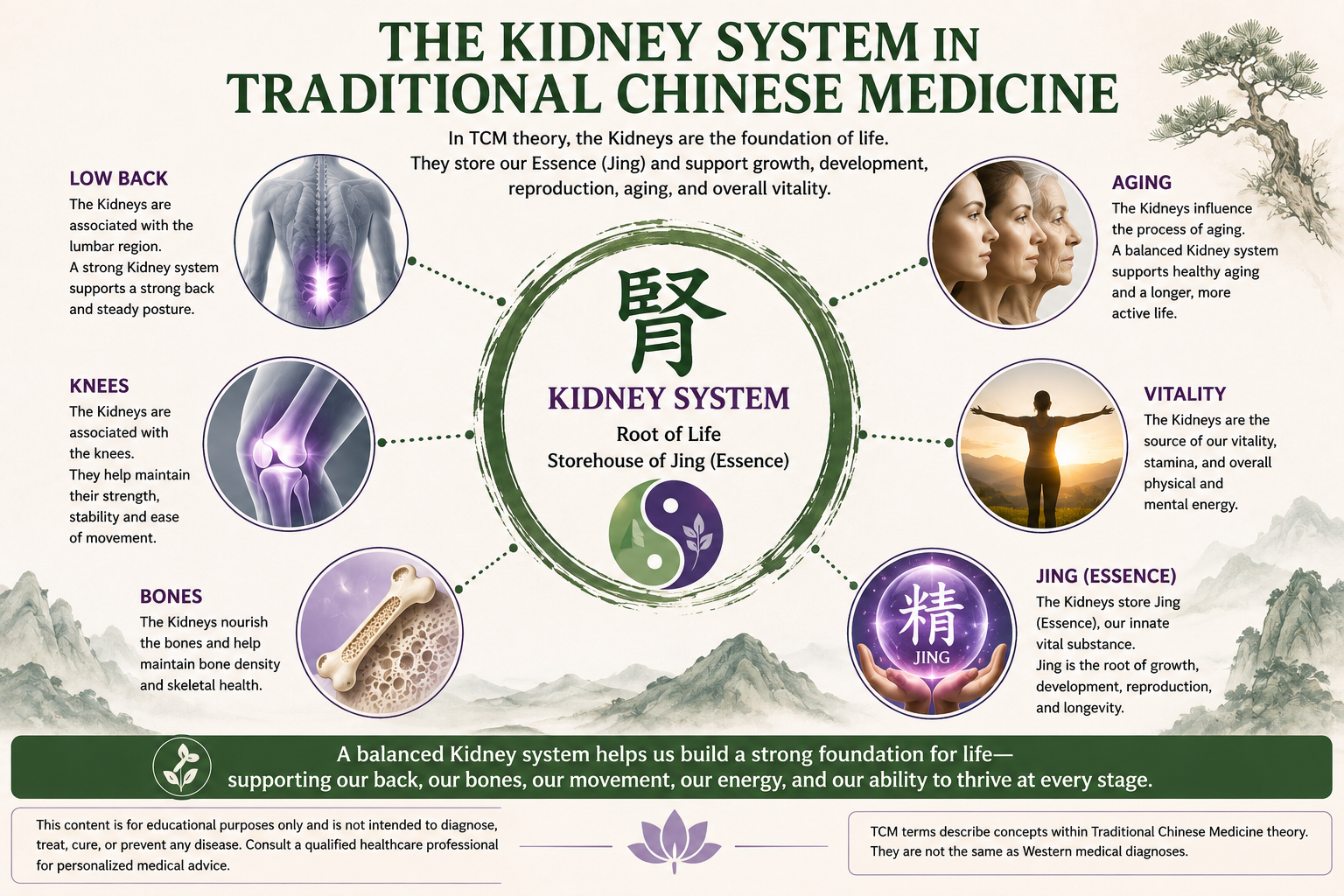
Traditional Chinese Medicine (TCM) also places great importance on what it calls the Kidney system. In TCM theory, the Kidneys are traditionally associated with the low back, knees, bones, aging, vitality, and Jing (Essence).
It is important, however, to understand that these are two different concepts.
The physical kidneys described by modern medicine and the TCM Kidney system are not interchangeable. A TCM diagnosis of “Kidney deficiency” does not mean that a person has kidney disease or impaired kidney function.
What Do Your Kidneys Do?
The physical kidneys are sophisticated filtering and regulatory organs.
Among their many functions, healthy kidneys help:
- Remove waste products and excess fluid from the blood
- Maintain normal fluid balance
- Help maintain appropriate levels of important minerals and electrolytes
- Participate in normal blood pressure regulation
- Produce erythropoietin (EPO), which helps regulate red blood cell production
- Activate vitamin D
- Help maintain normal mineral and bone metabolism
These functions help explain why the kidneys are important to far more than the urinary system.
What Do the Kidneys Have to Do With Strength and Energy?
There isn't a simple relationship where “weak kidneys equal weak legs.”
However, significant medically impaired kidney function can sometimes be accompanied by complications that affect how a person feels physically.
For example, chronic kidney disease can be associated with anemia. Damaged kidneys may produce less erythropoietin, a hormone involved in red blood cell production. Anemia can produce symptoms including fatigue and weakness.
Chronic kidney disease can also disrupt mineral and bone metabolism. This is a recognized medical complication that should be evaluated and managed by a healthcare professional.
This information is important for understanding the body's physiology, but it should not be interpreted as evidence that an herbal product can treat kidney disease, anemia, mineral abnormalities, muscle weakness, or another medical condition.
Does Poor Kidney Function Cause a Weak Back?
Not necessarily.
A weak, tired, or painful lower back can have many causes, including problems involving muscles, joints, nerves, the spine, physical conditioning, or other medical conditions.
Having low-back weakness or discomfort does not mean that your physical kidneys are weak.
This distinction becomes particularly important when discussing Chinese medicine because TCM uses the term Kidney differently.
The Kidney System in Traditional Chinese Medicine
For centuries, Traditional Chinese Medicine has associated the Kidney system with some very different concepts than those used in modern physiology.
According to traditional TCM theory, the Kidney system is associated with:
Low Back • Knees • Bones • Jing (Essence) • Growth • Aging • Vitality
This is why classical Chinese medicine discussions of Kidney deficiency frequently mention the low back and knees.
These are traditional pattern associations. They are not statements that low-back or knee weakness is caused by chronic kidney disease.
Why Does TCM Associate the Kidneys With the Low Back?
In traditional Chinese medicine theory, the lumbar region has a particularly close relationship with the Kidney system.
For this reason, when a TCM practitioner evaluates someone who describes a chronically weak or tired lower back, the practitioner may consider the Kidney system as one part of the overall traditional pattern assessment.
But one symptom by itself does not establish a TCM pattern.
A practitioner traditionally considers many characteristics together, including the person's overall constitution and other signs and symptoms.
Why Does TCM Associate the Kidneys With the Knees and Legs?
Traditional Chinese Medicine also associates the Kidney system with the bones and knees.
Consequently, weakness or soreness involving the knees and low back may be considered when evaluating certain traditional Kidney-deficiency patterns.
This does not mean:
Weak knees = kidney disease
or
Weak legs = Kidney deficiency
There are many possible explanations for leg or knee weakness, and unexplained or worsening weakness deserves appropriate medical evaluation.
What Is Kidney Deficiency in TCM?
This is one of the most important concepts for anyone learning about Chinese herbs.
Kidney deficiency is a Traditional Chinese Medicine pattern—not a Western medical diagnosis.
TCM practitioners further distinguish among several Kidney patterns rather than treating Kidney deficiency as one universal condition.
These can include concepts such as:
Kidney Qi deficiency
Kidney Yin deficiency
Kidney Yang deficiency
Kidney Jing deficiency
Each has its own traditional characteristics.
This distinction is also why two people who both complain of a tired lower back might traditionally receive very different recommendations from a Chinese medicine practitioner.
Kidney Yin and Kidney Yang Are Not the Same Thing
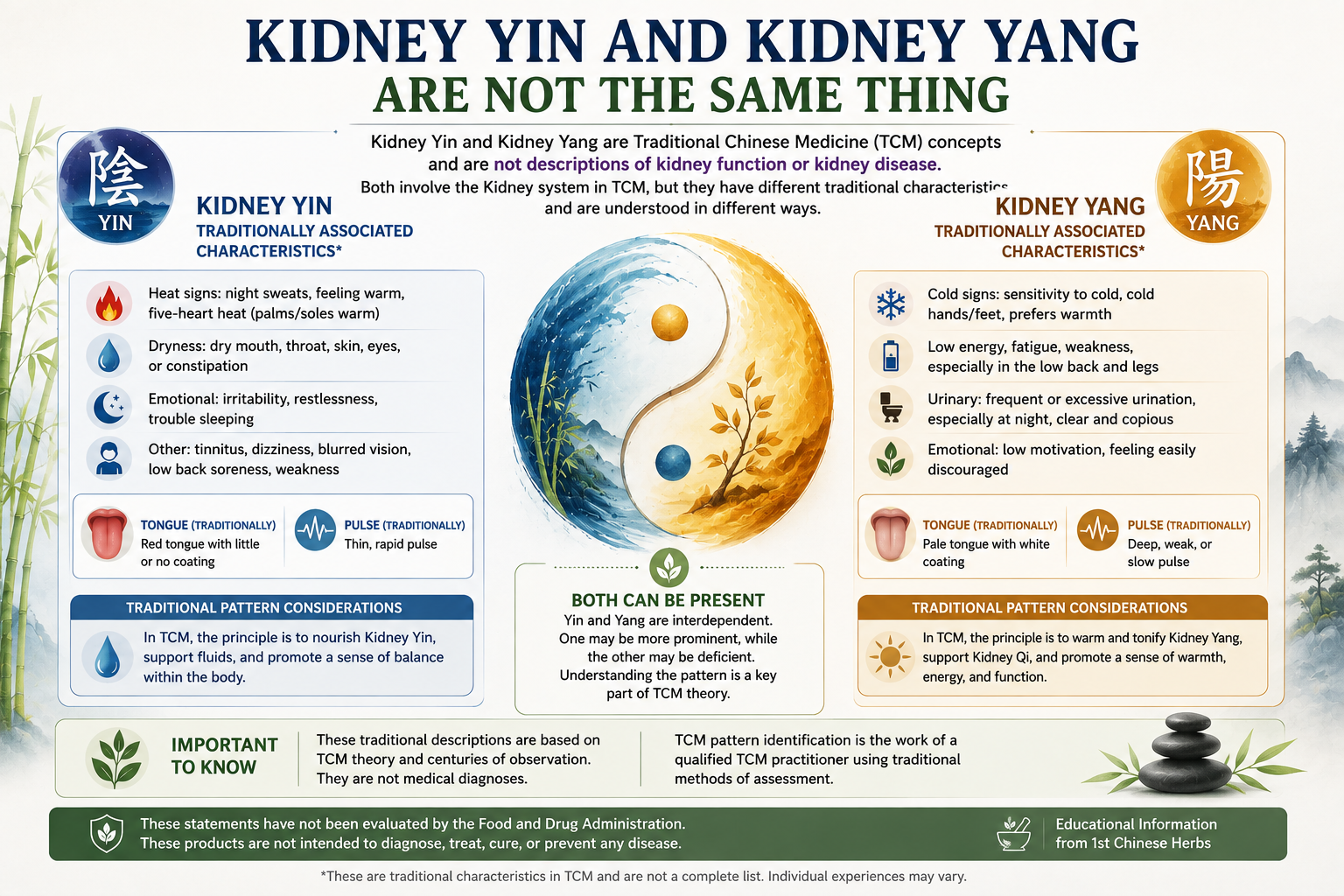
Two of the best-known traditional patterns are Kidney Yin deficiency and Kidney Yang deficiency.
Kidney Yin
In TCM theory, Yin represents nourishing, cooling, moistening, and restorative qualities.
A practitioner evaluating a traditional Kidney Yin pattern looks at the entire presentation rather than simply asking whether the person's back or knees feel weak.
Kidney Yang
Yang is traditionally associated with warming, activating, and functional qualities.
Again, a Kidney Yang pattern is determined from a combination of traditional signs rather than from one complaint.
This distinction matters when discussing Chinese herbal formulas.
A formula traditionally designed to nourish Kidney Yin is not automatically interchangeable with one traditionally designed to support Kidney Yang.
What Is Jing?
Another fascinating part of the TCM Kidney system is Jing, often translated as “Essence.”
In traditional theory, Jing is associated with growth, development, reproduction, maturation, aging, and our deeper constitutional reserves.
This is one reason the traditional Kidney system becomes particularly important in Chinese medicine discussions surrounding aging, bones, physical reserves, the low back, and knees.
Jing is a traditional Chinese medicine concept. It should not be interpreted as a hormone, laboratory value, anatomical substance, or measurable indicator of physical kidney function.
Modern Kidneys and the TCM Kidney System: Keep Them Separate
There are interesting parallels in the language used by the two systems, but they should not be combined into a single medical explanation.
Modern medicine
The physical kidneys filter blood and participate in fluid balance, electrolyte regulation, red blood cell production, blood pressure regulation, and bone and mineral metabolism.
Traditional Chinese Medicine
The TCM Kidney system is a traditional theoretical system associated with Jing, bones, the low back, knees, growth, aging, and vitality.
One does not diagnose the other.
Someone can have medically diagnosed kidney disease without having what a TCM practitioner identifies as a particular Kidney-deficiency pattern.
Likewise, someone identified by a TCM practitioner as having a Kidney-deficiency pattern should not assume that there is something medically wrong with their physical kidneys.
Why Weak Legs or a Weak Back Shouldn't Be Ignored
Weakness is worth paying attention to, particularly when it is new, persistent, or getting worse.
Weak legs or a weak lower back can have many possible causes involving the muscles, nerves, spine, circulation, medications, nutrition, activity level, or medical conditions.
The appropriate question isn't simply:
“Are my kidneys weak?”
A better question is:
“Why am I becoming weaker?”
That distinction matters.
Medical evaluation can look for physical causes of weakness. A qualified TCM practitioner can separately evaluate whether the person's overall presentation corresponds to a traditional Chinese medicine pattern.
Those are different evaluations serving different purposes.
Understanding Chinese Kidney Formulas
Chinese herbal medicine contains many formulas traditionally associated with the Kidney system, but they are not all designed for the same traditional pattern.
Some formulas are traditionally categorized around Kidney Yin.
Others are associated with Kidney Yang, Kidney Qi, Jing, or other pattern combinations.
That means selecting a traditional formula solely because someone has weak legs, knee discomfort, fatigue, or a tired back is not a good way to distinguish among formulas.
The complete traditional pattern matters.
This is also why our herbal descriptions use terms such as “traditionally used,” “traditionally associated with,” and “in Traditional Chinese Medicine.”
They describe the historical and traditional use of the formula rather than claiming that an herbal product treats a medical disease.
Your Kidneys Are Worth Protecting
Your physical kidneys perform essential functions every minute of every day.
Taking care of overall health—including appropriate nutrition, physical activity as tolerated, blood pressure management, medication management, and regular medical care when needed—can be important to long-term health.
Traditional Chinese Medicine offers a different historical framework. Its Kidney system connects the concepts of Jing, aging, vitality, bones, knees, and the low back.
Understanding the distinction between these two meanings of “Kidney” makes Chinese herbal medicine much easier to understand.
Kidney disease belongs in the realm of medical diagnosis and treatment.
Kidney deficiency is a traditional TCM pattern.
Keeping those concepts separate allows us to learn from traditional Chinese medicine without suggesting that a traditional herbal formula diagnoses, treats, cures, or prevents kidney disease.
Important Educational & Safety Information
The medical information in this article is provided for general education and is not intended to diagnose or treat kidney disease, weakness, back pain, or any other medical condition. Persistent or worsening weakness, significant changes in urination, swelling, severe pain, or other concerning symptoms should be evaluated by an appropriate healthcare professional.
Terms including Kidney Qi, Kidney Yin, Kidney Yang, Kidney Jing, Essence, and Kidney deficiency describe concepts within Traditional Chinese Medicine. They are not equivalent to chronic kidney disease, kidney failure, reduced kidney filtration, or other Western medical diagnoses.
Research & Further Reading
The following PubMed research provides additional information about kidney function and some of the ways chronic kidney disease can affect bones, minerals, vitamin D metabolism, muscle strength and physical function.
- Chronic Kidney Disease and Mineral & Bone Disorders
- Mineral and Bone Disorders in Chronic Kidney Disease
- Chronic Kidney Disease, Mineral & Bone Disorders: Pathogenesis and Management
- Vitamin D and Chronic Kidney Disease
- Muscle Strength and Sarcopenia in Chronic Kidney Disease
- Skeletal Muscle Atrophy in Chronic Kidney Disease
Research note: These studies are provided for general educational purposes and discuss medically diagnosed chronic kidney disease and related physiological changes. They do not validate Traditional Chinese Medicine concepts such as Kidney Qi, Kidney Yin, Kidney Yang or Jing, and they do not establish that an herbal product can treat kidney disease.
These statements have not been evaluated by the Food and Drug Administration. This product is not intended to diagnose, treat, cure, or prevent any disease.