
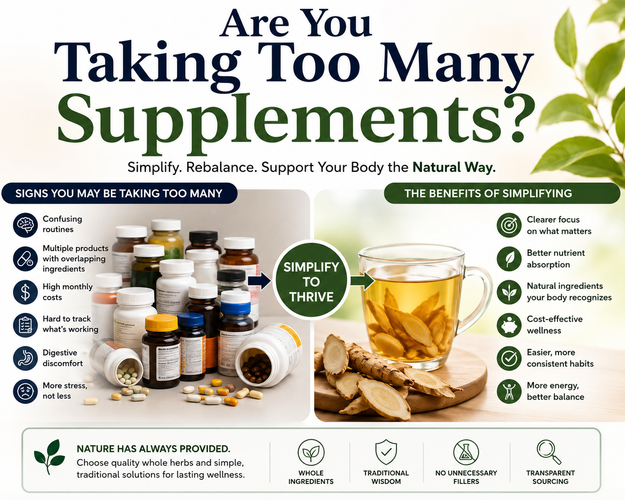
Are You Taking Too Many Supplements?
Posted by 1st Chinese Herbs Research Team. on Jul 20th 2026
Are You Taking Too Many Supplements? How to Simplify Your Wellness Routine with Whole Herbs
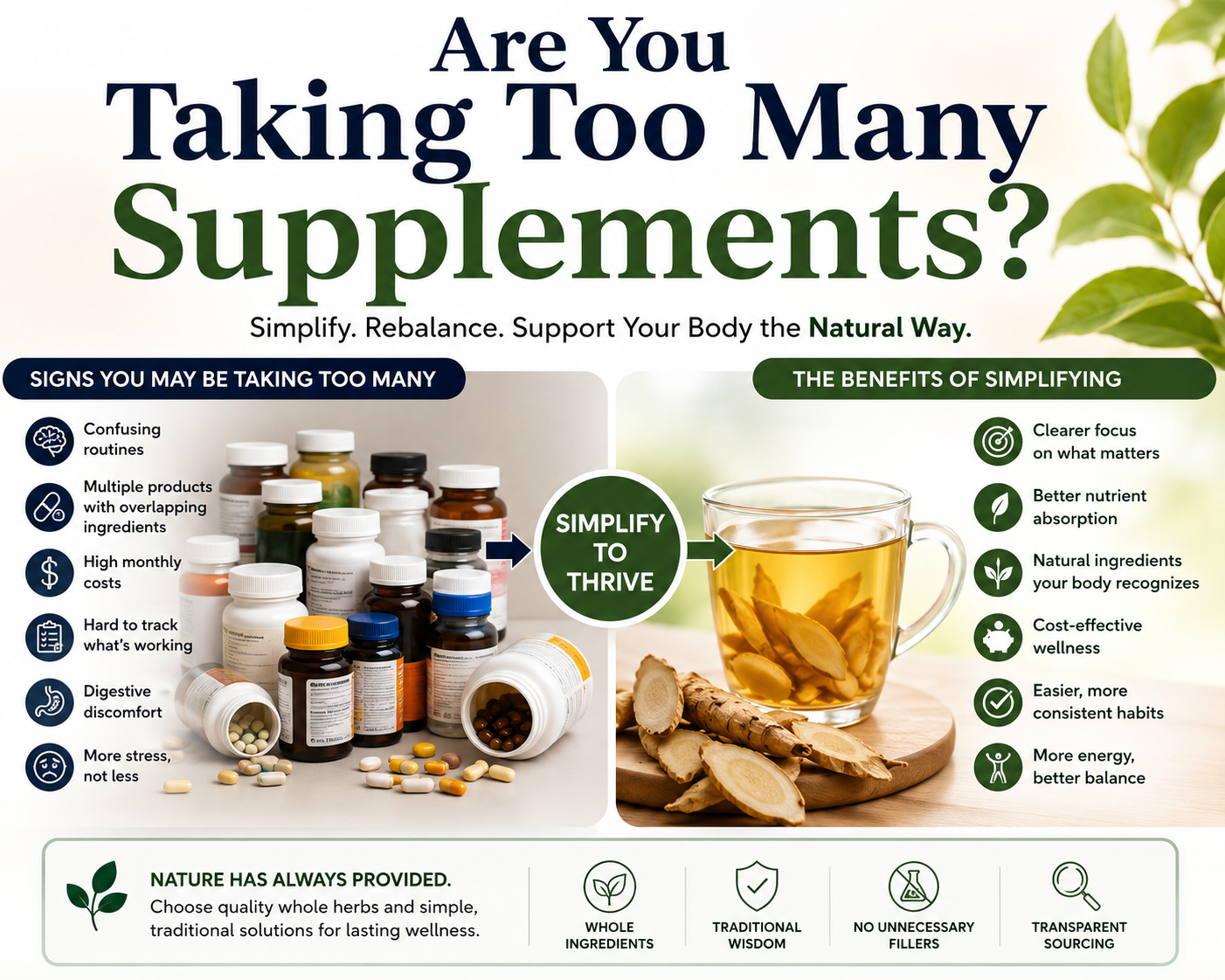
Open the average wellness cabinet and you may find a familiar collection: half-used vitamin bottles, herbal capsules, powdered drink mixes, tinctures, gummies, and products purchased for goals that no longer seem clear.
None of these products is automatically unnecessary or ineffective. Many supplements can be useful when they are selected carefully and used appropriately. The problem begins when a wellness routine becomes so complicated that it is difficult to follow, expensive to maintain, or impossible to evaluate.
This experience is sometimes called supplement fatigue. It happens when a person becomes overwhelmed by the number of products they are taking, uncertain about what each one does, or discouraged because the routine feels more stressful than supportive.
Simplifying does not mean throwing away every capsule or rejecting modern supplements. It means taking a more thoughtful approach: understanding what you use, reducing unnecessary duplication, and choosing forms that fit your goals, preferences, and daily routine.
For some people, that simpler approach includes traditional whole herbs such as Astragalus root, known in Chinese herbalism as Huang Qi.
What Is Supplement Fatigue?
Supplement fatigue is not a formal medical diagnosis. It is a practical description of what happens when a wellness routine becomes difficult to manage.
Common signs may include:
- Taking several products with overlapping ingredients
- Forgetting which supplement is intended for which purpose
- Buying new products before finishing older ones
- Feeling uncertain about timing, serving sizes, or combinations
- Spending more money without knowing which products are useful
- Avoiding the routine because it feels complicated
- Continuing products out of habit rather than clear need
A crowded supplement shelf often develops gradually. One product is added for energy, another for sleep, another for stress, and another for seasonal wellness. Over time, the routine can become disconnected from a clear plan.
The goal should not be to take the greatest number of products. A better goal is to build a routine that is understandable, sustainable, and appropriate for your individual needs.
Why More Is Not Always Better
Wellness products are often marketed individually. Each bottle may sound useful on its own, but several products taken together can contain repeated vitamins, minerals, herbs, sweeteners, or other ingredients.
That creates several possible concerns:
- Ingredient duplication: The same nutrient or botanical may appear in multiple formulas.
- Unclear serving totals: It can be difficult to calculate the combined amount of repeated ingredients.
- Interaction concerns: Herbs and supplements may interact with medications, medical conditions, or one another.
- Inconsistent use: Complicated routines are often harder to follow regularly.
- Difficulty measuring results: When several products are started at once, it is hard to know which one made a difference.
This is why a simpler routine can sometimes be more useful than an extensive one. Fewer carefully selected products are easier to understand, monitor, and discuss with a qualified healthcare professional.
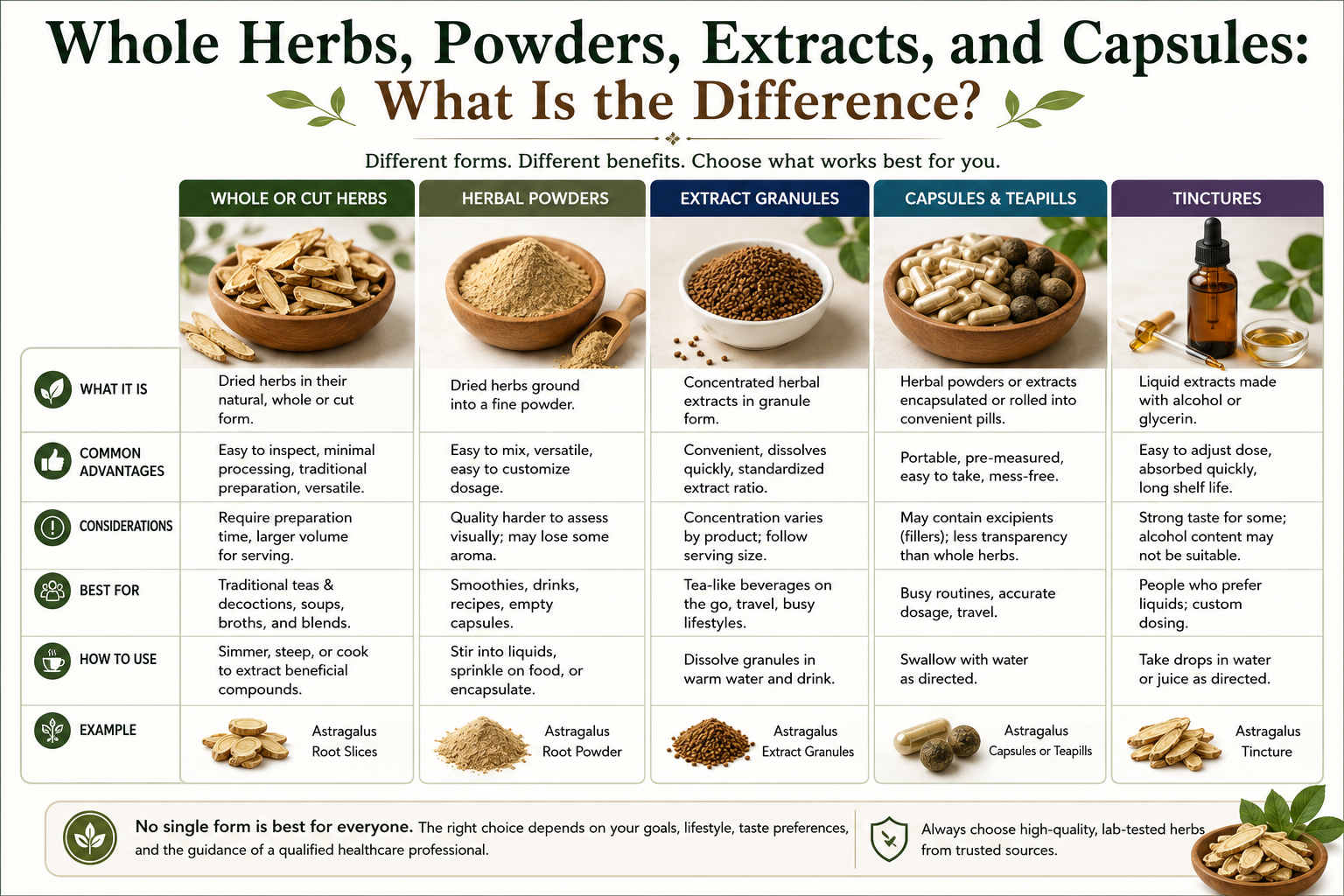
Whole Herbs, Powders, Extracts, and Capsules: What Is the Difference?
No single herbal form is best for every person. Whole herbs, powders, extracts, granules, tinctures, teapills, and capsules each have advantages.
The best choice depends on convenience, preparation preferences, taste, desired concentration, and the guidance of a knowledgeable practitioner.
| Herbal Form | Common Advantages | Considerations |
|---|---|---|
| Whole or Cut Herbs | Easy to visually inspect; useful for teas, decoctions, soups, and traditional preparation | Require preparation time and may have a strong flavor |
| Herbal Powders | Versatile; may be mixed into foods, drinks, or encapsulated | Quality can be harder to judge visually once the herb is powdered |
| Extract Granules | Convenient and concentrated; dissolve quickly in warm water | Extraction ratios and serving sizes vary by manufacturer |
| Capsules and Teapills | Portable, measured, and easy to use | May contain multiple ingredients or additional excipients |
| Tinctures | Convenient liquid form; easy to adjust by drops | Flavor and alcohol content may not suit everyone |
Whole herbs are not automatically superior to every other form. Their main advantage is transparency. You can often see the color, cut, texture, and general condition of the plant material before preparing it.
For people who enjoy making tea, broth, soup, or a traditional decoction, whole or cut herbs can also make the process feel more connected and intentional.
Why Whole Herbs Appeal to People Seeking Simplicity
Whole herbs have been prepared in homes, kitchens, and traditional herbal practices for generations. They appeal to many people because the routine is direct: select the herb, measure it, simmer or steep it, strain it, and use it as directed.
This does not eliminate the need for caution. Whole herbs still contain naturally occurring compounds, and they may not be suitable for everyone. However, they can make it easier to understand exactly what is being prepared.
People may choose whole herbs because they:
- Prefer a simple, single-herb preparation
- Want to see the botanical material before using it
- Enjoy the ritual of preparing herbal tea or decoctions
- Prefer to avoid swallowing multiple capsules
- Want an ingredient that can also be added to soups or broths
- Are following traditional preparation guidance
The key is not to replace every supplement with an herb. The key is to choose fewer products with clearer purposes.
Astragalus Root: A Traditional Example of a Versatile Whole Herb
Astragalus membranaceus is a perennial plant in the legume family. Its dried root is known as Huang Qi in traditional Chinese herbalism.
Astragalus has a long history of use in traditional Chinese formulas and food-like preparations. It is commonly sold in long, thin slices, shorter cut pieces, powders, extracts, granules, capsules, and teapills.
Within the traditional Chinese framework, Huang Qi is generally described as sweet and slightly warm. Historical herbal references associate it with supporting Qi and strengthening traditional defensive functions.
These traditional descriptions belong to a historical medical system. They should not be interpreted as modern medical diagnoses, guarantees, or proof that the herb will treat a disease.
Modern research has examined naturally occurring compounds in Astragalus, including polysaccharides, flavonoids, and saponins. Research continues, but laboratory findings and studies of isolated compounds should not automatically be applied to every Astragalus product or every person.
Why Astragalus Works Well in a Simplified Herbal Routine
Astragalus is often chosen by people who want a mild-tasting root that can be prepared in several ways.
Its practical advantages include:
- A mild, slightly sweet, earthy flavor
- Compatibility with soups, broths, rice, and herbal teas
- Easy identification when sold in visible root slices
- A long history of traditional use
- Availability in whole, cut, powdered, and extracted forms
It is not necessary to use Astragalus simply because it is popular. A qualified practitioner can help determine whether it fits your individual situation, especially if you take prescription medications or have an existing health condition.
How to Identify Quality Astragalus Root
Since 1994, we have worked with Chinese and Western herbs in many forms. One lesson that becomes clear after handling botanical ingredients for decades is that quality cannot be judged by a single feature.
Color, aroma, cut, storage, species identity, cleanliness, and supplier testing all matter.
When evaluating sliced Astragalus root, consider the following:
| Quality Feature | What to Look For |
|---|---|
| Botanical Identity | The product should clearly identify the botanical species and plant part. |
| Root Appearance | Slices are commonly pale tan or yellowish with visible fibrous grain. |
| Aroma | The scent is usually mild, clean, earthy, and slightly sweet rather than musty. |
| Texture | Properly dried slices should feel firm and dry, not damp, sticky, or unusually soft. |
| Cleanliness | The herb should be reasonably free from excess dirt, foreign matter, and visible deterioration. |
| Testing | Choose suppliers that use identity and contaminant testing appropriate to the product. |
| Traceability | Reliable vendors should be able to identify the brand, lot, or supplier source. |
Natural herbs can vary from harvest to harvest. A darker or lighter color does not automatically mean that an herb is stronger or weaker. Visual inspection is useful, but it should be combined with accurate identification, responsible sourcing, and laboratory testing.
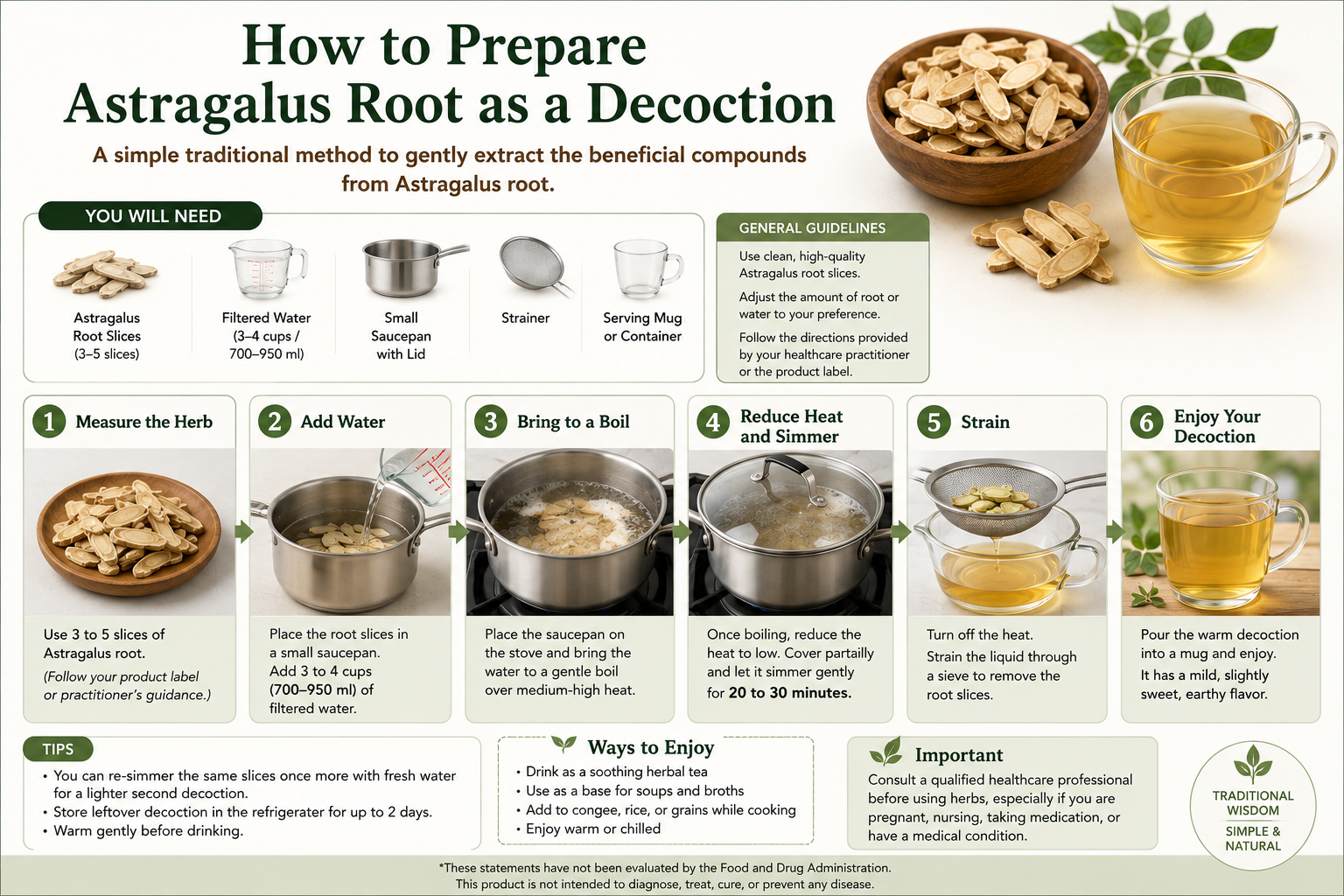
How to Prepare Astragalus Root as a Decoction
A decoction is a traditional method used for firmer plant materials such as roots, bark, seeds, and dense fruits. Instead of briefly steeping the herb like ordinary tea, a decoction is simmered for a longer period.
Simple Astragalus Root Decoction
- Measure the herb: Use the amount recommended on the product label or by a qualified practitioner.
- Add water: Place the sliced root in a small saucepan with approximately 3 to 4 cups of water.
- Bring to a gentle boil: Once boiling, reduce the heat.
- Simmer: Cover partially and simmer gently for approximately 20 to 30 minutes.
- Strain: Remove the root slices before drinking or using the liquid.
The finished liquid is typically light golden in color with a mild, earthy sweetness.
Preparation times and amounts vary depending on the product, formula, and intended use. Follow the directions provided with the herb or the instructions of your practitioner.
Other Practical Ways to Use Astragalus Root
Astragalus is often used as more than a stand-alone tea. Its mild flavor makes it suitable for food-based preparations.
Add It to Soup or Broth
Place several slices into a pot of vegetable, chicken, or mushroom broth while it simmers. Remove the slices before serving unless the product directions state otherwise.
Use It While Cooking Grains
A mild Astragalus decoction may be used as part of the cooking liquid for rice or other grains.
Combine It with Other Traditional Ingredients
Astragalus is often used in multi-herb formulas. However, combining herbs should be done thoughtfully. More ingredients do not automatically create a better formula.
Prepare a Larger Batch
Some people prepare more than one serving at a time and refrigerate the strained liquid in a covered container. Follow safe food-storage practices and use it promptly.
Who Should Use Extra Caution?
Natural does not mean appropriate for every person.
Speak with a qualified healthcare professional before using Astragalus if you:
- Are pregnant or nursing
- Take prescription medications
- Use immunosuppressive medication
- Have an autoimmune condition
- Are preparing for surgery
- Have a chronic medical condition
- Are using several herbs or supplements together
Stop using the product and seek professional advice if you experience an unexpected reaction.
Herbs should not be used as substitutes for medical evaluation, prescribed treatment, or emergency care.
How to Simplify Your Wellness Cabinet
A simplified wellness routine begins with clarity rather than a shopping list.
1. Write Down Everything You Use
Include vitamins, minerals, herbs, teas, powders, gummies, tinctures, protein products, and fortified drinks.
2. Record Why You Take Each Product
If you cannot identify its purpose, that product deserves a closer review.
3. Look for Repeated Ingredients
Check whether the same vitamins, minerals, or herbs appear in several formulas.
4. Review the Routine with a Professional
A pharmacist, physician, registered dietitian, or qualified herbal practitioner can help identify unnecessary overlap and possible interactions.
5. Introduce Changes One at a Time
Changing several products simultaneously makes it difficult to evaluate how you respond.
6. Choose Forms You Will Actually Use
A whole herb is not helpful if you dislike preparing it. A capsule is not convenient if you avoid swallowing it. The best form is one that is suitable, understandable, and realistic for your routine.
Whole Herbs Are an Option, Not a Requirement
A trustworthy herbal business should not tell every customer that one form is always superior.
Some people prefer the visibility and ritual of whole herbs. Others need the convenience of capsules or granules. Practitioners may select concentrated extracts for specific formulas, while home users may enjoy preparing sliced roots in soup.
The important questions are:
- Is the botanical correctly identified?
- Is the product appropriate for the person using it?
- Does the form match the intended preparation?
- Is the serving information clear?
- Has the product been sourced and tested responsibly?
- Can the user maintain the routine safely and consistently?
Why Purchase Astragalus Root from 1st Chinese Herbs?
1st Chinese Herbs has supplied Chinese and Western herbs since 1994. Over more than three decades, we have helped customers, herbalists, wellness enthusiasts, and practitioners locate herbs in forms that match their preparation preferences.
Our approach focuses on practical information and product transparency.
- Established herbal business since 1994
- Carefully selected Chinese and Western herbs
- Lab-tested products from established herbal brands
- Clear botanical and product-form information
- Whole, cut, powdered, and concentrated options
- Customer support from people familiar with herbal products
- Shipping from Washington State
We believe customers should be able to understand what they are buying, how it is commonly prepared, and what questions to ask before using it.
Frequently Asked Questions
Is Astragalus root the same as Astragalus powder?
They come from the same type of botanical ingredient but are prepared differently. Sliced root is typically simmered or added to food. Powder may be mixed into liquids, foods, or capsules. Extract granules are more concentrated and should be used according to their specific directions.
What does Astragalus tea taste like?
Astragalus is generally mild, earthy, and slightly sweet. It is usually less bitter than many traditional roots.
Can Astragalus root be reused?
Some traditional preparations simmer the same roots more than once, but the second preparation is generally milder. Follow your product instructions or practitioner guidance.
Can Astragalus be taken every day?
Daily use may not be appropriate for everyone. Frequency and duration depend on the product, the individual, other medications or supplements, and practitioner guidance.
Is whole Astragalus better than capsules?
Not necessarily. Whole root offers visual transparency and traditional preparation options. Capsules offer convenience. Quality, suitability, accurate identity, and responsible use matter more than form alone.
How should dried Astragalus root be stored?
Keep it sealed in a cool, dry place away from direct sunlight, moisture, heat, and strong odors. Always inspect dried herbs before use and discard them if they develop moisture damage, mold, or an abnormal odor.
A Simpler Routine Begins with Better Decisions
A crowded wellness cabinet is not proof of a better wellness routine. In many cases, it is a sign that the routine needs to be reviewed and simplified.
You do not need to reject every capsule, powder, or extract. You also do not need to buy the latest product every time a new wellness trend appears.
Instead, begin with a few practical questions:
- Why am I using this product?
- Does it duplicate something else?
- Do I understand its ingredients?
- Is it appropriate with my medications and health history?
- Will I use it consistently?
- Is there a simpler form that better fits my routine?
For people who enjoy traditional preparation, whole herbs such as Astragalus root can offer a practical and transparent option. The visible root slices, mild flavor, and versatility in tea, broth, and food make it approachable for many home herbal users.
The goal is not to fill another shelf. The goal is to create a routine that feels clear, intentional, and manageable.
Explore Premium Astragalus Root
Discover carefully selected Astragalus root in whole, cut, powdered, and concentrated forms. Review the product details, preparation instructions, brand information, and available quality features before choosing the form that best fits your routine.
RELATED LINKS
Disclaimer: These statements have not been evaluated by the Food and Drug Administration. These products are not intended to diagnose, treat, cure, or prevent any disease. The information on this page is provided for educational purposes only and is not a substitute for professional medical advice. Consult a qualified healthcare professional before using herbs or supplements, particularly if you are pregnant, nursing, taking medication, preparing for surgery, or managing a medical condition.