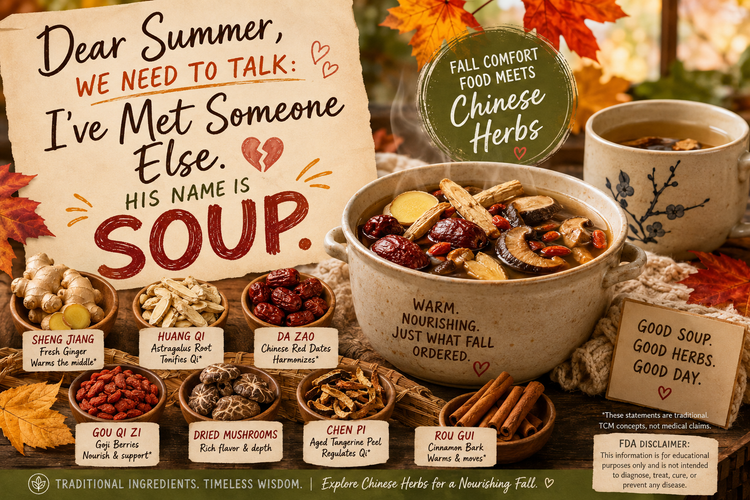
Dear Summer, We Need to Talk: I’ve Met Someone Else. His Name Is Soup.
Posted by 1st Chinese Herbs Guest Writer Beth and the 1st Chinese Herbs Research Team on Sep 3rd 2026
Dear Summer, We Need to Talk:
I’ve Met Someone Else. His Name Is Soup.
Summer, I have to tell you something, and this is difficult.
We had a good run. There were long evenings, fresh vegetables, iced drinks, and days when turning on the stove felt completely unreasonable.
But lately, things have changed.
The mornings are colder. The sun is disappearing earlier. I caught myself looking for a sweater.
And then it happened.
I met someone. His name is Soup.
Soup is warm. Soup is dependable. Soup does not care if I am wearing fuzzy socks at 4:00 in the afternoon.
And best of all, Soup understands the herb cabinet.
It Starts With Ginger
No one wakes up one September morning and announces, “Today I shall become a person who simmers roots.”
It happens gradually. First you make one cup of hot tea.
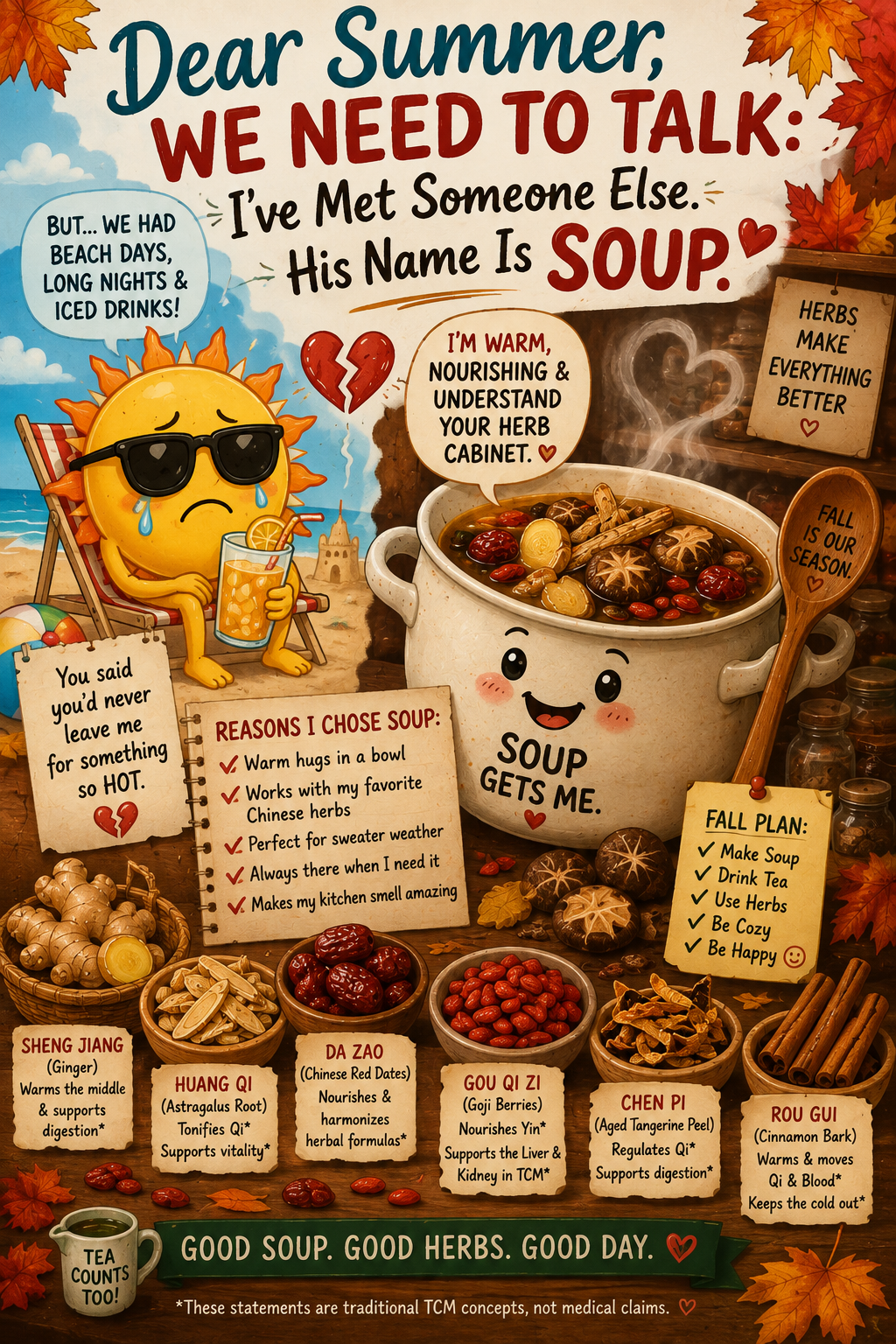
Then you open the herb cabinet looking for Sheng Jiang, or fresh ginger.
Ten minutes later you have found the ginger, discovered a bag of Huang Qi you forgot you owned, and uncovered at least one mysterious brown bag that absolutely should have been labeled.
This is how fall begins.
Not with the changing leaves.
With the stockpot.
Sheng Jiang: Because Everything Needs Ginger Now
Sheng Jiang (生姜) is fresh ginger.
During summer, you may barely think about it. Fall arrives and suddenly ginger seems appropriate for everything.
Tea? Ginger.
Broth? Ginger.
Dinner? Probably ginger.
Standing in the kitchen wondering why it is already dark outside?
Definitely ginger.
In Traditional Chinese Medicine, Sheng Jiang is traditionally described as warm and acrid. These are traditional TCM terms and are not claims that ginger prevents or treats seasonal illness.
Huang Qi Has Entered the Stockpot
Next comes Huang Qi (黄芪), commonly known as Astragalus Root.
Huang Qi has a long history in Chinese herbalism and is traditionally described in TCM as an herb that “tonifies Qi.” Qi is a traditional Chinese medicine concept and should not be interpreted as a modern medical diagnosis or health claim.
But today we are not turning dinner into a medical lecture.
It is fall. There is a stockpot. Huang Qi is a root.
You can probably see where this is going.
Da Zao Makes Everything Look More Impressive
Da Zao (大枣), or Chinese red dates, have a long history as both food and an ingredient in traditional Chinese herbal formulas.
Put a few into a pot and suddenly your ordinary broth looks like you have been studying Chinese herbal cooking for 30 years.
Nobody needs to know you were eating crackers over the sink yesterday.
Within TCM, Da Zao is traditionally described as sweet and warm and is often used in formulas to harmonize other ingredients.
Then the Mushrooms Appear
Now things are getting serious.
You find dried Chinese mushrooms in the pantry.
Suddenly Soup is no longer dinner.
Soup is a project.
Dried mushrooms can add rich flavor and depth to broth, and they fit perfectly into the whole fall routine of simmering things slowly while pretending you planned dinner hours ago.
Gou Qi Zi: Soup Accessories
Gou Qi Zi (枸杞子), or goji berries, can add color and a touch of sweetness to certain Chinese-style soups and broths.
They also make the finished bowl look much more intentional.
There is a big difference between:
“I threw everything I could find into a pot.”
and
“I prepared an herbal broth.”
Sometimes that difference is a handful of little red berries.
Chen Pi: The Unexpected One
Chen Pi (陈皮) is dried or aged tangerine peel.
It is traditionally categorized in TCM among herbs that regulate Qi, but in the kitchen it can also bring an interesting citrus aroma to certain broths and dishes.
Use it thoughtfully.
This is not one of those situations where “if a little is good, half the bag must be better.”
That philosophy has ruined many perfectly innocent dinners.
And Then There Is Rou Gui
Rou Gui (肉桂) is Chinese cinnamon bark.
Cinnamon announces fall more efficiently than a calendar.
One whiff and your brain starts looking for sweaters.
Within TCM, Rou Gui is traditionally considered a warming herb. That is traditional terminology, not a claim that it treats a medical condition.
But from a culinary point of view, the aroma alone says one thing very clearly:
Summer is over.
The Fall Herb Cabinet Inspection
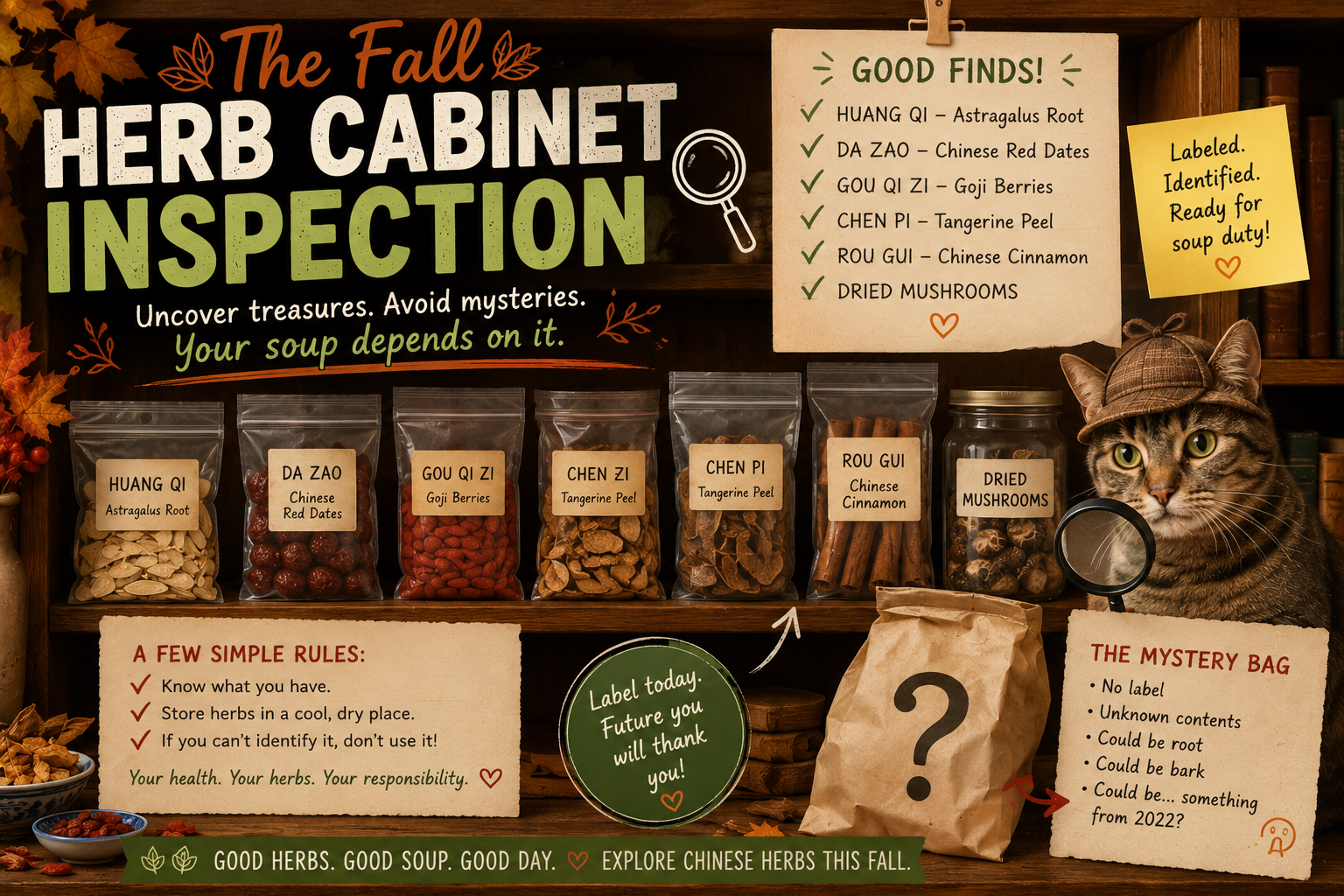
Fall is also a good time to investigate the archaeological site known as your herb cupboard.
You find a neatly labeled bag of Huang Qi.
Excellent.
A package of Da Zao.
Very responsible.
And then...
The Bag.
No label.
Brown things inside.
Could be root. Could be bark. Could be something you ordered three years ago after reading an article at midnight.
If you cannot confidently identify an herb, do not guess and do not use it.
Your soup deserves better.
A Simple Fall Broth Idea
If you want to experiment with Chinese ingredients in the kitchen, keep it simple.
- Sheng Jiang — fresh ginger
- Huang Qi — Astragalus Root
- Da Zao — Chinese red dates
- Gou Qi Zi — goji berries
- Dried Chinese mushrooms
Use familiar culinary ingredients and follow the directions for any herbal product you use.
Remember that whole herbs, ground powders, and concentrated extracts are not necessarily interchangeable.
Summer, I Hope We Can Still Be Friends
So, Summer, this is not goodbye forever.
I will miss the tomatoes.
I will miss the long evenings.
I may even miss complaining that it is too hot.
But right now?
Something is simmering on the stove.
The kettle is boiling.
The sweaters have returned.
The herb cabinet is open.
And Soup and I are getting serious.
I will see you next year, probably around the moment I announce:
“It is WAY too hot to make soup.”
Until then...
Happy fall. Put the kettle on.
Traditional Chinese Medicine Note
Terms such as Qi, Blood, Jing, Heat, Cold, Kidney, Liver, Lung, Spleen, warming, tonifying, and regulating Qi are concepts used within Traditional Chinese Medicine. They do not correspond directly to modern medical diagnoses, diseases, anatomical organ function, hormones, or laboratory findings.
Traditional-use information is provided for educational and historical purposes and should not be interpreted as evidence that an herb prevents, treats, cures, or mitigates disease.
Disclaimer: These statements have not been evaluated by the Food and Drug Administration. This information is for educational purposes only and is not intended to diagnose, treat, cure, or prevent any disease.