If an Herb Sounds Too Good to Be True, It Probably Is
Posted by Written by Sarah Johnson, Certified Herbalist, 1st Chinese Herbs. Trusted since 1994. on Sep 7th 2026
If an Herb Sounds Too Good to Be True, It Probably Is
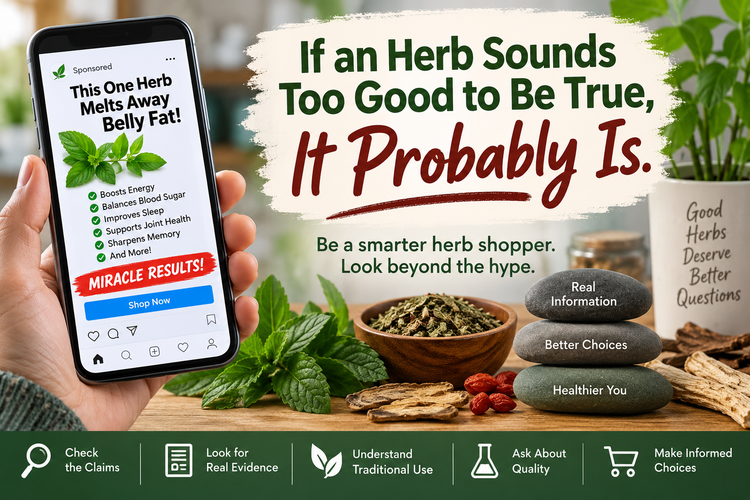
You're scrolling through social media when an ad catches your attention.
“This one herb melts away belly fat!”
“The ancient herb doctors don't want you to know about!”
Or perhaps it's the truly remarkable herb that supposedly helps with your weight, blood sugar, blood pressure, memory, joints, sleep, energy—and practically everything else.
Wow.
Where has this little plant been all our lives?
It's easy to understand why these advertisements get our attention. Most of us would love to discover something simple and natural that could solve a difficult problem.
But when an herbal claim sounds too good to be true, that's exactly when it's time to slow down and ask a few questions.
Herbs Don't Have to Be Miracles to Be Interesting
Herbs have been part of cultures and traditional practices around the world for generations.
Chinese herbal traditions have histories extending back thousands of years. Western herbalism also has a long and fascinating history.
Today, scientists continue to study plants, their naturally occurring compounds, and their potential effects.
That's interesting enough.
We don't need to turn every herb into a miracle cure to make it worth learning about.
In fact, exaggerated claims can make it harder to separate genuine traditional knowledge and legitimate research from clever marketing.
Watch for the Miracle Words
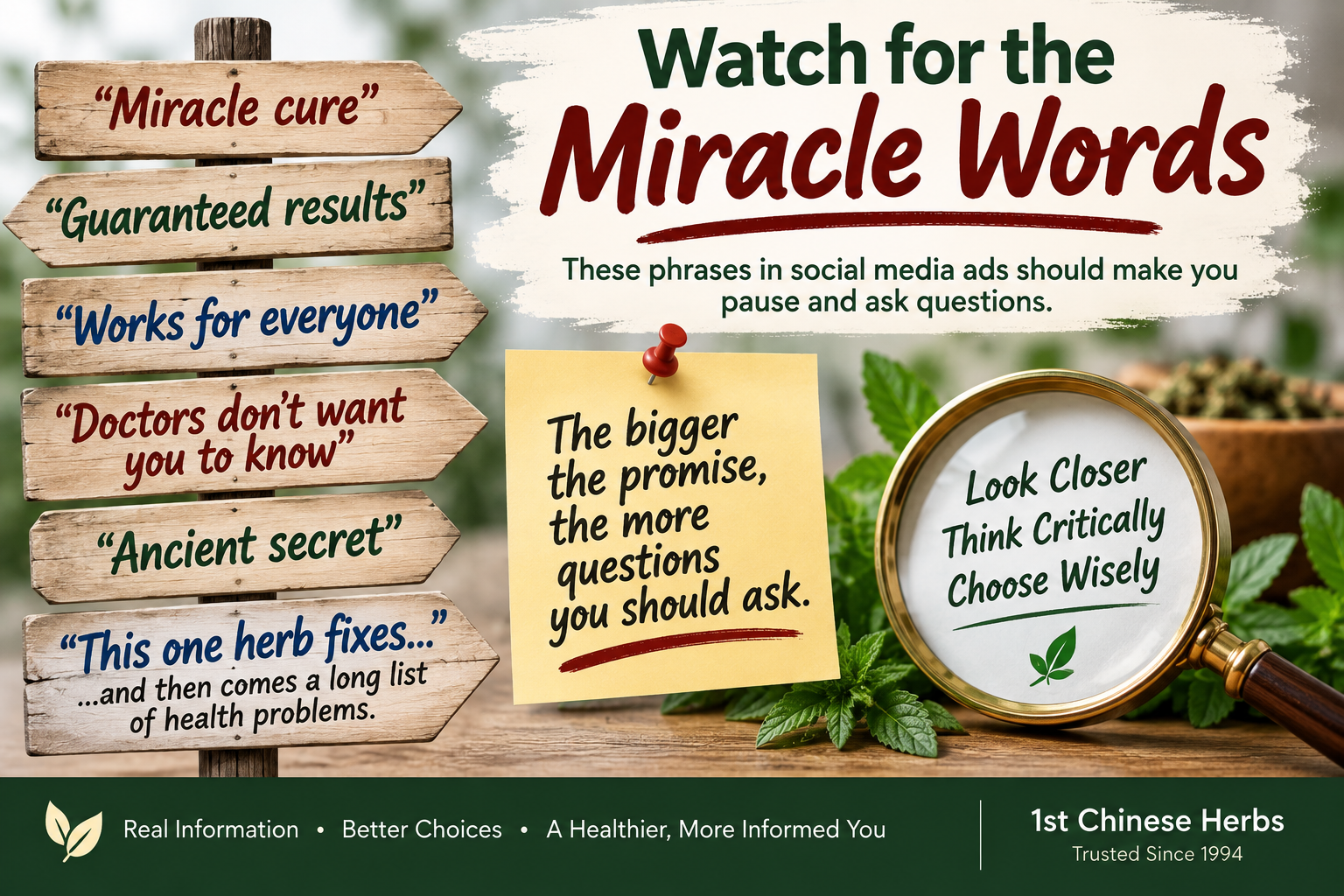
Some words and phrases in social media ads should immediately make you ask questions:
“Miracle cure”
“Guaranteed results”
“Works for everyone”
“Doctors don't want you to know”
“Ancient secret”
“This one herb fixes...”
“Watch this now before they take it down!”
False Urgency — Be cautious when an ad pressures you to act immediately because the information is supposedly going to be “removed,” “banned,” or “taken down.” Creating fear that you'll miss out can be a marketing tactic designed to get you to act before you have time to check the claims.
And then comes a list of seemingly unrelated health problems.
Here's a simple rule:
The bigger the promise, the more questions you should ask.
Traditional Use Is Not the Same as Scientific Proof
This distinction is particularly important when learning about Chinese herbs.
You may read that an herb has traditionally been described as supporting Qi, nourishing Yin, clearing Heat, or addressing other traditional patterns.
These terms belong to the traditional framework of Chinese medicine.
They should not be turned into statements claiming that an herb treats or cures a specific disease.
The same principle applies to Western herbal traditions.
A plant may have a long and interesting history of traditional use. That history is worth preserving and understanding.
But traditional use is not the same thing as scientific proof of a modern medical treatment.
We can respect traditional knowledge without exaggerating what it tells us.
What Does “Studies Show” Really Mean?
You've probably seen this phrase:
“Studies show...”
It sounds convincing—but there's a lot more you need to know.
Ask:
Was the study conducted in people?
Was it an animal or laboratory study?
How many people participated?
What part of the plant was studied?
Was it the whole herb, a concentrated extract, or one isolated compound?
How much was used?
Was the research actually performed on the same product being advertised?
And most importantly:
Did the study actually conclude what the advertisement claims?
Early research can be exciting and worth following. But a promising laboratory study is not the same as proving that an herb will produce the same result in people.
Interesting research and proven treatment are not the same thing.
Be Careful With Testimonials Too
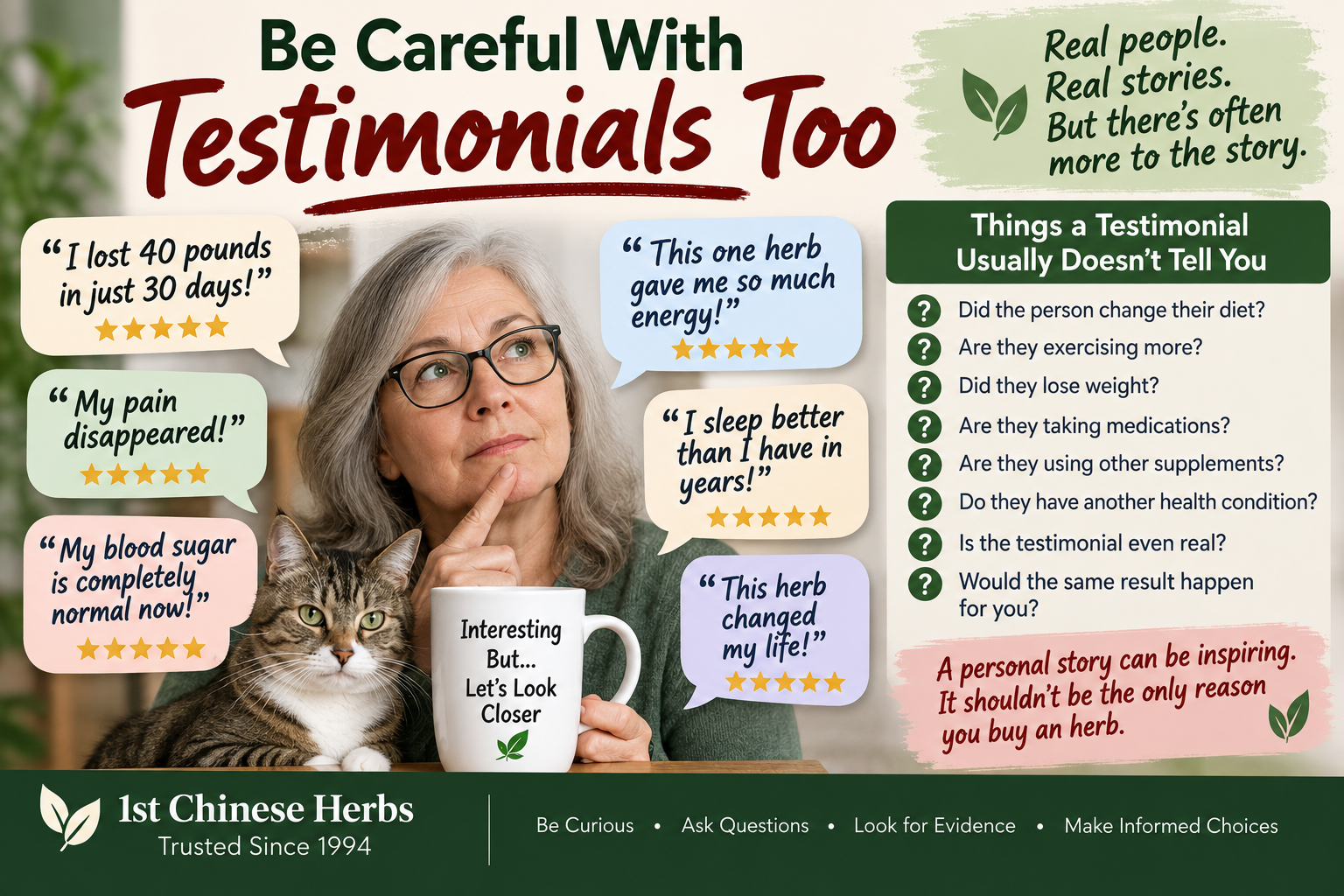
Personal stories can be incredibly persuasive.
“I lost 40 pounds!”
“My pain disappeared!”
“My blood sugar completely changed!”
But there are things a testimonial usually doesn't tell you.
Did the person change their diet? Start exercising? Lose weight? Begin medical treatment? Change medications? Take other supplements?
And with something posted online, there's another basic question:
Is the testimonial even authentic?
Someone's personal experience might make you interested enough to learn more.
It shouldn't be the only reason you purchase an herb.
Before You Buy an Herb, Ask These Questions
You don't need to be an herbalist or scientist to become a smarter herb shopper.
Start with a few simple questions:
What is the actual herb?
Look for the common name and botanical name.
What part of the plant am I buying?
Root, leaf, flower, bark, fruit, or seed?
What form is it?
Whole herb, powder, concentrated extract, tea, tablet, capsule, or teapill?
What exactly is being promised?
Is the seller educating you—or promising you a miracle?
Where is the research?
If an advertisement says “studies show,” can you actually find the studies?
What do I know about the product's quality?
Look for useful information about botanical identity, sourcing, processing, testing, and other quality standards.
And finally, ask yourself:
Does this claim actually sound realistic?
If one herb supposedly solves a dozen unrelated health problems, that's a good reason to investigate before buying.
At 1st Chinese Herbs, We'd Rather Educate Than Exaggerate
At 1st Chinese Herbs, we've been serving customers interested in Chinese and Western herbs since 1994.
Over those years, we've watched herbal trends come and go.
Our approach is simple:
Herbs don't need exaggerated promises to be interesting.
We would rather help you understand:
-
What the herb actually is
-
Which part of the plant you're buying
-
How it has traditionally been described or used
-
What form of the herb you're purchasing
-
What modern research is investigating
-
What quality information is available
-
And, when appropriate, what we simply don't know yet
Sometimes “the research isn't conclusive” isn't as exciting as a miracle headline.
But it's more useful—and more honest.
Be Curious. Ask Questions.
You don't have to become suspicious of every herb you hear about.
Quite the opposite.
Be curious.
Learn about Chinese and Western herbal traditions. Read about unfamiliar plants. Look at the research. Ask questions. Find out what you're actually buying.
There are thousands of fascinating plants worth discovering.
They don't need miracle claims to make them interesting.
So the next time a social media ad tells you that someone has discovered the one secret herb that fixes practically everything, remember:
If it sounds too good to be true, it probably is.
Keep your wallet in your pocket for a moment.
Do a little research.
Ask a few questions.
Then decide for yourself.
Traditional herbal information is presented for educational purposes and describes historical or traditional practices. Research information is provided for educational purposes and should not be interpreted as a claim that an herb or product can diagnose, treat, cure, or prevent disease.
Research & Further Reading
- Misinformation and Disinformation About Dietary Supplements on Social Media – PubMed — Discusses how social media can spread misleading information about dietary supplements and the need for evidence-based consumer education.
- Diet Pills and Deception: Supplement Claims on TikTok – PubMed — Researchers found that 97% of the analyzed videos did not provide scientific evidence supporting their health or appearance claims.
- Disinformation on Dietary Supplements by Social Media Influencers – PubMed — Examines supplement promotions by influencers and found problems including promises of effectiveness while risks and contraindications were often inadequately discussed.
- Herbal Medicine: Review of Efficacy, Safety and Regulation – PubMed — Reviews the evidence, safety considerations, and regulation surrounding herbal products.