
Skip the Tea Bag: An Easy Way to Brew Loose Tea Without Plastic-Containing Bags
Posted by 1st Chinese Herbs Research Team. on Aug 31st 2026
Skip the Tea Bag: An Easy Way to Brew Loose Tea Without Plastic-Containing Bags
Making tea should be simple: herbs, hot water, a favorite cup, and a few minutes to steep.
But have you ever wondered what your tea bag is actually made from?
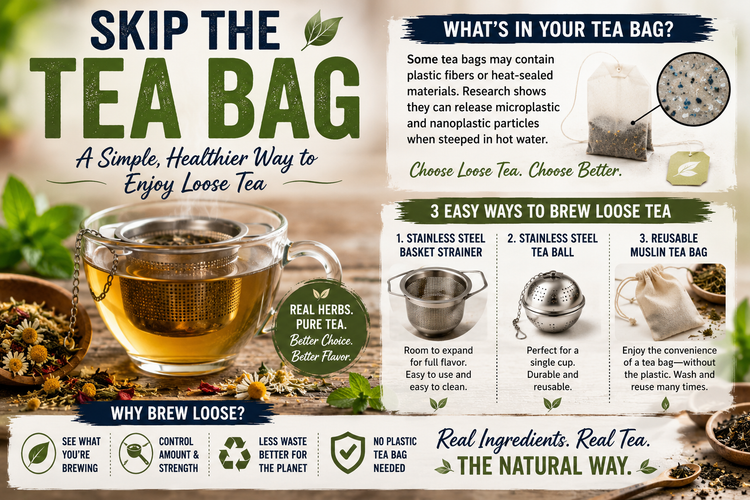
Although many tea bags look like paper, some contain synthetic materials such as polypropylene, nylon, PET, or other polymers. Even some paper-style tea bags may contain plastic-based fibers or heat-sealing materials that help hold the bag together.
Research has found that certain plastic-containing tea bags can release microplastic and nanoplastic particles when exposed to hot water.
That does not mean every tea bag contains plastic or that every tea bag releases the same amount. It also does not mean that drinking tea from a tea bag has been proven to cause harm. Research into the health effects of microplastics is still developing.
But if you would rather avoid putting a plastic-containing tea bag into hot water, there is a remarkably simple alternative:
Use loose tea.
Three Easy Ways to Brew Loose Tea
You do not need special equipment or an elaborate tea ceremony. There are several inexpensive ways to make loose herbal tea.
1. Stainless-Steel Tea Strainer
A basket-style stainless-steel strainer sits directly inside your mug.
Add your loose tea or herbs, pour in hot water, allow them to steep, and remove the strainer when you are finished.
A basket strainer is particularly useful because it gives leaves and flowers plenty of room to expand in the water.
2. Stainless-Steel Tea Ball
A reusable stainless-steel tea ball is another simple option.
Fill it with loose herbs, close it, and place it in your cup. When you are finished, empty the herbs, rinse the tea ball, and it is ready for your next cup.
For larger-cut herbs or teas that expand considerably, choose a larger tea ball rather than packing the herbs tightly.
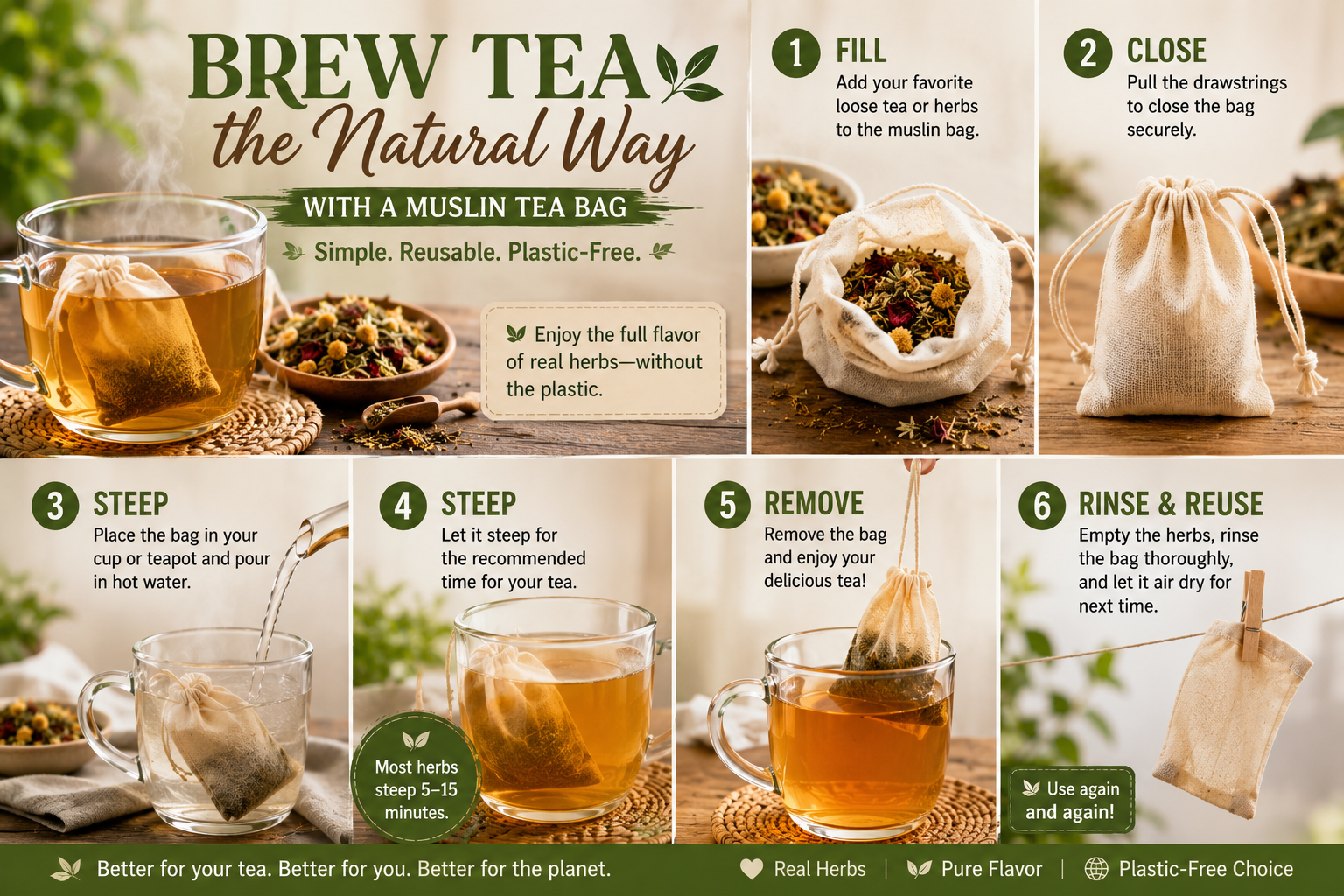
3. Reusable Muslin Tea Bags
Prefer the convenience of a tea bag?
Try a reusable cotton muslin tea bag.
Fill the muslin bag with your loose herbs, steep it in hot water, empty it afterward, wash it thoroughly, and allow it to dry completely before using it again.
This gives you the familiar convenience of a tea bag while allowing you to choose your own loose herbs.
Why Can There Be Plastic in a Paper-Looking Tea Bag?
This is one of the most confusing parts for consumers.
A tea bag may look like ordinary paper while still containing polymer fibers or materials used to help seal the edges of the bag.
Other tea bags, particularly some pyramid-style varieties, may be manufactured from nylon, PET, or other synthetic materials.
That is why simply looking at a tea bag does not necessarily tell you what it contains.
If avoiding plastic-containing tea bags is important to you, you could research the construction of every brand you purchase.
Or you can make things much simpler:
Skip the disposable bag altogether.
Loose Tea Has Other Advantages, Too
Avoiding a disposable tea bag is not the only reason to choose loose herbs.
With loose tea, you can actually see what you are brewing.
You can see the flowers in chamomile, the leaves in peppermint, pieces of ginger root, hibiscus flowers, cinnamon bark, or the individual botanicals in an herbal blend.
You can also control how much you use rather than being limited to the quantity that a manufacturer puts into an individual tea bag.
Reusable strainers and tea balls also mean less disposable packaging going into the trash after every cup.
Which Brewing Method Is Best?
| Brewing Method | Best For | Reusable? |
|---|---|---|
| Stainless-Steel Basket Strainer | Loose leaves, flowers, and larger-cut herbs | Yes |
| Stainless-Steel Tea Ball | Single cups and smaller-cut loose tea | Yes |
| Cotton Muslin Tea Bag | People who prefer a bag-style brewing method | Yes |
Do Not Give Up Tea — Just Change How You Brew It
There is no reason to become afraid of tea bags.
The FDA currently states that available scientific evidence does not demonstrate that the levels of microplastics and nanoplastics detected in foods pose a human-health risk. Scientists are continuing to study exposure and possible long-term effects.
For people who nevertheless want to reduce unnecessary exposure to plastic-containing materials, brewing loose tea is an easy choice.
Loose herbs + stainless steel or reusable muslin + hot water.
No disposable tea bag necessary.
Sometimes going back to the traditional way of making tea is also the simplest.
PubMed Research & Further Reading
Tea Bags as a Source of Micro- and Nanoplastics — Systematic Review
Microplastics and Nanoplastics in Tea — Scientific Review
Microplastics Released From Tea Bags Into Water
Research Note: Research on microplastics and nanoplastics continues to evolve. Studies have found that some tea-bag materials can release particles during brewing, but materials, testing methods, and reported quantities vary. These findings should not be interpreted as establishing that drinking tea from tea bags causes disease.