
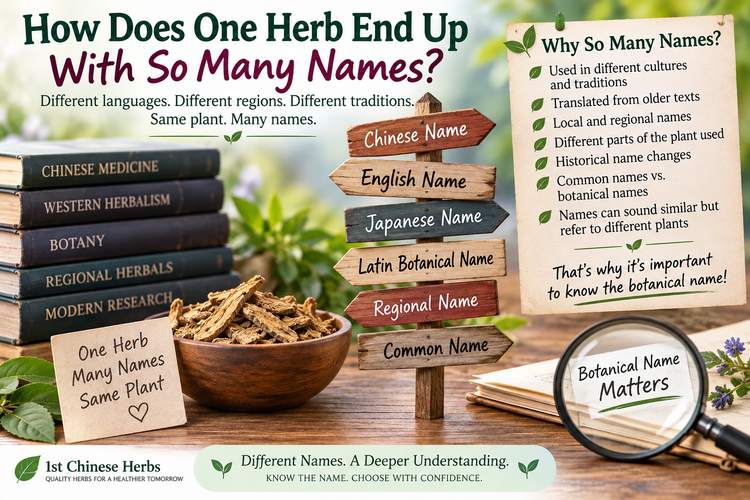
Why Does This Herb Have So Many Names? Am I Buying the Right One?
Posted by 1st Chinese Herbs Research Team. on Sep 9th 2026
Why Does This Herb Have So Many Names? Am I Buying the Right One?
You search for an herb online.
You find the English name. Then another common name. Then a Chinese name. Then a botanical name that looks like something from a high-school biology exam.
And you wonder:
“Are these all the same herb?”
Sometimes, yes.
Some herbs can be known by many different names depending on the country, region, language, herbal tradition, or period in history.
But here's the part many people don't realize:
Many names can lead to one plant. But one name can also lead to many plants.
And that's why the botanical name matters.
How Does One Herb End Up With So Many Names?
People were gathering, trading, cooking, and using plants long before standardized botanical names existed.
Different communities naturally developed their own names for the same plants.
Today, one herb might have an English common name, regional or folk names, a Chinese name, a Pinyin name, historical names, trade names, and a scientific botanical name.
So when you see a long list of names, they may all lead back to the same plant.
But don't automatically buy the first herb with a familiar name.
Here's why.
Meet the Skullcaps
Suppose you're shopping for skullcap.
You search for skullcap.
You find skullcap.
Great. Add to cart.
Well...not quite yet.
There are numerous species within the genus Scutellaria, and several are commonly referred to as skullcap.
They may be related botanically, but they are not necessarily the same herbal material and should not automatically be used interchangeably.
Here are four examples.
Chinese Skullcap — Scutellaria baicalensis
Chinese Skullcap is also known in Chinese herbalism as Huang Qin.
The traditional herbal material is the root.
Within Traditional Chinese Medicine, Huang Qin has traditionally been described using concepts such as clearing Heat and drying Dampness.
Modern researchers have investigated naturally occurring compounds in Scutellaria baicalensis, including baicalin, baicalein, and wogonin.
American Skullcap — Scutellaria lateriflora
American Skullcap is a different species.
It has a history of use in Western and North American herbal traditions, particularly in preparations traditionally associated with relaxation and nervous-system support.
So if you're looking for Huang Qin and buy American Skullcap because the package says “skullcap,” you haven't purchased another version of Huang Qin.
You've purchased a different plant.
Barbed Skullcap — Scutellaria barbata
Barbed Skullcap is another species altogether.
In Chinese herbal traditions it is commonly known as Ban Zhi Lian and has its own history of traditional use.
Modern researchers have also studied Scutellaria barbata and its naturally occurring constituents.
It belongs to the same genus as Chinese Skullcap, but:
Scutellaria barbata is not Scutellaria baicalensis.
Marsh Skullcap — Scutellaria galericulata
Then we have Scutellaria galericulata, often called Marsh Skullcap or Common Skullcap.
It has its own geographic distribution and history of traditional herbal use.
Once again:
It's a skullcap.
It's a Scutellaria.
But it isn't automatically the skullcap you were looking for.
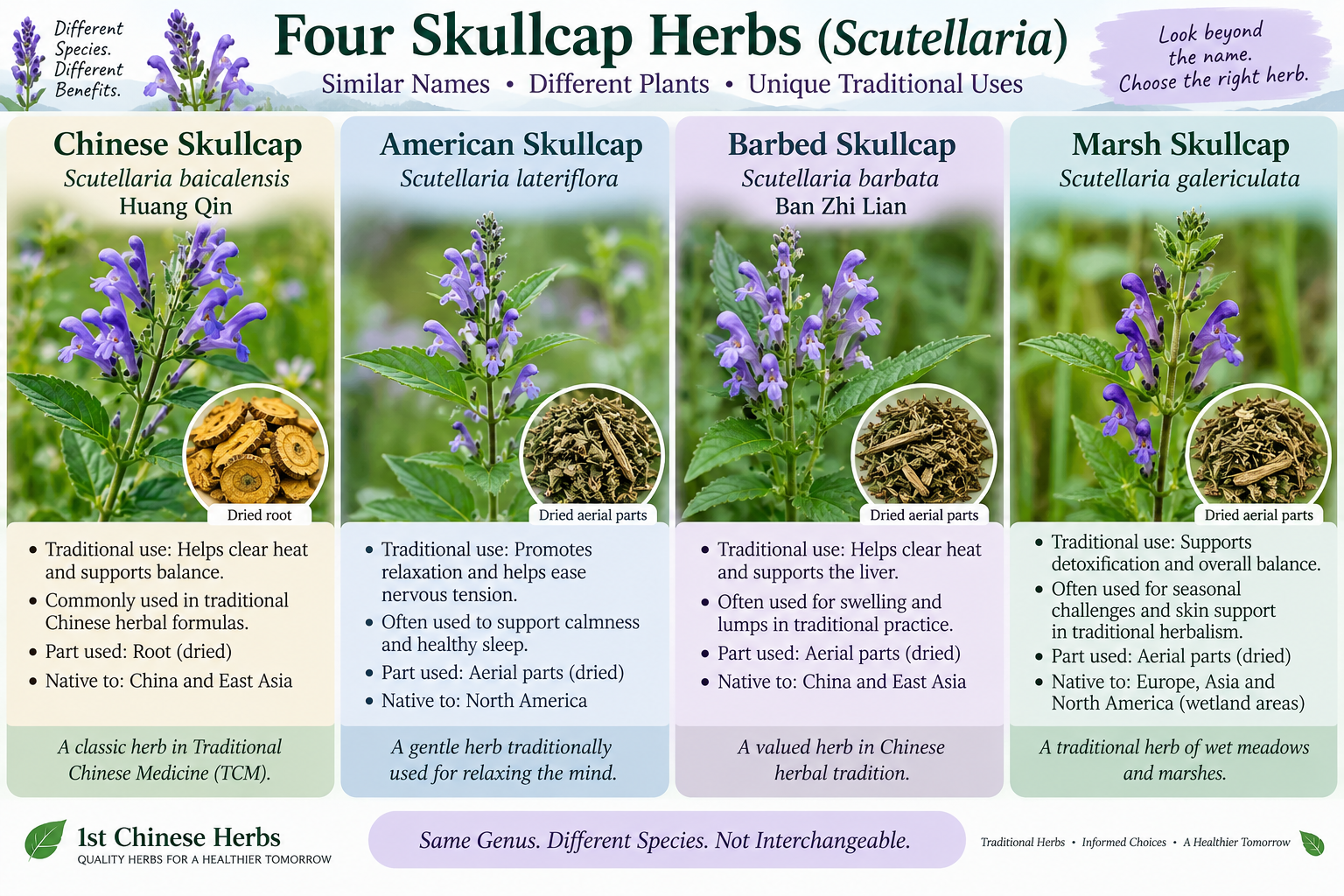
And Here This Is The Real Story
We started with one innocent little word:
SKULLCAP
But look where it took us:
Chinese Skullcap — Scutellaria baicalensis — Huang Qin
American Skullcap — Scutellaria lateriflora
Barbed Skullcap — Scutellaria barbata — Ban Zhi Lian
Marsh Skullcap — Scutellaria galericulata
They are related plants, but they are different species with different histories of traditional use and different areas of scientific interest.
They should not be assumed to be interchangeable simply because they share the name “skullcap.”
Suddenly that long botanical name doesn't look quite so unnecessary, does it?
Think of a Botanical Name Like an Address
Imagine someone tells you:
“I live on Main Street.”
That's helpful.
But which Main Street?
Which town?
Which house?
A common herb name can work the same way.
“Skullcap” gets you into the neighborhood.
The complete botanical name helps you find the right address.
You don't need to memorize it.
You don't even need to know how to pronounce it.
You just need to look at it before you buy.
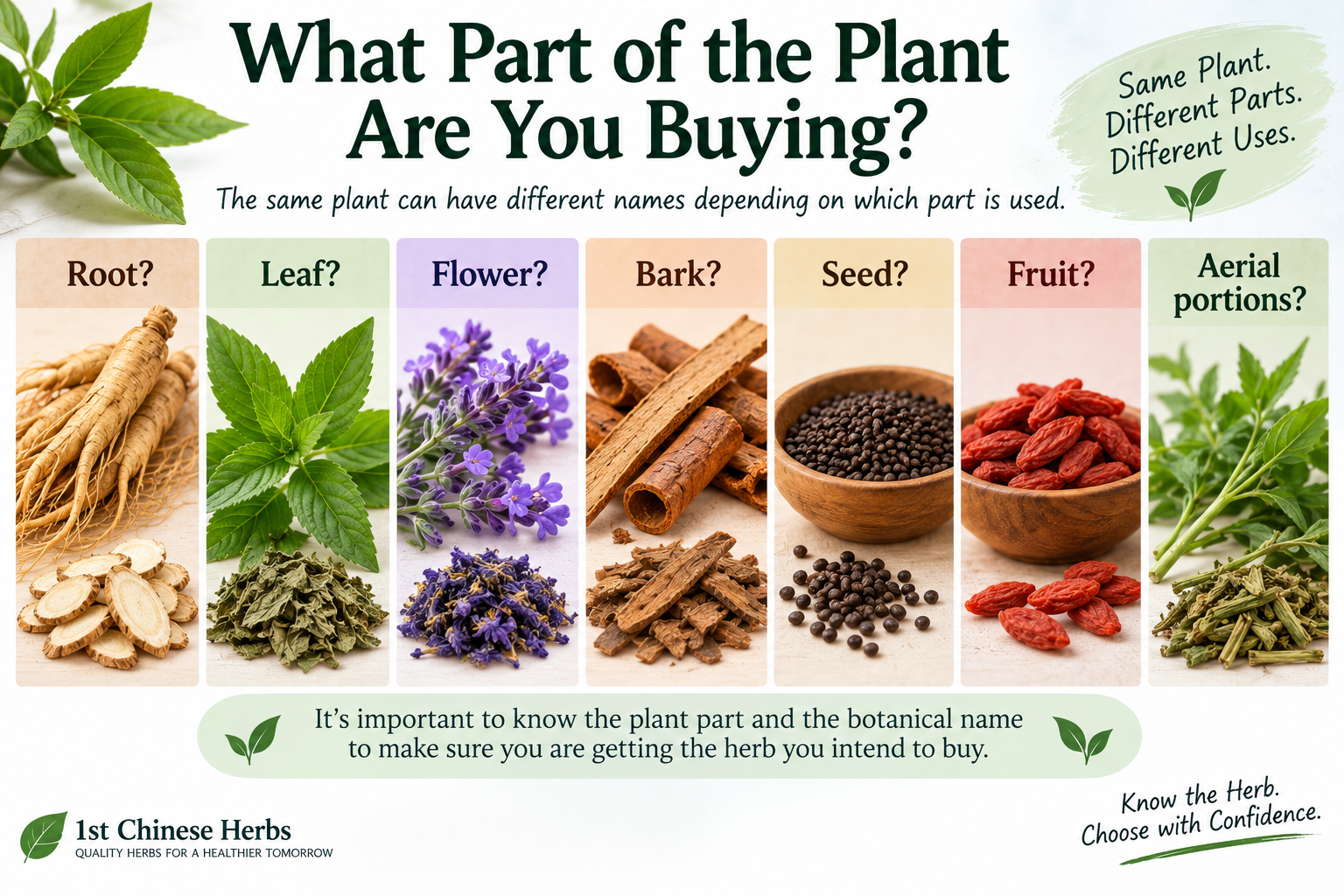
Don't Forget the Plant Part
Once you've identified the correct species, there's one more question:
What part of the plant are you buying?
Root? Leaf? Flower? Bark? Seed? Fruit? Aerial portions?
Plant part matters because different portions of a plant are not automatically interchangeable either.
For example, Huang Qin traditionally refers to the root of Scutellaria baicalensis.
Compare these two descriptions:
Skullcap
versus
Chinese Skullcap | Huang Qin | Scutellaria baicalensis | Root
Now you know considerably more about what's actually in the bag.
Why We Show All Those Names at 1st Chinese Herbs
We're not trying to make herb shopping complicated.
We're trying to make sure the herb you order is the herb you intended to buy.
At 1st Chinese Herbs, we've worked with Chinese and Western herbs since 1994.
When appropriate and available, we provide identifying information such as:
Common name • Pinyin name • Botanical name • Plant part • Origin
Those details aren't there just to fill space on a product page.
They can help you compare products and better understand exactly what you're purchasing.
Three Things to Check Before Buying an Herb
You don't need to become a botanist.
And don't worry—there isn't going to be a Latin pronunciation test at checkout.
Just get into the habit of checking three things:
1. The complete botanical name
This helps identify the actual plant species.
2. The plant part
Root, leaf, flower, bark, seed, fruit, or another portion of the plant can matter.
3. The traditional or Pinyin name when applicable
This can be particularly helpful when shopping for Chinese herbs.
And remember:
Don't stop at the first familiar name.
Sometimes 20 different names can lead you back to the same plant.
But sometimes one familiar name—like skullcap—can lead you to several different plants.
That's the real reason botanical names matter.
They're not there to make herb shopping more complicated.
They're there to help you know what you're actually buying.
And once you understand that, those strange-looking botanical names suddenly start looking a whole lot more useful.
That's your moment of Okay, Got It!
Research & Further Reading
- Traditional Uses and Research Progress on the Genus Scutellaria — PubMed — Excellent overall reference comparing the Scutellaria genus, including S. baicalensis, S. barbata, and S. lateriflora.
- Scutellaria baicalensis: The Golden Herb from the Garden of Chinese Medicinal Plants — PubMed — Discusses Huang Qin, its root, and major naturally occurring flavones including baicalin, baicalein, and wogonin.
- Phytochemical and Biological Analysis of American Skullcap (Scutellaria lateriflora) — PubMed — Research on American Skullcap and its phytochemistry and traditional association with calming use.
- Scutellaria barbata: Ethnopharmacology, Phytochemistry and Quality Control — PubMed — Detailed review of Ban Zhi Lian and its traditional use and chemical constituents.
Traditional herbal information is provided for educational purposes and describes historical or traditional practices. References to modern research are educational and should not be interpreted as claims that an herb or product can diagnose, treat, cure, or prevent disease. Herbs that share common names or belong to the same botanical genus should not be assumed to be interchangeable.