
What Are Chinese Herbal Teapills?
Posted by Written by Sarah Johnson, Certified Herbalist, 1st Chinese Herbs. on Sep 28th 2026
What Are Chinese Herbal Teapills? How They're Made, Why They're Small & How to Take Them
If you've opened a bottle of Chinese herbal teapills for the first time, you may have had a few questions.
Why are these pills so small?
Why does the bottle say to take several pills at a time?
Why are they called “teapills” if I'm supposed to swallow them with water?
And perhaps the biggest question:
Do I have to brew these into tea?
The short answer is no.
Modern Chinese herbal teapills are a convenient prepared form of traditional Chinese herbal formulas. The herbs have already gone through an extraction and concentration process during manufacturing. You don't put the little pills into a cup and make tea from them.
You simply take the teapills with water according to the directions on the product label.
Let's look at how that works.
What Exactly Is a Teapill?
A teapill is a small, round form of a prepared Chinese herbal formula.
The name makes more sense once you understand how many modern teapills are manufactured.
They begin with something similar to the traditional process of making a strong herbal tea—more accurately called a decoction.
A decoction is made by extracting herbs in liquid. Instead of giving you that liquid in a pot or bottle, the manufacturer concentrates the herbal decoction and turns it into small pills.
So think of a modern extracted teapill this way:
Herbs → Decoction → Concentrated Extract → Herbal Paste → Small Pills
The tea-making step has essentially already been performed during manufacturing.
That's why you don't have to brew the pills when you get home.
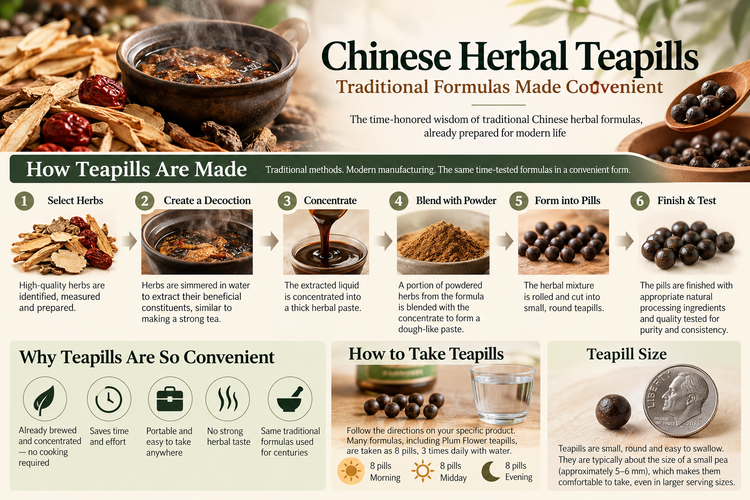
How Are Chinese Herbal Teapills Made?
The exact manufacturing process varies by brand and product, but Plum Flower teapills provide a useful example of how modern extracted teapills are produced.
| Step | What Happens |
|---|---|
| 1. Herbs are selected | The herbs specified by the formula are identified, measured, and prepared. |
| 2. Herbs are extracted | The formula is decocted under controlled conditions to extract soluble herbal constituents. |
| 3. Aromatic oils are preserved | During Plum Flower's process, volatile oils released during extraction are collected for later addition rather than simply being lost in steam. |
| 4. Liquid is concentrated | Excess water is removed from the extracted liquid until it becomes a concentrated herbal paste. |
| 5. Herbal powder is added | A portion of powdered herbs from the formula is blended with the concentrate to create an herbal dough or paste suitable for forming pills. |
| 6. Tiny pills are formed | The herbal mixture is cut and rolled into the familiar small, round teapills. |
| 7. Pills are finished | Small amounts of appropriate processing ingredients may be used to improve consistency, smoothness, stability, and ease of swallowing. |
| 8. Finished product is tested | Quality testing may include identity, moisture, disintegration, microbial contamination and heavy metals, depending on the manufacturer and product. |
This is considerably different from simply grinding up a handful of dry herbs and putting the powder into a capsule.
So Are Teapills Already “Brewed”?
In everyday language, yes—that is a useful way to think about extracted teapills.
More precisely, the herbs have already been decocted, extracted, and concentrated during manufacturing.
You are not expected to boil the finished pills again.
That is one of their biggest conveniences.
Instead of:
Measure herbs → add water → simmer → strain → drink the decoction → wash the pot
you have:
Open bottle → measure the label dose → swallow with water.
That makes traditional formulas considerably easier to incorporate into everyday life.
Why Are Teapills So Convenient?
Traditional raw-herb decoctions still have an important place in Chinese herbalism, particularly when a practitioner wants to customize a formula.
But they require time.
You need the correct herbs, the proper quantities, water, a suitable pot, cooking time, straining, storage, and usually another preparation later.
Teapills remove much of that work.
They are particularly convenient because they are:
| Traditional Raw-Herb Decoction | Prepared Teapills |
|---|---|
| Herbs must be measured | Formula is already prepared |
| Requires simmering/decocting | No brewing required |
| Must be strained | No straining |
| Liquid can be inconvenient to transport | Bottle is portable |
| Flavor may be strong | Pills are swallowed |
| Preparation takes time | Ready when needed |
| Practitioner can customize ingredients | Formula is standardized and cannot easily be customized |
For many people, the biggest advantage is simple:
They are much easier to use consistently.
A traditional formula sitting in a cupboard because you don't have time to prepare it isn't particularly convenient.
How Do You Take Chinese Teapills?
Always follow the directions for the specific product you purchased, because formulas and manufacturers can differ.
For many Plum Flower teapills, a common label direction is:
8 pills, 3 times daily, or as directed by your healthcare practitioner.
That means:
Morning: 8 teapills
Midday: 8 teapills
Evening: 8 teapills
Swallow them with water.
You don't chew them unless the product specifically directs you to do so.
You don't dissolve them in hot water.
And you don't boil them into tea.
The extraction/decoction process has already been performed.
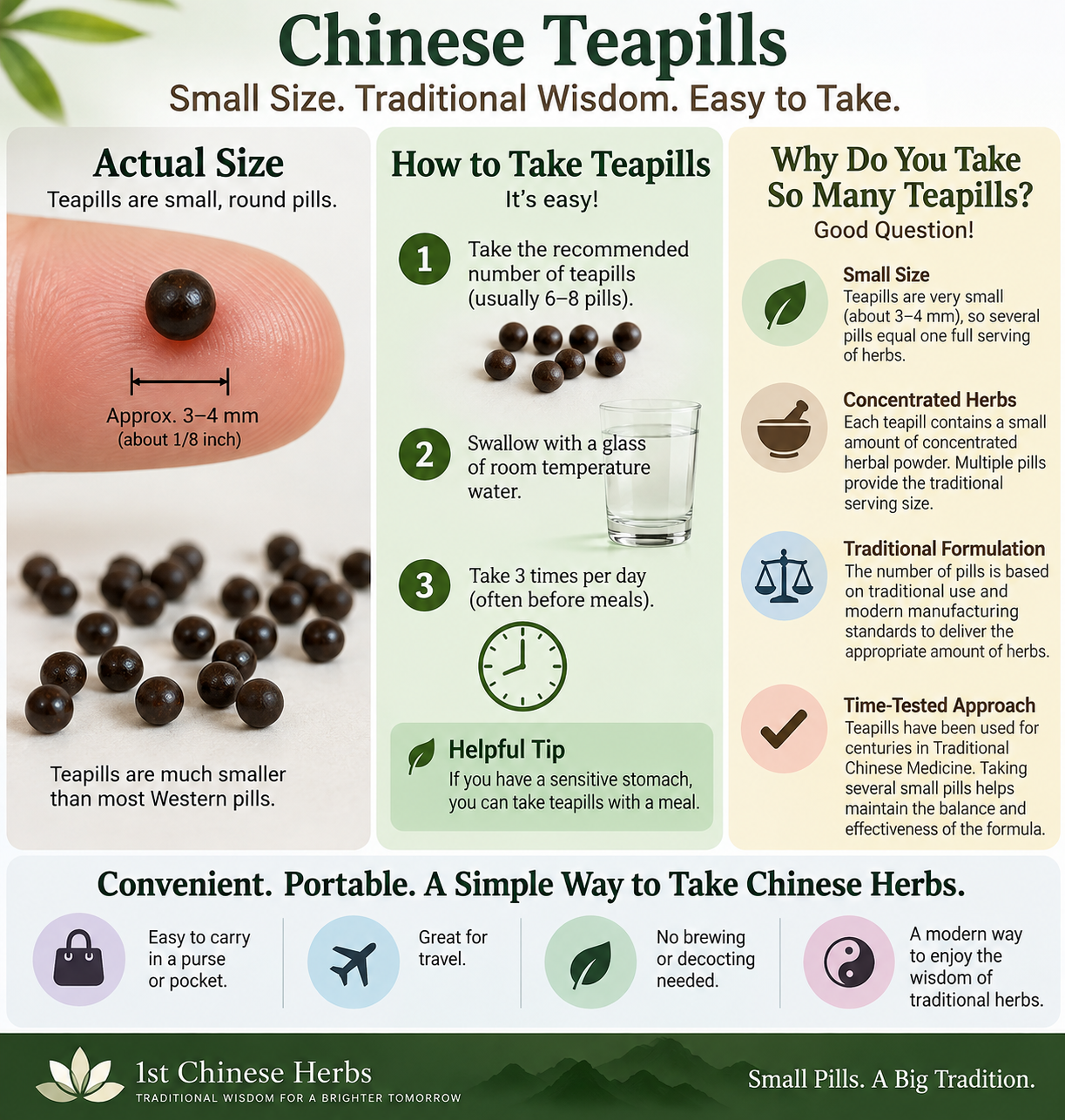
Why Do I Have to Take 8 Pills at Once?
This is probably the part that seems strangest to someone accustomed to American supplements.
We're used to directions such as:
Take 1 capsule daily.
So when a Chinese herbal product says:
Take 8 pills, 3 times daily
it can sound like an enormous amount.
But eight tiny teapills are not equivalent to eight conventional capsules or eight pharmaceutical tablets.
The difference is largely about size and dosage form.
Chinese herbal formulas contain plant materials and, depending on the formula, may contain roots, seeds, bark, twigs, leaves, fruits, flowers, fungi, shells or mineral ingredients.
The finished teapills are intentionally quite small.
Instead of manufacturing one very large pill that could be unpleasant or difficult to swallow, the formula is divided among multiple small pills.
So don't think:
“Eight pills? That's eight doses!”
Think:
“Eight small teapills make one label serving.”
For a product whose serving size is eight teapills, those eight little pills collectively represent one serving.
Why Are Teapills Made So Small?
There are practical reasons.
They Are Easier to Swallow
Imagine trying to compress an entire serving of concentrated herbal material into one enormous pill.
For many people, that would be much harder to swallow than several small pills.
They Allow the Herbal Material to Be Divided
Chinese formulas aren't usually based around one highly concentrated isolated chemical.
They contain multiple herbal materials combined according to a traditional formula.
Small pills provide a practical way to divide that material into a manageable dosage form.
Small Pills Have a Long Tradition
The word Wan (丸) that you frequently see at the end of Chinese formula names means pill.
Pills have been used as a traditional Chinese herbal dosage form for centuries, although historical pill-making methods and modern extracted teapill manufacturing are not identical.
Modern manufacturing has made the dosage form more consistent and convenient.
Why Take Teapills Three Times a Day?
Again, follow the directions for the particular product because not every formula has identical dosing instructions.
The common Plum Flower direction of 8 pills three times daily divides the total daily amount into three smaller servings throughout the day rather than putting the entire day's herbal material into one dose.
There is also a historical and manufacturing reason for the amount.
Modern concentrated teapill dosing was developed around the amount of raw herbal material used in traditional formulas and the amount of extract produced during manufacturing.
In other words, 8 pills three times daily isn't an arbitrary number chosen because the pills look small.
The dosage reflects the manufacturer's formulation, extraction yield, and intended serving size.
Are Eight Teapills Really a Lot?
Not in the way most people initially imagine.
Eight small teapills can look like “eight medications” when you count them individually.
But that's not the best comparison.
A better comparison is a measured serving of powder.
Imagine putting a scoop of herbal powder on the counter and then dividing that scoop into eight small portions.
You haven't suddenly created eight separate servings.
You've divided one serving into eight smaller pieces.
That is essentially the concept customers need to understand when they see an eight-teapill serving.
Why Do Some Teapill Formulas Have Only One or Two Herbs While Others Have 10, 15 or More?
This gets to the heart of traditional Chinese herbal formulation.
More ingredients does not automatically mean a stronger or better formula.
And fewer ingredients does not mean an inferior formula.
The number of ingredients depends on what the formula was designed to accomplish.
Some formulas have a very narrow traditional strategy and need only a few ingredients.
For example, a traditional formula might contain just two herbs that complement each other.
Another formula may need:
-
A principal herb addressing the main traditional pattern
-
Supporting herbs
-
Herbs that reinforce a particular action
-
Ingredients that balance other herbs
-
Ingredients traditionally used to direct or harmonize the formula
That can result in formulas containing 8, 10, 12, 15 or even more ingredients.
Why Would a Formula Contain Just One Ingredient?
Not every teapill-style herbal product is a complex classical formula.
Some products are essentially single-herb preparations.
A single-herb product allows someone to use one particular botanical without the additional herbs found in a multi-herb traditional formula.
Multi-herb formulas work differently.
They are built around relationships between ingredients.
Traditional Chinese herbal formulation often considers how herbs support, balance, moderate or complement one another.
Therefore:
1 herb isn't automatically weaker.
15 herbs aren't automatically better.
They are simply different approaches intended for different purposes.
How Are Multi-Herb Chinese Formulas Designed?
Traditional Chinese formulas are often easier to understand when you stop thinking of the ingredient list as a collection of unrelated herbs.
Think of it more like a team.
Traditionally, herbs within a formula may serve different roles.
| Traditional Formula Role | Simple Explanation |
|---|---|
| Chief / Emperor | Addresses the primary traditional pattern or purpose of the formula |
| Deputy / Minister | Supports the chief ingredient or addresses related aspects of the pattern |
| Assistant | Reinforces, balances, or moderates other ingredients |
| Envoy / Messenger | Harmonizes the formula or traditionally guides its action |
Not every modern formula fits neatly into four roles, and different TCM sources may interpret individual ingredients somewhat differently.
But the concept helps explain why a Chinese herbal formula might contain many ingredients instead of one.
The goal isn't necessarily to add more herbs.
The goal is to create a balanced formula.
Is a 15-Herb Formula Stronger Than a 5-Herb Formula?
No.
Ingredient count is not a measure of strength or quality.
A five-herb formula may have a very focused traditional strategy.
A 15-herb formula may address a more complex traditional pattern.
What matters is why the ingredients are combined, their proportions, processing, quality, and whether the formula is appropriate for the person using it.
That's one reason choosing Chinese formulas by ingredient count alone isn't particularly useful.
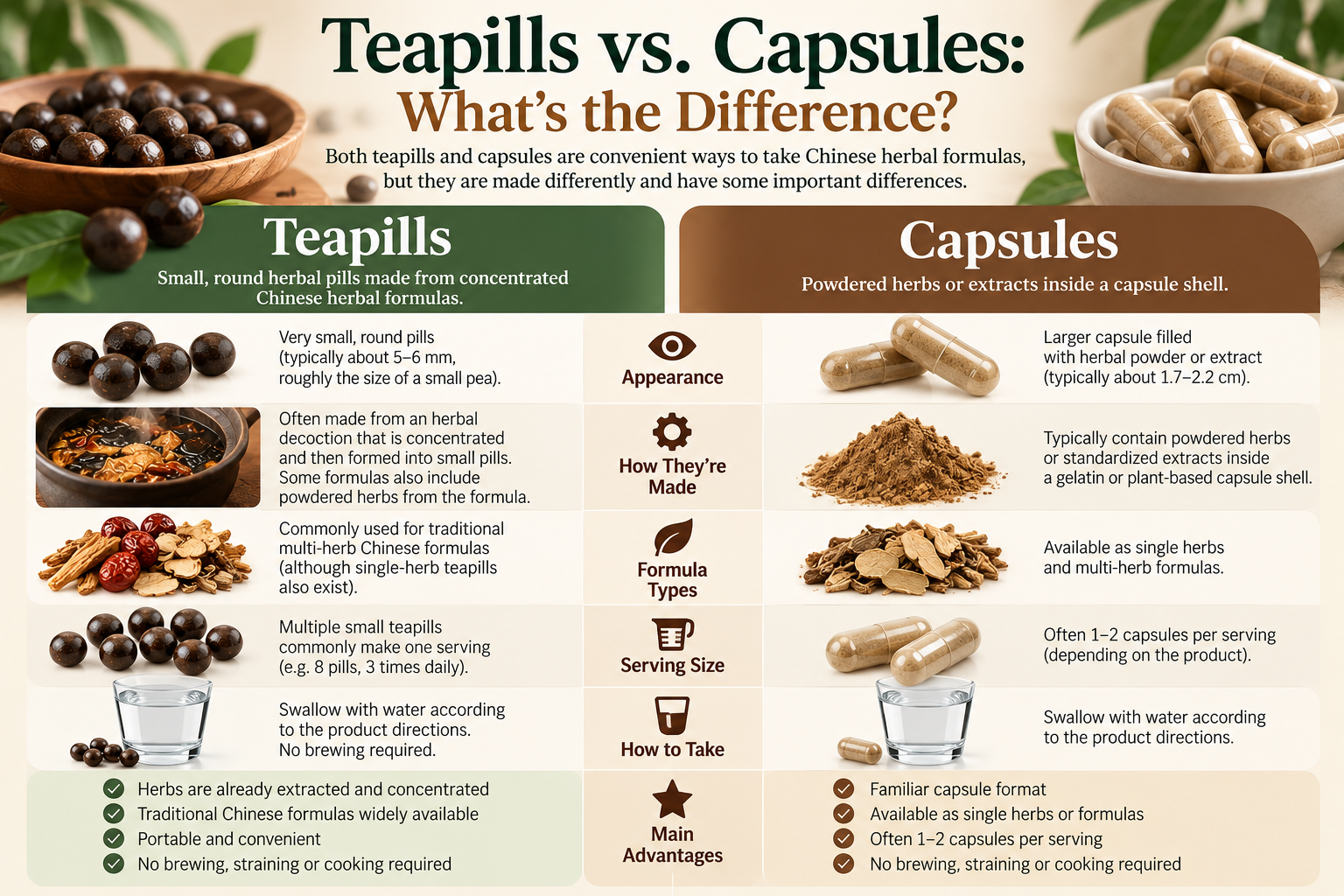
Teapills vs. Capsules: What's the Difference?
They may look similar when sitting on a supplement shelf, but the manufacturing concept can be quite different.
| Teapills | Typical Herbal Capsules |
|---|---|
| Very small round pills | Larger capsule shell |
| May be made from concentrated herbal decoctions | Often contain powdered herb or extract |
| Multiple pills commonly make one serving | Often 1–2 capsules per serving |
| No brewing required | No brewing required |
| Traditional Chinese formulas commonly available | Single herbs and formulas available |
| Designed around a specific formula and serving size | Amount depends on capsule size and extract |
Neither form is automatically superior.
They are simply different ways of delivering herbal ingredients.
Teapills vs. Raw Herbs: Which Is Better?
There isn't one answer for everyone.
Raw herbs have the advantage of customization. A qualified practitioner can adjust individual ingredients and amounts according to a person's traditional pattern.
Teapills have the advantage of convenience and consistency. The formula is already prepared, portable, and requires no cooking.
For someone working with a practitioner who needs a highly individualized formula, raw herbs may make sense.
For someone using an established prepared formula, teapills can make traditional Chinese herbalism considerably easier to incorporate into daily life.
Why Take a Traditional Formula Instead of Several Individual Herbs?
This is another important part of Chinese herbal theory.
A traditional formula is not merely a list of good herbs put into the same bottle.
The ingredients are selected because of how they traditionally function together.
One herb may provide the principal action.
Another may reinforce it.
Another may balance an unwanted characteristic.
Another may address a secondary aspect of the traditional pattern.
That relationship among ingredients is one of the defining features of Chinese herbal formula design.
This is why taking five unrelated single-herb supplements isn't necessarily equivalent to taking a traditional five-herb formula.
Do I Need to Brew Teapills Before Taking Them?
No.
For extracted teapills such as the Plum Flower products discussed here, the herbs have already undergone the decoction and concentration process during manufacturing.
Take the finished teapills with water according to the label.
You do not need to:
-
Boil them
-
Steep them
-
Put them in a tea infuser
-
Dissolve them in a cup
-
Grind them
-
Cook them again
That's the convenience of the teapill format.
Quick Guide to Chinese Herbal Teapills
| Question | Answer |
|---|---|
| Are teapills actually tea? | They are called teapills because extracted versions are made from an herbal decoction that is concentrated and formed into pills. |
| Do I brew them? | No. The extraction/decoction process has already been done. |
| How do I take them? | Swallow with water according to the product label. |
| Why are they so small? | Their small size makes them easier to swallow and allows an herbal serving to be divided among several small pills. |
| Why do some labels say 8 pills? | Several small teapills collectively make one serving. |
| Why 3 times daily? | Many traditional teapill labels divide the daily amount into several servings. Follow the specific product directions. |
| Why do formulas contain different numbers of herbs? | Each formula is designed around a particular traditional strategy. |
| Is a formula with more herbs better? | No. Ingredient count does not determine quality or appropriateness. |
| Are all teapills identical? | No. Ingredients, formulas, processing methods, dosage and cautions vary by product and manufacturer. |
The Bottom Line
Chinese herbal teapills take something that traditionally required considerably more preparation and make it much easier to use.
For modern extracted teapills, the manufacturer has already done the difficult part:
Selecting the formula → extracting the herbs → concentrating the decoction → forming the herbal material into small pills.
You do the easy part:
Measure the label serving → take it with water.
And those eight tiny pills?
They aren't eight separate servings.
When the label specifies eight pills per serving, they collectively make one serving of the prepared herbal formula.
The small size isn't a flaw or a sign that the product is weak. It is simply part of the dosage form.
Perhaps most importantly, don't judge a Chinese herbal formula by how many ingredients it contains.
A formula with two herbs can be elegantly focused. A formula with fifteen herbs can be carefully constructed to address a more complex traditional pattern.
In Chinese herbalism, the important question isn't:
“How many herbs are in this?”
It's:
“Why were these particular herbs put together?”
Now that you understand how teapills are made and taken, you can explore individual traditional Chinese herbal formulas. Each formula contains its own combination of herbs and has its own traditional uses, directions, and precautions.
Golden Lock Teapills – Jin Suo Gu Jing Wan
Learn about the ingredients and traditional formula strategy behind Golden Lock Teapills.
Peach Kernel Teapills – Tao Ren Wan
Explore the five-herb formula and learn how the individual ingredients traditionally work together.
Jade Screen Teapills – Yu Ping Feng Wan
Learn about this well-known three-herb traditional Chinese formula and its ingredients.
Bright Eyes Teapills – Ming Mu Di Huang Wan
Explore the ingredients, traditional formula theory, and directions for Bright Eyes Teapills.
Free & Easy Wanderer Plus – Jia Wei Xiao Yao Wan
Learn about the herbs and traditional formula strategy behind Free & Easy Wanderer Plus.
Agastache Qi Correcting Pills – Huo Xiang Zheng Qi
Explore the ingredients, traditional uses, and formula structure of Agastache Qi Correcting Pills.
Eight Righteous Teapills – Ba Zheng San Wan
Learn about the ingredients and traditional formula strategy of Eight Righteous Teapills.
Shop Chinese Herbal Teapills
Looking for a specific formula? Browse our Chinese Herbal Teapills to explore the formulas available from 1st Chinese Herbs.
Important Safety Information
Always follow the directions and cautions on the specific teapill product you purchase.
Different formulas have different ingredients, contraindications, allergens, and potential herb-drug interactions. Some formulas should not be used during pregnancy or nursing, and some may be inappropriate with certain medications or medical conditions.
If you take prescription medications, have a medical condition, are pregnant or nursing, or are unsure which traditional formula is appropriate for you, consult a qualified healthcare professional before use.
Traditional Chinese Medicine "Pill", an Ancient Dosage Form with Surprising Modern Pharmaceutical Characteristics
This review examines traditional Chinese herbal pills as a dosage form, including different types of pills, preparation methods, binders, excipients, and pharmaceutical characteristics.
PMID: 33604785
https://pubmed.ncbi.nlm.nih.gov/33604785/
Traditional Theory and Use of Chinese Herbal Pills
Analysis on Dosage Form Theory and Current Application Situation of Traditional Chinese Medicine Pill
This article discusses the historical theory behind Chinese herbal pills, pharmaceutical preparation technology, and their traditional clinical use.
PMID: 28822200
https://pubmed.ncbi.nlm.nih.gov/28822200/
Herbal Decoctions vs. Concentrated Granules
Comparison of Effectiveness and Safety Between Granules and Decoction of Chinese Herbal Medicine: A Systematic Review of Randomized Clinical Trials
This systematic review examined studies comparing prepared Chinese herbal granules with traditional herbal decoctions. The authors noted limitations in the quality of the available studies and called for additional research and standardization.
PMID: 22343092
https://pubmed.ncbi.nlm.nih.gov/22343092/
Extraction and Concentration of Chinese Herbs
Analysis of the Impact of Extraction Processes on the Quality of Traditional Chinese Medicine Granules
This review discusses herbal extraction technology, factors affecting extraction efficiency, and quality-control considerations involved in producing concentrated Chinese herbal preparations.
PMID: 39623607
https://pubmed.ncbi.nlm.nih.gov/39623607/
Why Chinese Herbal Formulas Contain Multiple Ingredients
Recent Pharmaceutical Evidence on the Compatibility Rationality of Traditional Chinese Medicine
This review examines the reasoning behind combining multiple herbs in traditional Chinese formulas and explores how interactions among formula ingredients may influence the characteristics of the finished preparation.
PMID: 28606807
https://pubmed.ncbi.nlm.nih.gov/28606807/
Understanding Multi-Herb Chinese Formula Design
Compound-Based Chinese Medicine Formula: From Discovery to Compatibility Mechanism
This review discusses the complexity of Chinese herbal formulas and modern research attempting to understand how multiple constituents within a formula interact.
PMID: 32105748
https://pubmed.ncbi.nlm.nih.gov/32105748/
Research Note
These studies are provided for educational purposes. Research involving traditional dosage forms, individual herbs, extracts, granules, laboratory models, or particular Chinese herbal formulas should not be interpreted as evidence that all teapills are equivalent or that a specific teapill product diagnoses, treats, cures, or prevents disease.
Important Disclaimer
This article is provided for educational purposes and explains traditional Chinese herbal terminology, formula theory, and common teapill manufacturing practices.
Traditional Chinese Medicine concepts and traditional-use descriptions are not intended to represent modern medical diagnoses or establish that a product treats a medical condition.
These statements have not been evaluated by the Food and Drug Administration. Products discussed are not intended to diagnose, treat, cure, or prevent any disease.