Teapills

1st Chinese Herbs • Serving Herbal Customers Since 1994

Chinese Herbal Teapills: A Complete Guide to Choosing & Using Traditional Formulas

Chinese herbal teapills offer a convenient way to use traditional Chinese herbal formulas without preparing a decoction. But choosing a formula should involve more than matching a bottle to a symptom.

This guide explains what teapills are, how formula names work, how to compare products, what traditional TCM terminology means, how teapills are taken, and what to check before purchasing.

Chinese herbal teapills complete guide – how to use teapills, understand formula names, compare quality and choose traditional Chinese herbal formulas

Our Approach to Chinese Herbal Information

Chinese herbal medicine is a complex traditional system. A formula is not simply a collection of herbs associated with a particular symptom.

Traditional Chinese Medicine practitioners historically select formulas according to an individual's overall pattern, which may include numerous observations and traditional diagnostic considerations.

For that reason, our goal is not to tell every visitor which formula they should take.

Our goal is to give you clear information about the product you are considering: its Chinese and English names, ingredients, traditional formula background, preparation, directions, important warnings, and available research—so you can make a better-informed decision and consult a qualified professional when appropriate.

Start Here: What Would You Like to Know?

What Are Chinese Herbal Teapills?

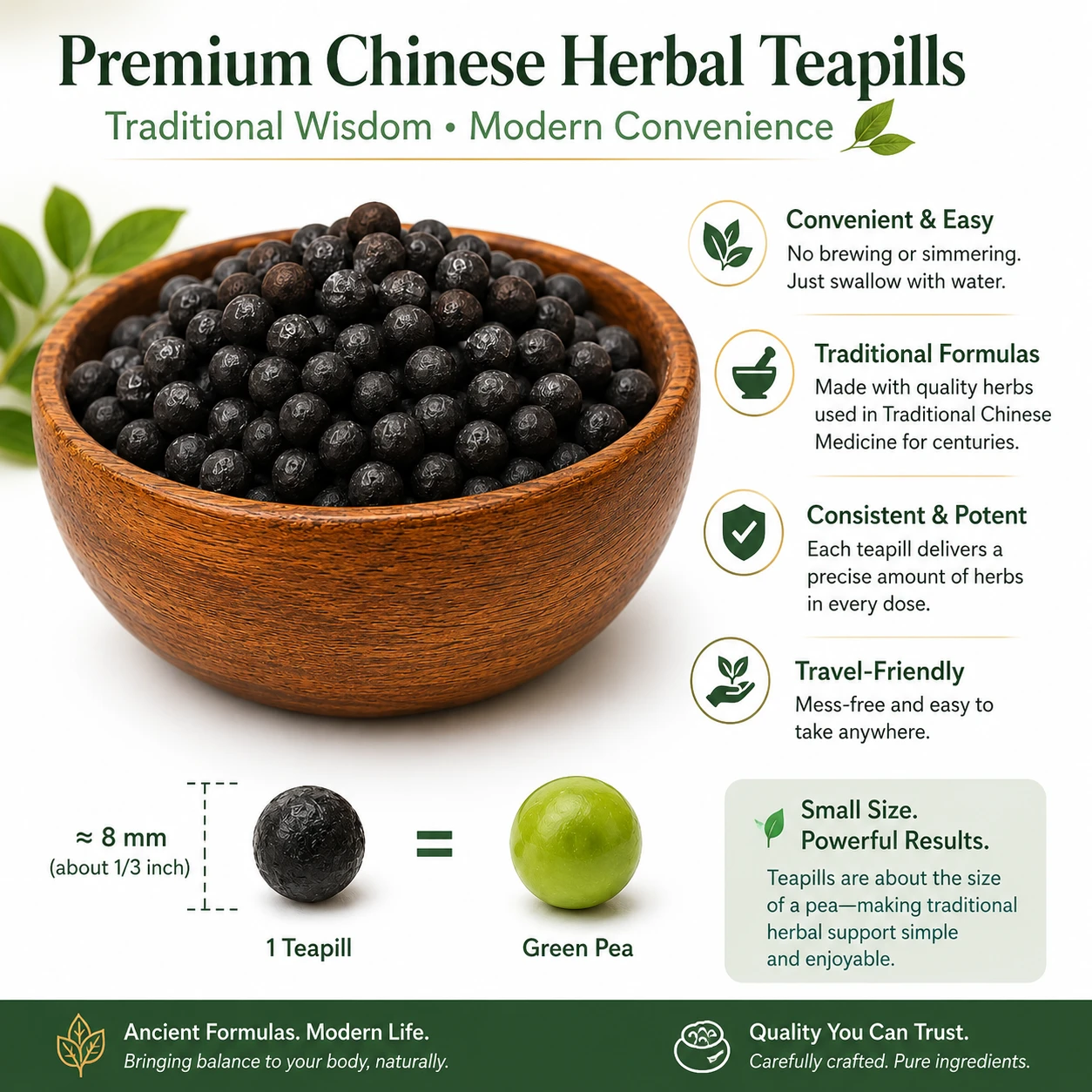
Chinese herbal teapills are small prepared pills based on traditional Chinese herbal formulas. They are commonly called teapills in the United States, although they are not pills made from tea.

Traditional Chinese herbal formulas may be prepared in several forms, including raw-herb decoctions, powders, granules, tablets, capsules and small pills.

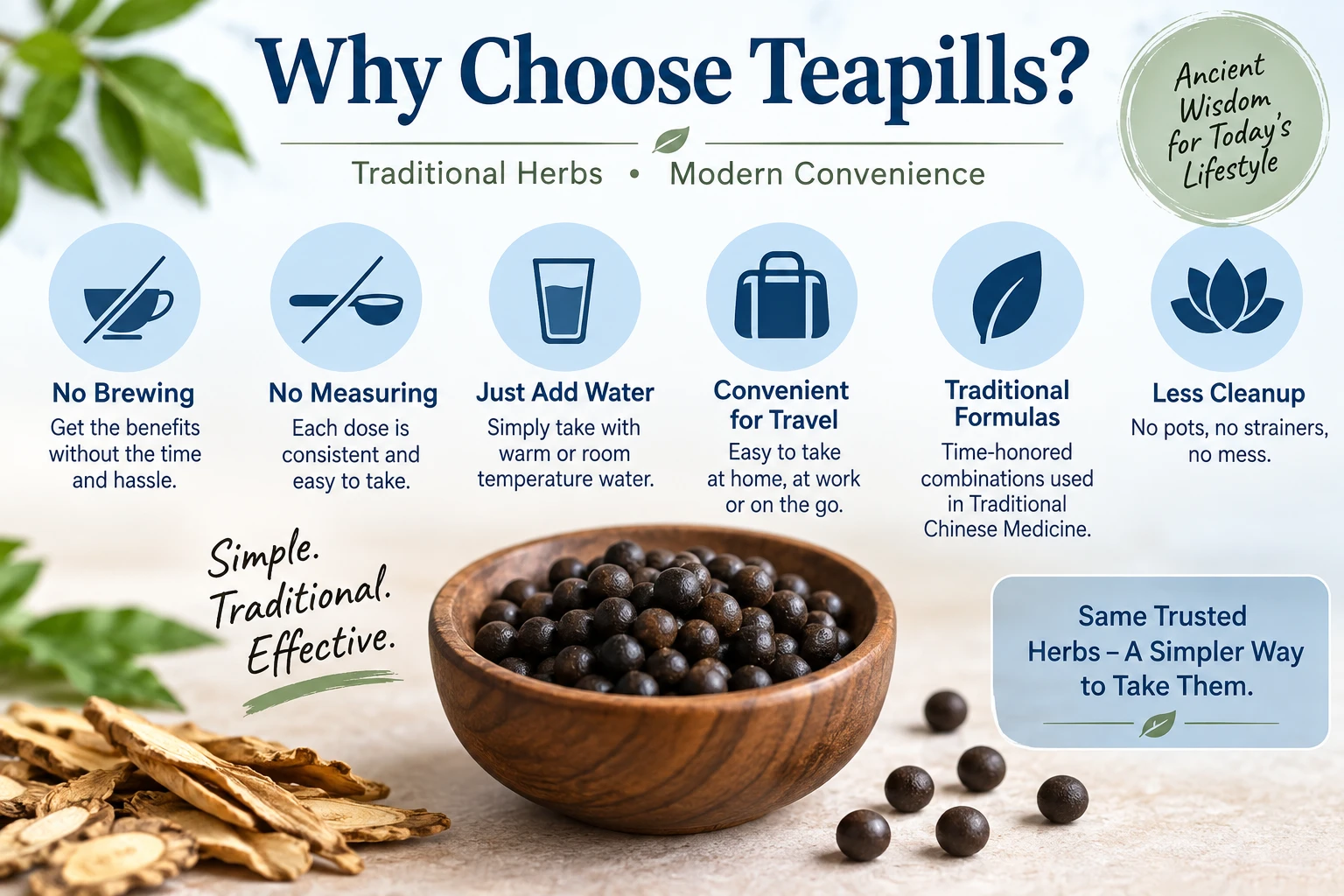
Teapills provide a convenient prepared format for people who do not want to measure and simmer raw herbs.

Preparation What It Is Preparation Needed
Raw Herbs Individual herbs or a traditional formula Usually simmered as a decoction
Granules / Extract Powders Processed herbal preparations in powder or granule form Usually mixed according to product directions
Teapills Small prepared pills based on Chinese herbal formulas Generally swallowed with water according to label directions
Capsules / Tablets Prepared herbal products in familiar Western dosage forms Taken according to manufacturer directions

None of these forms is automatically the “best.” They are different ways of preparing herbs, and formulas, concentrations and serving sizes can vary considerably between products.

What are the modern conveniences of using teapills

Why Do Teapill Directions Often Call for Several Pills?

This is one of the most common questions from people purchasing teapills for the first time.

A teapill is typically quite small. It should not be compared pill-for-pill with a standard Western capsule or tablet.

Depending on the manufacturer and formula, label directions may call for several teapills per serving.

Important: There is no universal serving size for all Chinese teapills. Always follow the directions for the specific product you purchased or the directions provided by your qualified healthcare practitioner.

Why Does One Chinese Herbal Formula Have So Many Names?

Chinese herbal formulas can be confusing to shop for because the same or related formula may appear under several names.

You may encounter:

  • Pinyin names — Romanized Chinese names such as Gan Mai Da Zao Wan.
  • English translations — Translated names used by herbal companies and practitioners.
  • Brand names — A manufacturer may give a traditional formula a distinctive English product name.
  • Older product names — Manufacturers sometimes rename products.
  • Different preparation names — The ending may change depending on the form of preparation.

What Do Wan and Tang Mean?

Term General Meaning
Wan (丸) Traditionally refers to a pill preparation.
Tang (汤) Traditionally refers to a decoction or soup preparation.
San (散) Traditionally refers to a powder preparation.

This is one reason we list alternate formula names whenever possible. We want you to be able to determine what you are actually buying rather than relying only on the English name printed prominently on a bottle.

A Real Example: Serene Spirit / Calm Spirit / Gan Mai Da Zao Wan

A good example of the naming issue is Plum Flower Serene Spirit.

Current Product Name Serene Spirit Teapills
Former Product Name Calm Spirit Teapills
Chinese Formula Name Gan Mai Da Zao Wan
Traditional Decoction Name Gan Mai Da Zao Tang
Brand Plum Flower

Even when formulas share a traditional name, commercial preparations can differ. Manufacturers may use modified formulas, different concentrations or different ingredients.

That is why we recommend comparing the actual ingredient list rather than purchasing solely by formula name.

See Serene Spirit Teapills

How Do I Choose a Chinese Herbal Teapill Formula?

This is where careful shopping matters.

Traditional Chinese herbal formulas were not historically selected simply by finding a Western symptom and matching it to a product.

Traditional Chinese Medicine uses concepts such as Qi, Blood, Yin, Yang, Heat, Cold, Dampness, the Shen, and functional systems such as the Heart, Liver, Spleen, Lung and Kidney.

These traditional terms do not always correspond directly to Western anatomical or medical definitions.

Don't Choose a Formula From One Symptom Alone

Two people describing the same concern may be understood differently within traditional Chinese herbal theory. If you are unsure which formula is appropriate, especially if you have a medical condition or take medication, consult a qualified healthcare professional rather than combining formulas based only on internet descriptions.

Before Buying a Teapill, Check These 7 Things

  1. Exact formula name: Verify the Chinese/Pinyin name and English product name.
  2. Complete ingredient list: Similar formula names do not guarantee identical ingredients.
  3. Manufacturer: Determine who made the product.
  4. Serving directions: Do not assume all teapills use the same serving size.
  5. Allergens and other ingredients: Check for wheat and other ingredients important to you.
  6. Warnings: Review cautions for pregnancy, medications and medical conditions.
  7. Bottle size: Compare the number of teapills and approximate number of servings, not simply the bottle price.

How to use teapills

How Do You Take Chinese Herbal Teapills?

Most teapills are designed to be swallowed with water according to the directions printed on the product label.

1
Read the Label

Find the directions for your exact formula and brand.

2
Check the Serving

Do not assume one pill equals one serving.

3
Take With Water

Prepared teapills generally do not require brewing.

4
Follow Professional Advice

Follow individualized instructions from your qualified practitioner when applicable.

For a deeper explanation, visit our Beginner's Guide to Chinese Herbal Teapills.

How Do You Compare Teapill Quality?

Price alone does not tell you whether two herbal products are equivalent.

When comparing teapills, look at the complete product rather than simply searching for the lowest-priced bottle.

What to Compare Why It Matters
Formula Ingredients Products with similar names may not have identical formulas.
Manufacturer Manufacturing and quality-control practices matter.
Serving Size Bottle count alone does not tell you how many servings it contains.
Other Ingredients Binders and other non-herbal ingredients can differ.
Allergens Some formulas or preparations may contain wheat or other ingredients you need to avoid.
Testing Information Review manufacturer quality information and available documentation.

How to Read a Chinese Teapill Product Page

We believe a useful product page should tell you more than the bottle name and price.

When possible, our teapill pages are designed to identify:

  • English product name
  • Chinese or Pinyin formula name
  • Alternate or former names
  • Manufacturer or brand
  • Bottle count
  • Herbal ingredients
  • Other ingredients
  • Allergen information
  • Manufacturer directions
  • Approximate supply when it can be reasonably calculated
  • Traditional Chinese herbal context
  • Important safety considerations
  • Relevant educational resources and research where appropriate

If information varies by manufacturer or cannot be confirmed, we would rather tell you that than fill the gap with an assumption.

Chinese Herbal Teapill Safety: What Should You Know?

“Natural” does not mean that an herbal product is appropriate for every person.

Herbs can have physiological effects and may interact with medications, supplements or medical conditions.

Talk With a Qualified Healthcare Professional Before Use If You:

  • Take prescription or over-the-counter medications.
  • Are pregnant, planning pregnancy or nursing.
  • Have a chronic medical condition.
  • Are preparing for surgery.
  • Are considering combining several herbal formulas.
  • Are uncertain about the ingredients or appropriate use of a formula.
Important: Do not discontinue prescribed medication or substitute an herbal formula for medical treatment without discussing the change with your healthcare professional.

Understanding Traditional Chinese Medicine Language

One of the easiest ways to misunderstand a Chinese herbal product is to interpret traditional terminology as though it were a modern Western medical diagnosis.

For example, when a traditional formula description discusses the Heart, Liver, Spleen or Kidney, the terminology may refer to traditional TCM functional systems rather than only the anatomical organ.

Likewise, terms such as Qi, Blood, Shen, Yin, Yang, Heat, Cold and Dampness belong to the traditional theoretical framework.

On 1st Chinese Herbs, we try to identify traditional terminology as traditional terminology rather than presenting it as established modern medical fact.

Shop Chinese Herbal Teapills With More Confidence

Once you understand the basics, you can compare formulas more intelligently.

When browsing our teapill products, start with the formula name you already know, the brand recommended to you, or educational information about the traditional formula.

Know the Formula?

Search by its Pinyin, Chinese or English product name.

Know the Brand?

Compare formulas from established Chinese herbal product brands.

Still Learning?

Use our educational guides before choosing a product.

Why Shop for Chinese Herbs at 1st Chinese Herbs?

1st Chinese Herbs has served herbal customers since 1994.

Our goal is not to win your business with exaggerated promises.
We want to earn it by helping you understand what you are purchasing.

  • Serving herbal customers since 1994
  • Chinese and Western herbal products
  • Established herbal brands
  • Detailed ingredient information
  • Traditional formula education
  • Safety and allergen information where applicable
  • Educational research references where appropriate
  • Ships from Washington State
  • Free U.S. shipping on qualifying orders of $40 or more

We believe trust is built by being clear about what is known, what comes from traditional herbal practice, what modern research has investigated, and where professional guidance is appropriate.

Frequently Asked Questions About Chinese Herbal Teapills

Are teapills made from tea?

No. “Teapill” is a common term used for small prepared Chinese herbal pills. They are not simply pills made from brewed tea.

Do I need to brew teapills?

Generally, no. Prepared teapills are usually swallowed with water according to the manufacturer's directions.

Why do I have to take so many teapills?

Teapills are small and should not be compared directly with the size or serving of a Western capsule. Follow the directions for the specific product because serving sizes vary.

What does “Wan” mean in a Chinese formula name?

Wan (丸) traditionally refers to a pill preparation. A related traditional formula may have a different ending when prepared in another form.

What does “Tang” mean?

Tang (汤) traditionally refers to a decoction or soup preparation.

Are formulas with the same Chinese name identical?

Not necessarily. Commercial formulas can differ by manufacturer, ingredients, modifications, concentration and preparation. Compare the actual labels and ingredient lists.

Can I choose a Chinese herbal formula by my symptoms?

Traditional Chinese Medicine historically uses pattern differentiation rather than simply matching one symptom to one formula. If you are unsure which formula is appropriate, seek guidance from a qualified healthcare professional.

Can teapills interact with medication?

Yes. Herbal ingredients can interact with prescription drugs, over-the-counter medications and other supplements. Ask your physician or pharmacist about potential interactions when appropriate.

Can I take more than one Chinese herbal formula?

Combining formulas can duplicate ingredients or alter the overall herbal combination. If you are considering multiple formulas, consult a qualified practitioner rather than assuming that more formulas will provide greater benefit.

How can I tell how long a bottle will last?

Divide the number of pills in the bottle by the total number called for each day on the manufacturer's label. For example, a 1000-count product taken at 24 teapills per day would provide approximately 41 days of use.

Better Information Makes Herbal Shopping Easier

Whether you have used Chinese herbs for years or are learning about teapills for the first time,
we want you to understand what you are buying before it arrives at your door.

Read the ingredients. Understand the formula.
Check the directions. Ask questions. Choose thoughtfully.

Scientific Research & Further Reading

Modern research continues to examine the quality, safety, and potential interactions of traditional Chinese herbal preparations. The following peer-reviewed publications provide additional educational information.

  • Safety and Quality of Traditional Chinese Medicine
    A review discussing quality control, contamination, and safety considerations for Chinese herbal preparations.
    Read on PubMed – PMID: 25647717
  • Herb–Drug Interactions of Commonly Used Chinese Herbs
    A scientific review examining potential interactions between Chinese herbal ingredients and medications.
    Read on PubMed – PMID: 28807159
  • Quality and Safety of Herbal Products
    A review examining contamination and adulteration concerns in herbal medicinal products.
    Read on PubMed – PMID: 22843016

Research Note: These publications are provided for educational purposes. They do not establish the safety or effectiveness of any specific teapill product or formula.

Traditional Use Notice: Traditional Chinese Medicine terminology and historical-use information are provided for educational purposes. Traditional terminology should not be interpreted as a modern medical diagnosis.

FDA Disclaimer: These statements have not been evaluated by the Food and Drug Administration. Products discussed on this page are not intended to diagnose, treat, cure, or prevent any disease.


Recommended For You View all